
Introduction:
- Corporate Average Fuel Efficiency (CAFE) norms are fleet-wide regulatory standards that mandate automobile manufacturers to maintain an average fuel efficiency and corresponding CO₂ emission threshold across all passenger vehicles sold. Rather than regulating individual vehicles, they influence the entire product portfolio of manufacturers, thereby acting as a market-shaping instrument.
- For a country where nearly 85–90% of crude oil demand is import-dependent, transport decarbonisation is not merely an environmental necessity but an issue of energy security, trade balance, and urban public health. The transport sector contributes roughly 13–15% of national energy-related emissions, while passenger vehicles constitute a major source of rising urban carbon intensity. Although electric mobility has expanded rapidly in two- and three-wheelers, passenger car electrification remains modest at around 4–5% of annual sales, making CAFE-3 (2027–2032) a crucial regulatory inflection point.
Body:
1. Effectiveness of CAFE-3 as a Regulatory Tool for Passenger Vehicle Electrification
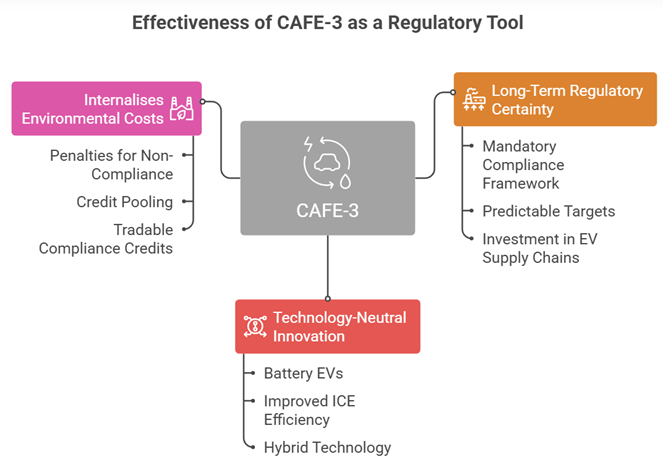
(a) Provides long-term regulatory certainty, which drives industry investment
- Unlike subsidy-led approaches, CAFE creates a mandatory compliance framework, forcing manufacturers to redesign product portfolios toward lower-emission technologies.
- Predictable targets reduce policy uncertainty and encourage investments in battery manufacturing, charging ecosystems, and EV-specific supply chains.
- Example: The EU’s fleet-emission regulations accelerated EV launches by Volkswagen, Stellantis, and Renault after 2020.
(b) Encourages technology-neutral innovation, allowing multiple pathways
- Manufacturers may comply through battery EVs, improved ICE efficiency, lightweighting, hybrids, or better aerodynamics.
- This flexibility reduces transition shocks and supports gradual industrial adaptation.
- Case Study: Japan used stringent fleet efficiency norms to stimulate hybrid leadership through Toyota Prius, before large-scale EV transition.
(c) Internalises environmental costs through market discipline
- Penalties for non-compliance shift pollution costs onto manufacturers rather than society.
- Mechanisms such as credit pooling and tradable compliance credits improve cost efficiency while retaining accountability.
- Government initiative: India’s existing CAFE-I (2017) and CAFE-II (2022) already lowered fleet-average emissions; CAFE-3 deepens this trajectory.
2. Key limitations reducing CAFE-3’s transformative potential
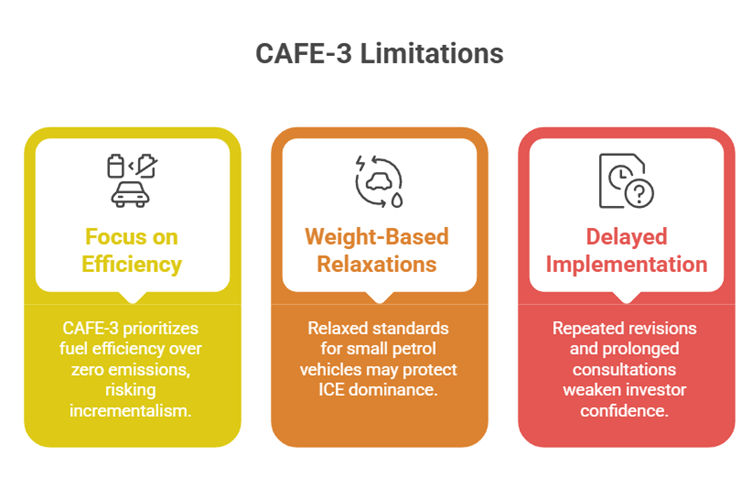
(a) Focuses on efficiency, not necessarily zero emissions
- A manufacturer can meet CAFE targets while still selling mostly fossil-fuel vehicles, if fuel efficiency improves marginally.
- This creates a risk of incrementalism, not structural transition.
- Example: Downsized turbo-petrol engines can comply without reducing oil dependence substantially.
(b) Weight-based relaxations may unintentionally protect ICE dominance
- Relaxed standards for small petrol vehicles may preserve legacy internal combustion segments.
- This weakens incentives for firms to shift aggressively toward EVs.
- Case Study: Similar loopholes in early US fuel-efficiency rules delayed SUV electrification.
(c) Delayed implementation weakens investor confidence
- Repeated revisions and prolonged consultations create uncertainty.
- Manufacturers defer capital expenditure when standards remain unsettled.
- Example: India’s CAFE-3 discussions have extended for over three years, slowing strategic product planning.
3. Does inclusion of hybrids dilute the zero-emission objective?
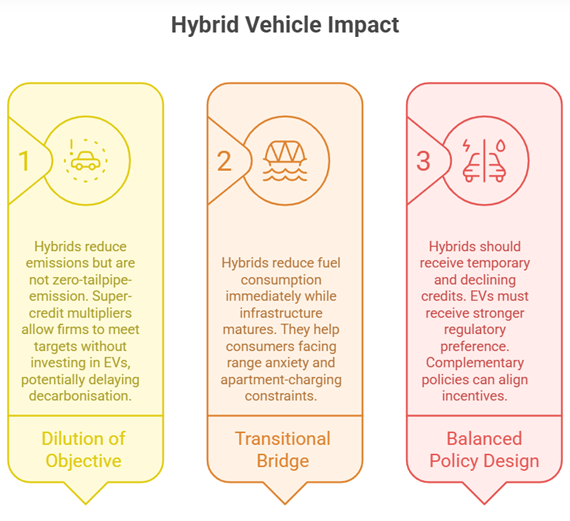
(a) Yes—excessive hybrid credits can dilute electrification incentives
- Strong hybrids, plug-in hybrids, and flex-fuel vehicles reduce emissions but are not zero-tailpipe-emission
- Generous super-credit multipliers allow firms to meet targets without investing proportionately in EVs.
- This may create a technology lock-in effect, delaying full decarbonisation.
- Example: Several Indian manufacturers have argued for stronger hybrid preference because it is cheaper than scaling EV platforms.
(b) However, hybrids can function as an important transitional bridge
- India’s charging network remains uneven, especially beyond metros.
- Hybrids help reduce fuel consumption immediately while infrastructure matures.
- For consumers facing range anxiety and apartment-charging constraints, hybrids can accelerate behavioural transition.
- Case Study: Japan’s decarbonisation pathway relied heavily on hybrids before wider EV expansion.
(c) Balanced policy design is therefore essential
- Hybrids should receive temporary and declining credits, not permanent advantages.
- EVs must receive stronger regulatory preference through higher zero-emission multipliers and phase-out deadlines.
- Complementary policies such as FAME, PM E-Drive, PLI for ACC batteries, and state EV policies can align incentives.
- Government initiatives:
- PM E-Drive Scheme for charging and EV support.
- PLI Scheme for Advanced Chemistry Cells to localise battery manufacturing.
- Delhi EV Policy 2.0 draft, proposing phase-out timelines for ICE segments.
Conclusion:
- CAFE-3 is an essential transition-regulation, not a complete decarbonisation solution. Its greatest strength lies in creating predictable market pressure for cleaner vehicles; however, its effectiveness will depend on whether it sends an unmistakable signal toward full electrification rather than partial efficiency gains. Hybrids should be treated as bridging technologies, not end-state solutions.
- If aligned with clear phase-out timelines, stronger charging infrastructure, and domestic battery manufacturing, India can move from today’s ~5% passenger EV penetration toward its broader clean mobility ambition and substantially reduce both oil vulnerability and transport emissions over the coming decade.