

Introduction:
- Corporate Average Fuel Efficiency (CAFE) norms are regulatory standards that mandate automakers to meet fleet-wide average CO₂ emission limits per kilometre, forming a key pillar of transport-sector decarbonisation.
- In India, where the transport sector contributes nearly 14–15% of total greenhouse gas emissions and is the third-largest emitting sector, tightening fuel efficiency norms is central to achieving net-zero by 2070 and interim Nationally Determined Contributions (NDCs).
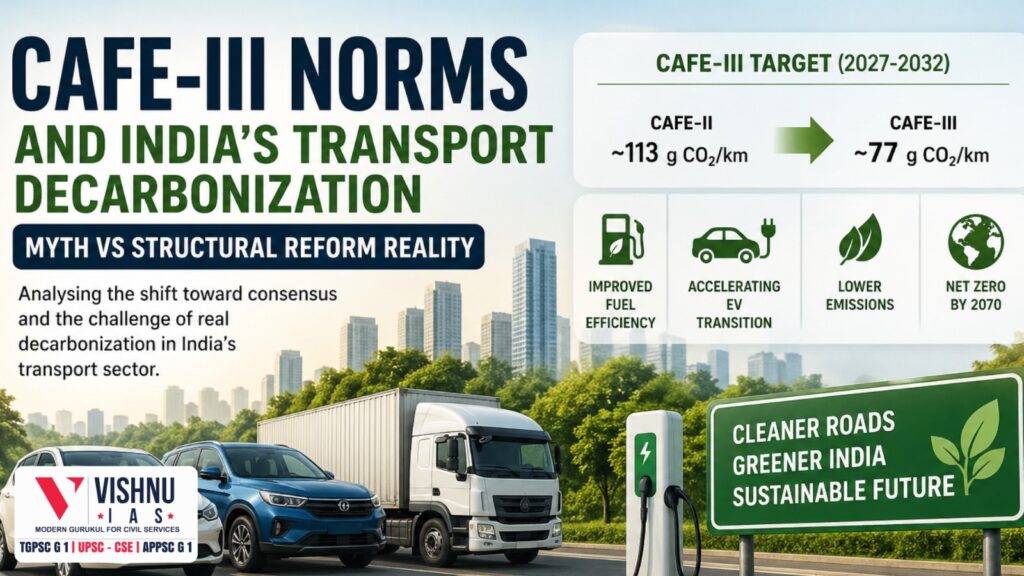
- The proposed CAFE-III (2027–2032) targets a reduction to around 77 g CO₂/km from ~113 g CO₂/km under CAFE-II, signalling ambition but raising concerns about the depth and pace of structural transformation.
Body:
1. CAFE-III as a Shift Toward Consensus: Political Economy and Industry Alignment
Resolution of Industry Fragmentation
- Earlier disagreements, particularly between small-car dominant firms and larger vehicle manufacturers, reflected divergent cost structures and market strategies; removal of explicit small-car carve-outs under CAFE-III indicates a move toward regulatory harmonisation.
- Example: The earlier preferential treatment risked distorting competition by shielding a segment contributing ~15% of sales, while burdening larger vehicles with disproportionate compliance costs.
Flexible Compliance Mechanisms as Negotiated Outcomes
- Introduction of multiple compliance pathways—including ethanol-compatible vehicles (E20–E85), and efficiency technologies—reflects compromise between environmental goals and industry feasibility.
- Case Study: Flex-fuel vehicle push aligns with India’s Ethanol Blending Programme, which has already crossed 12% blending nationally, reducing oil import dependence.
Policy Stability and Investment Signalling
- Consensus reduces regulatory uncertainty, encouraging long-term investments in cleaner technologies, including hybrids and EVs.
- Example: Stability in emission norms has been crucial in attracting investments under schemes like Production Linked Incentive (PLI) for Automobile and Auto Components, promoting advanced automotive technologies.

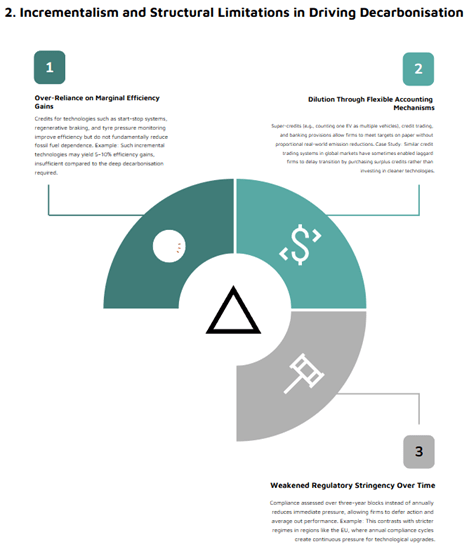
2. Incrementalism and Structural Limitations in Driving Decarbonisation
Over-Reliance on Marginal Efficiency Gains
- Credits for technologies such as start-stop systems, regenerative braking, and tyre pressure monitoring improve efficiency but do not fundamentally reduce fossil fuel dependence.
- Example: Such incremental technologies may yield 5–10% efficiency gains, insufficient compared to the deep decarbonisation required.
Dilution Through Flexible Accounting Mechanisms
- Super-credits (e.g., counting one EV as multiple vehicles), credit trading, and banking provisions allow firms to meet targets on paper without proportional real-world emission reductions.
- Case Study: Similar credit trading systems in global markets have sometimes enabled laggard firms to delay transition by purchasing surplus credits rather than investing in cleaner technologies.
Weakened Regulatory Stringency Over Time
- Compliance assessed over three-year blocks instead of annually reduces immediate pressure, allowing firms to defer action and average out performance.
- Example: This contrasts with stricter regimes in regions like the EU, where annual compliance cycles create continuous pressure for technological upgrades.
3. Implications for Transport Decarbonisation and Energy Transition
Delayed Electrification Trajectory
- By enabling compliance through non-electric pathways, CAFE-III risks slowing the transition to battery electric vehicles (BEVs), which are critical for deep emission cuts.
- Example: India’s EV penetration in passenger vehicles remains below 3%, far from the targets envisioned under initiatives like FAME-II.
Energy Security and Fossil Fuel Dependence
- Incremental improvements do little to reduce reliance on imported crude oil, which constitutes over 85% of India’s oil needs, exposing the economy to global price volatility.
- Case Study: Periods of high crude prices have significantly widened India’s current account deficit, underscoring the macroeconomic stakes of delayed transition.
Mismatch with Climate Commitments and Urban Air Quality Goals
- Weak structural push may undermine India’s commitments under global climate frameworks and domestic goals like reducing emission intensity of GDP by 45% by 2030.
- Example: Urban centres such as Delhi and Mumbai continue to face severe air pollution, where vehicular emissions are a major contributor, necessitating faster adoption of zero-emission technologies.

Conclusion:
- While CAFE-III represents a pragmatic shift toward industry consensus and regulatory continuity, its design risks prioritising compliance flexibility over transformative change. For a sector critical to both climate mitigation and energy security, incrementalism may fall short of the scale required.
- A more effective pathway would combine stricter annual targets, phased reduction of credit-based relaxations, and stronger incentives for electrification, supported by infrastructure expansion and fiscal measures.
- Aligning fuel efficiency norms with broader initiatives such as EV adoption, renewable energy integration, and urban mobility reforms can ensure that emission reductions are not merely statistical artefacts but translate into real, measurable decarbonisation outcomes, positioning India on a credible trajectory toward its long-term climate goals.