Tension Between State Control and ECI Powers: Article 324 vs Seventh Schedule Explained
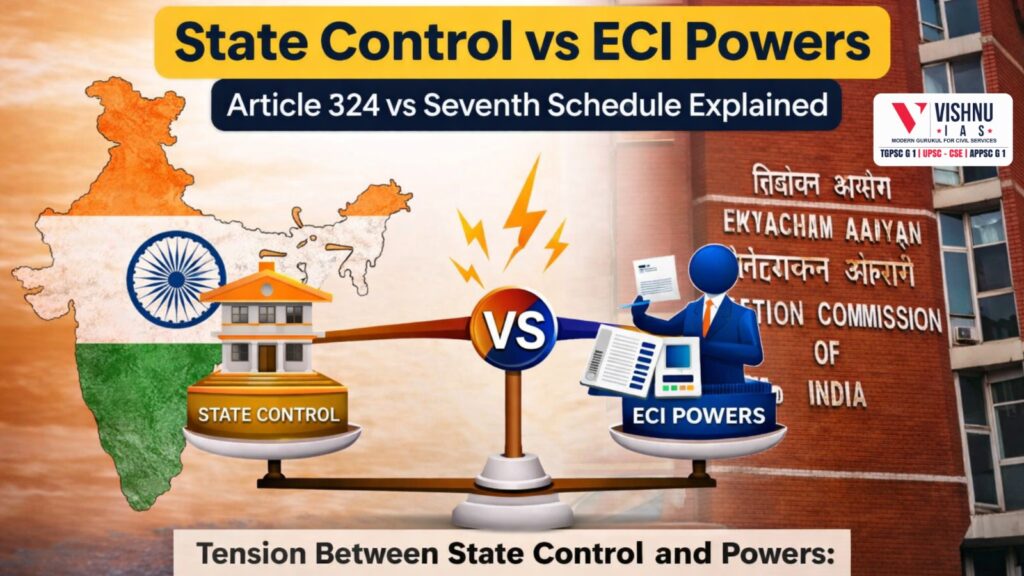
ECI powers vs State control is a critical constitutional issue in India that highlights the delicate balance between federal autonomy and institutional independence. The conduct of elections in India rests on a delicate constitutional balance between federal autonomy and institutional independence. While Article 324 vests the Election Commission of India (ECI) with the “superintendence, direction and control” of elections, the Seventh Schedule assigns “State Public Services” under the State List, granting States exclusive administrative control over their personnel. This creates an inherent tension, particularly during elections when neutrality of administration becomes critical.
India, administering elections to over 900 million voters, as seen in the 2019 general elections, relies almost entirely on State machinery, making coordination between constitutional mandates indispensable. Judicial interpretations, notably in Mohinder Singh Gill v. Chief Election Commissioner, have recognized Article 324 as a plenary reservoir of powers, but with constitutional and legal limitations, thereby intensifying the debate on the scope of ECI’s authority vis-à-vis State control.
1. Constitutional and Legal Foundations of the Tension
1.1 Federal Allocation of Administrative Powers
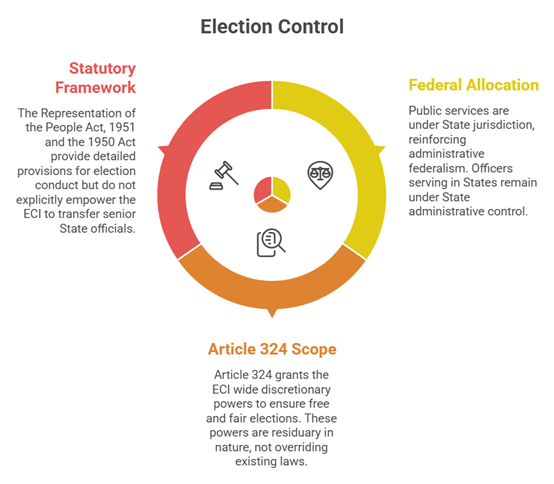
- The Seventh Schedule (State List) explicitly places public services under State jurisdiction, reinforcing the principle of administrative federalism.
- The All India Services framework, governed by the All India Services Act, 1951, establishes that officers serving in States remain under State administrative control, including transfers and postings.
- Example: Routine transfers of IAS and IPS officers are executed by State governments to ensure accountability within State governance structures.
1.2 Scope of Article 324 as a Plenary Power
- Article 324 grants the ECI wide discretionary powers to ensure free and fair elections, especially in areas where statutory law is silent.
- Judicial interpretation in Mohinder Singh Gill case emphasized that these powers are residuary in nature, not overriding existing laws.
- Case Study: In T.N. Seshan v. Union of India, the Court upheld the primacy of ECI’s independence but also clarified that it operates within constitutional boundaries.
1.3 Statutory Framework Governing Elections
- The Representation of the People Act, 1951 and the 1950 Act provide detailed provisions for election conduct but do not explicitly empower the ECI to transfer senior State officials.
- Article 324(6) mandates States to provide staff support, but does not extend to personnel control or disciplinary authority.
- This creates a legal grey area, where administrative control and electoral supervision overlap without clear statutory reconciliation.
2. Functional Justifications and Concerns in ECI’s Actions
2.1 Necessity for Neutral Administrative Machinery
- Free and fair elections require impartial bureaucracy, especially in politically sensitive environments.
- The ECI often justifies transfers to prevent conflict of interest, partisan bias, or misuse of State machinery.
- Example: Transfer of officials during elections in states with a history of electoral violence, such as West Bengal, is aimed at ensuring level playing field.
2.2 Risks of Administrative Disruption and Federal Friction
- Sudden transfers of senior officials like Chief Secretaries or DGPs may lead to administrative paralysis, affecting governance continuity.
- Such actions may be perceived as encroachment on State autonomy, undermining the federal structure.
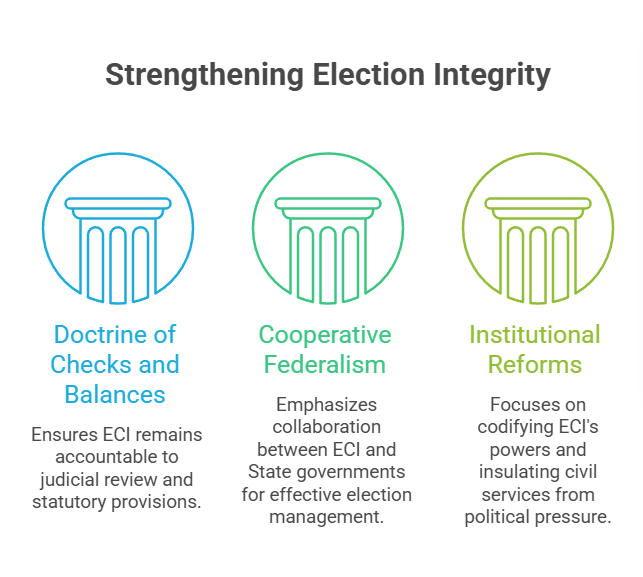
- Case Study: The recent controversy in West Bengal highlighted concerns over lack of consultation, raising questions on cooperative federalism.
Recap: