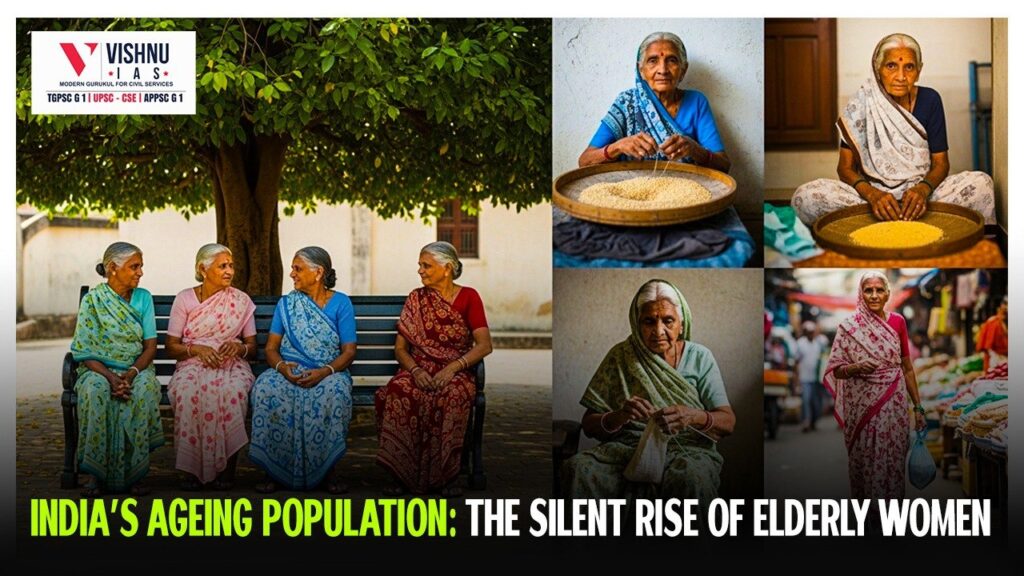
India Ageing Population: Demographic and Socio-Economic Implications for Ageing Women
Introduction
India ageing population refers to the increasing proportion of elderly persons (usually defined as those aged 60 years and above) in a population due to declining fertility, improved healthcare, and rising life expectancy. India is entering a phase of rapid demographic ageing. More than 100 million Indians are already above the age of 60, and projections suggest that the elderly population may exceed 250 million by 2040, constituting nearly one-fifth of the population.
Ageing in India has a distinct gender dimension, as women live about 4–5 years longer than men on average, yet they enter old age with lower savings, weaker asset ownership, interrupted employment histories, and higher dependency.
This phenomenon, often termed the “feminisation of ageing”, has significant demographic, economic, and social implications, especially because existing welfare systems were largely designed without explicitly incorporating a gender-sensitive elder-care framework.
1. Demographic Implications of Population Ageing
1.1 Changing Population Structure and Dependency Burden
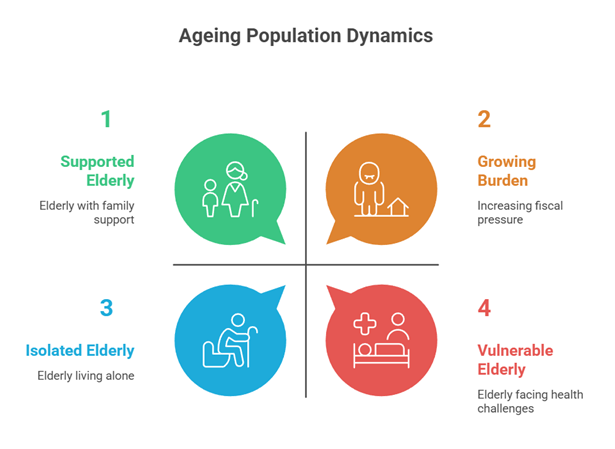
The demographic transition in India is resulting in a steady rise in the old-age dependency ratio, which increases fiscal pressure on working populations and welfare systems. As longevity improves, families and governments must support a growing cohort of elderly citizens for longer durations.
Ageing women constitute a larger share of the elderly population because of higher life expectancy and lower remarriage rates among widows. This leads to the phenomenon of widowhood concentration among elderly women, increasing vulnerability and dependence.
Example: In states such as Kerala and Tamil Nadu, where demographic transition is advanced, elderly populations already exceed the national average, demonstrating the emerging demographic reality for the rest of the country.
1.2 Rise of Solitary Living and Feminisation of Ageing
Due to migration, nuclear family structures, and declining fertility, elderly women increasingly live alone, often without reliable family support. This intensifies emotional, social, and economic vulnerabilities.
Women who survive their spouses frequently experience longer years of widowhood, leading to a higher likelihood of isolation, poverty, and lack of caregiving support.
Case Study – Urban elderly women in Lucknow: Many elderly women living alone depend on periodic visits from children working in other cities, highlighting the growing challenge of long-distance caregiving in urban India.
1.3 Rising Health and Care Needs in Later Life
Population ageing is accompanied by an increase in chronic illnesses, disabilities, and neurodegenerative conditions, which require sustained long-term care systems.
Studies estimate that millions of Indians over 60 live with dementia and cognitive disorders, and this number is expected to rise sharply in the coming decades. Women are disproportionately affected due to their longer lifespan and higher likelihood of living alone.
Example: The growing demand for geriatric care has led to the expansion of geriatric wards in public hospitals under the National Programme for Health Care of the Elderly, indicating the increasing scale of healthcare needs associated with ageing.
2. Socio-Economic Implications with Special Reference to Women
2.1 Economic Insecurity and Inadequate Social Protection
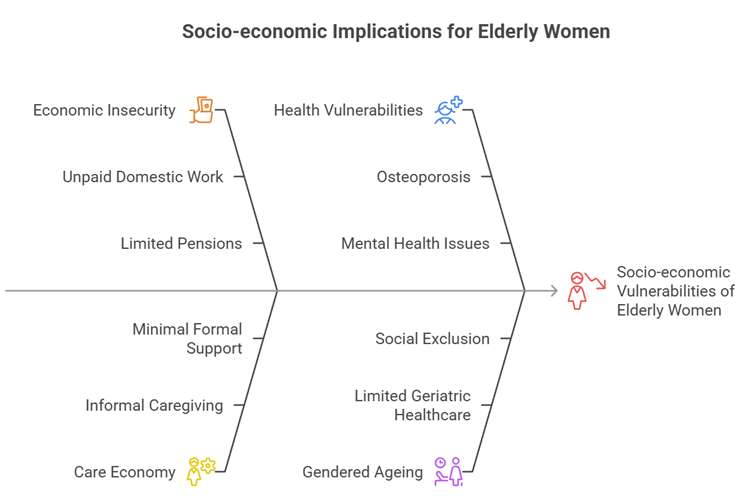
Many elderly women experience financial vulnerability because they spent much of their lives in unpaid domestic work or informal employment, resulting in limited pensions or savings.
Asset ownership patterns remain gender-skewed, leaving older women without property or financial independence during widowhood.
Example: The Indira Gandhi National Old Age Pension Scheme provides modest support to elderly citizens below the poverty line, but the pension amount remains insufficient for meeting healthcare and living costs in urban settings.
2.2 Care Economy and Invisible Unpaid Labour
Women perform the majority of informal caregiving labour, looking after children, the sick, and elderly relatives throughout their lives. However, when they themselves age, formal support systems are minimal.
This imbalance reflects a broader gender gap in the care economy, where caregiving remains socially expected but institutionally unsupported.
Case Study – Family caregiving patterns in India: Studies of households across northern and southern states show that daughters and daughters-in-law often manage elder care, balancing employment, domestic responsibilities, and caregiving without institutional support.
2.3 Health Vulnerabilities and Gendered Ageing
Women face distinct health challenges in later life, including osteoporosis, post-menopausal complications, and mental health issues linked to loneliness and social exclusion.
Limited access to geriatric healthcare, especially in rural areas, aggravates these challenges.
Example: The establishment of menopause clinics across hundreds of public health facilities in Maharashtra in 2026 demonstrates how targeted interventions can encourage women to seek care for age-related health issues that were previously neglected.
3. Policy and Governance Challenges in Addressing Ageing Women’s Needs
3.1 Limited Gender Sensitivity in Existing Elder-Care Policies
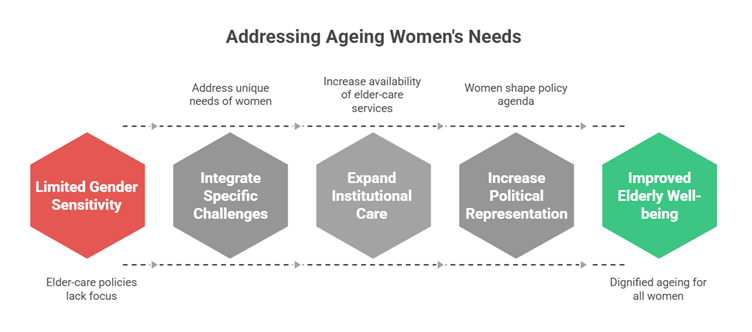
India’s elder-care framework historically addressed ageing mainly through poverty alleviation and healthcare access, rather than through a comprehensive gender-responsive policy approach.
Programmes such as the National Policy for Older Persons (1999) provided a foundational framework but did not sufficiently integrate the specific challenges faced by ageing women.
Example: Many elderly women who lack independent income or property are excluded from welfare benefits that require proof of financial eligibility or documentation.
3.2 Inadequate Institutional Care Infrastructure
India’s elder-care infrastructure—such as old-age homes, assisted living centres, and community-based care services—remains limited relative to the rapidly expanding elderly population.
Rural areas, where access to healthcare and social services is already constrained, face greater difficulties in supporting elderly women living alone.
Case Study – Community-based elder care initiatives in Kerala: Local self-governments and voluntary organisations have experimented with day-care centres and home-based geriatric care services, demonstrating how decentralised support systems can improve elderly well-being.
3.3 Need for Gender-Inclusive Political Representation and Policy Prioritisation
Political representation of women can shape the policy agenda related to social welfare, health, and family care systems. Increased participation of women in legislatures has the potential to highlight issues such as dignified ageing, caregiver support, and pension security.
However, representation alone does not automatically translate into policy change; it requires institutional commitment, data-driven policymaking, and gender-disaggregated statistics on ageing populations.
Example: Greater emphasis on age- and gender-disaggregated data in population surveys and census operations can help identify the specific needs of elderly women and guide targeted interventions.
Conclusion
India’s demographic transition is steadily transforming the country into an ageing society, with the elderly population projected to cross 250 million by 2040. Within this transformation, ageing women represent one of the most vulnerable yet least visible groups, experiencing longer life spans alongside economic insecurity, health challenges, and social isolation.
Addressing these issues requires a holistic elder-care ecosystem that integrates gender-sensitive social protection, accessible geriatric healthcare, community-based caregiving systems, and improved data on ageing populations.
Strengthening initiatives such as universal pension coverage, expansion of geriatric health services, and recognition of the care economy can ensure that increased longevity translates into dignified and secure ageing for women, enabling society to adapt constructively to the realities of demographic change.
Recap: