
Women’s Reservation Bill Since 1996: Historical Evolution, Roadblocks & the 106th Constitutional Amendment
Women’s Reservation Bill since 1996 has undergone nearly three decades of legislative debate, political contestation, and constitutional reform before culminating in the 106th Constitutional Amendment Act, 2023. The Women’s Reservation Bill, enacted as the 106th Constitutional Amendment Act, 2023, seeks to reserve one-third (33%) of seats in the Lok Sabha and State Legislative Assemblies for women, including proportional reservation for Scheduled Castes (SCs) and Scheduled Tribes (STs).
This represents a major constitutional effort to address the structural under-representation of women in political institutions, where women constituted only about 15% of the Lok Sabha after the 2019 general elections, far below the global average of over 26%. Despite women forming nearly 48% of India’s population, their political representation has historically remained constrained by institutional, socio-cultural, and constitutional barriers, making the evolution of the Bill since 1996 both significant and contested.
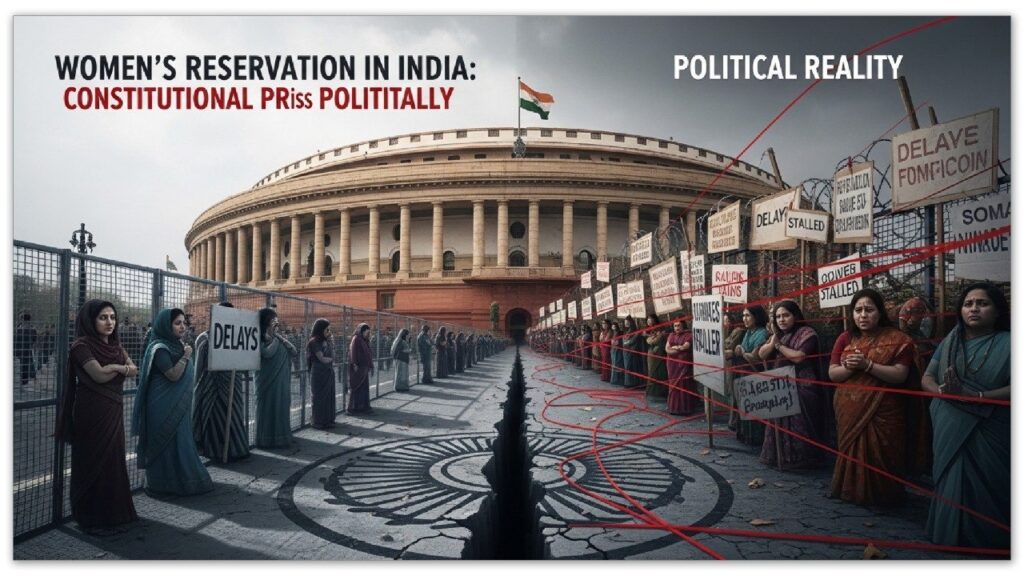
While its enactment marked a historic milestone, its implementation remains contingent upon constitutional prerequisites such as Census and delimitation, creating new roadblocks in translating constitutional promise into political reality.
I. Historical Evolution of Women’s Reservation (1996–2023)
1. Origins and Early Legislative Attempts (1996–2004)
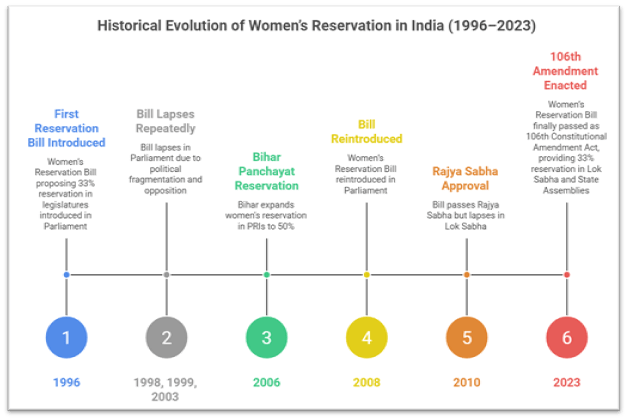
- The first Women’s Reservation Bill was introduced in 1996 in the Parliament of India, proposing 33% reservation in legislatures, but faced strong opposition due to demands for sub-quotas for Other Backward Classes (OBCs) and concerns over elite capture.
- Political fragmentation and coalition governments led to repeated lapses of the Bill in 1998, 1999, and 2003, reflecting the difficulty of building consensus on gender representation reforms.
- Example – Panchayati Raj Institutions (PRIs): The 73rd and 74th Constitutional Amendments (1992) reserved one-third seats for women in local bodies. Women now constitute over 46% of elected representatives (over 1.4 million women), strengthening arguments for legislative reservation.
2. Renewed Political Momentum and Partial Breakthrough (2008–2010)
- The Bill was reintroduced in 2008 and passed by the Rajya Sabha in 2010, marking the first major parliamentary approval, but it lapsed in the Lok Sabha.
- Opposition stemmed from concerns regarding social justice, political displacement of incumbents, and lack of OBC sub-reservation.
- Case Study – Bihar Panchayat Reservation: Bihar expanded reservation to 50% for women in PRIs in 2006, improving governance outcomes in education, sanitation, and welfare delivery.
3. Enactment Through the 106th Constitutional Amendment Act, 2023
- The Bill was finally passed in 2023, providing 33% reservation in the Lok Sabha and State Assemblies.
- Key provisions include reservation rotation, SC/ST sub-reservation, and a sunset clause of 15 years.
- Example – Grassroots Leadership: Leaders like Chhavi Rajawat demonstrated how women’s political participation enhances governance innovation.
II. Current Constitutional and Structural Roadblocks
1. Census and Delimitation Linkage
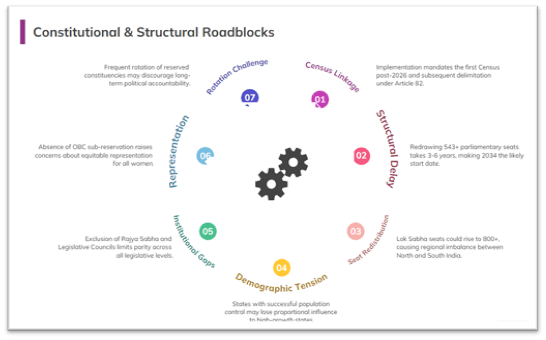
- The Act mandates implementation only after the first Census conducted post-2026 and subsequent delimitation under Article 82.
- The Delimitation Commission must redraw 543+ parliamentary and nearly 4,000 assembly constituencies, potentially delaying implementation until the mid-2030s.
- Example – Delimitation (2002–2008): The last exercise took six years, indicating the complexity ahead.
2. Federal and Demographic Tensions
- Delimitation may increase Lok Sabha seats to 800+, raising concerns about regional imbalance.
- Northern states may gain seats, while southern states may see reduced proportional influence.
- Case Study – Delimitation Freeze (1976–2001): Implemented to avoid penalising states that controlled population growth.
3. Institutional Design Gaps
- The Act excludes reservation in the Rajya Sabha and State Legislative Councils.
- Absence of OBC sub-reservation raises equity concerns.
- Constituency Rotation Challenge: Frequent rotation may affect long-term accountability.
III. Democratic Significance and Governance Implications
1. Strengthening Inclusive Democracy
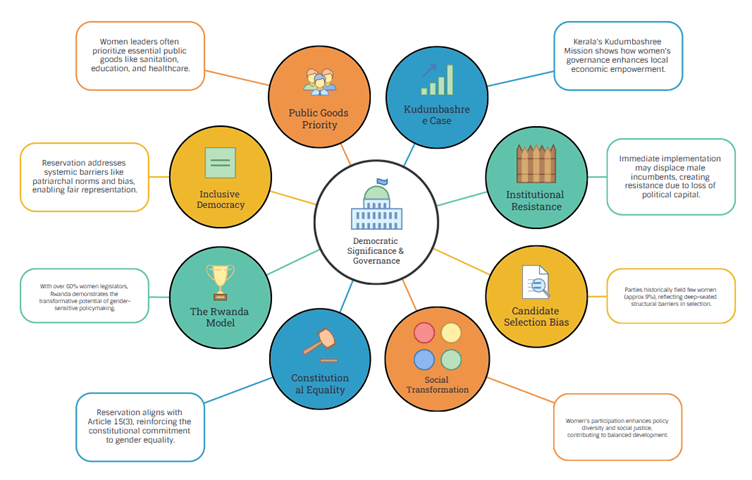
- Reservation addresses systemic barriers such as patriarchal norms and electoral bias.
- Evidence from Panchayati Raj shows women leaders prioritise public goods.
- Case Study – Kudumbashree (Kerala): Enhanced women’s economic empowerment and welfare outcomes.
2. Political Economy and Institutional Resistance
- Immediate implementation may displace around 181 male incumbents.
- Political parties nominate only around 9% women candidates in general elections.
3. Long-Term Governance and Social Transformation
- Women’s participation enhances policy diversity and social justice outcomes.
- Reservation aligns with Article 15(3) of the Constitution.
- Example – Rwanda: Over 60% women legislators demonstrating transformative potential.
Conclusion
The Women’s Reservation Act represents a historic constitutional milestone in advancing gender equality and democratic inclusiveness, ending nearly three decades of legislative stagnation since 1996. However, linkage with Census and delimitation has created structural delays, potentially postponing implementation until the mid-2030s.
Evidence from local governance, where women constitute nearly 46% of elected representatives, demonstrates that reservation improves governance quality and inclusiveness. Ensuring timely Census completion, expedited delimitation, and inclusive frameworks will be essential to translate constitutional commitment into political reality.
Effective representation of women will strengthen democratic legitimacy, improve policy outcomes, and accelerate India’s progress toward equitable governance.
Recap: