
Public-Led Capex Model in India: Implications for Industrial Growth and Domestic Demand
Introduction:
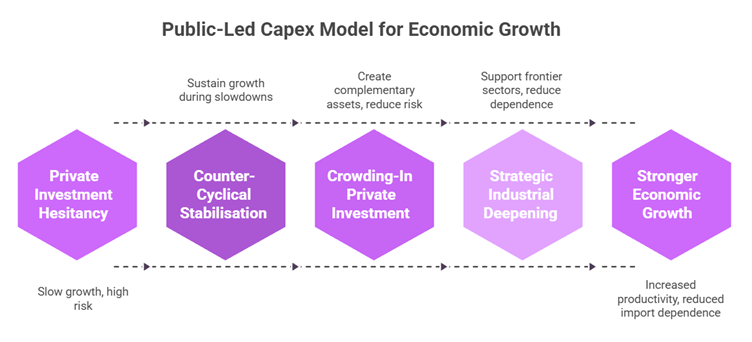
- Public-led capital expenditure refers to the State using budgetary resources to drive economic growth by investing directly in infrastructure, industrial capacity and strategic sectors, with the expectation that such spending crowds in private investment and stimulates demand through multiplier effects.
- Over the last decade, India has increasingly relied on this model, with central capital expenditure rising from around 1.7% of GDP in the mid-2010s to well above 3% of GDP in recent years, even as fiscal consolidation remains a stated objective.
- This approach has coincided with a phase of relatively strong real growth and moderating inflation, placing the economy in a rare “goldilocks” zone. However, persistent undershooting of budgeted capital expenditure and weak transmission into employment and consumption raise questions about the sustainability of industrial growth and domestic demand under a predominantly public-led investment strategy.
Body:
I. Rationale and strengths of the public-led Capex model
1. Counter-cyclical stabilisation and growth anchoring
- Public capital expenditure has functioned as a macroeconomic stabiliser during periods of global slowdown and private investment hesitancy, allowing growth momentum to be sustained even amid external shocks such as pandemics, supply chain disruptions and geopolitical conflicts.
- By prioritising infrastructure-intensive sectors like transport corridors, logistics networks and urban development, the State has attempted to lower transaction costs and improve productivity across the economy.
- Example: The accelerated rollout of dedicated freight corridors has reduced transit time and logistics costs, indirectly supporting manufacturing competitiveness and export capacity.
2. Crowding-in potential for private investment
- The theoretical foundation of public-led Capex rests on its ability to “crowd in” private investment by creating complementary assets and reducing risk for private players.
- Large-scale public investment in power, roads and ports improves factor mobility and market access, which can encourage private firms to expand capacity.
- Case study: The Bharatmala and Sagarmala programmes illustrate how State-led infrastructure can catalyse private participation in logistics, warehousing and industrial parks.
3. Strategic industrial deepening
- Public Capex has increasingly been aligned with industrial policy objectives, particularly in frontier and strategic sectors where private capital alone may be reluctant due to high risk and long gestation periods.
- Support for semiconductors, electronics components, defence manufacturing and capital goods reflects an attempt to strengthen domestic value chains and reduce import dependence.
- Government initiative: The India Semiconductor Mission represents State intervention to overcome entry barriers in a globally concentrated and geopolitically sensitive industry.
II. Limitations and risks of over-reliance on public-led Capex
1. Persistent gap between budgeted and actual expenditure
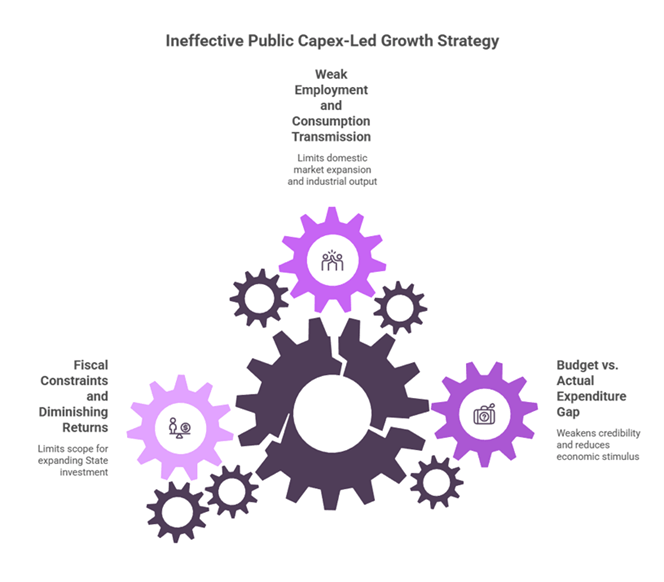
- Repeated divergence between planned and realised capital spending weakens the credibility and effectiveness of the Capex-led growth strategy.
- Administrative bottlenecks, land acquisition delays and procurement challenges often result in underutilisation of allocated funds, reducing the actual stimulus transmitted to the economy.
- Case study: Slower-than-expected execution of urban infrastructure projects has diluted anticipated employment and income multipliers in several regions.
2. Weak employment and consumption transmission
- Capital-intensive public projects generate limited direct employment relative to their scale, particularly when compared to labour-intensive manufacturing or services.
- When income gains remain concentrated and job creation is modest, the expansion of mass consumption demand remains subdued, constraining the domestic market for industrial output.
- Example: Despite large infrastructure outlays, consumption indicators in lower-income segments have shown uneven recovery.
3. Fiscal constraints and diminishing returns
- Sustained reliance on public Capex places pressure on fiscal balances, especially when revenue mobilisation or disinvestment proceeds fall short of targets.
- As public debt levels remain elevated, the scope for continuously expanding State investment without compromising fiscal prudence becomes limited.
- Case study: Recurring shortfalls in non-tax revenues have increased dependence on borrowing.
III. Implications for long-term domestic demand and industrial growth
1. Fragile demand base for manufacturing expansion
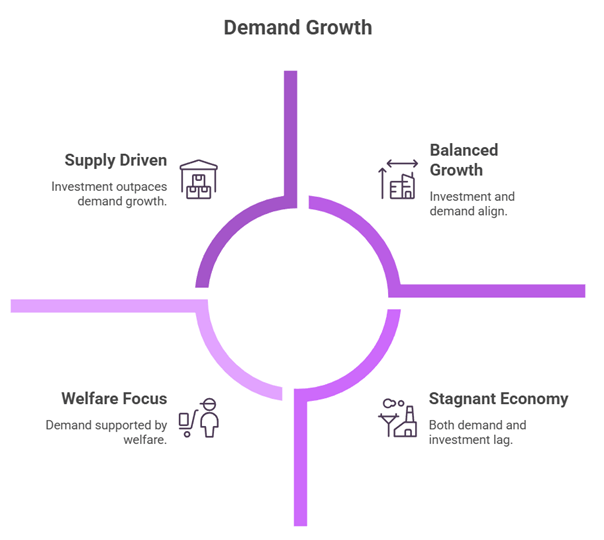
- Industrial growth driven primarily by supply-side capacity creation risks running ahead of demand if household incomes and employment do not keep pace.
- Example: Export-oriented sectors such as textiles and leather have faced stress during global demand slowdowns.
2. Incomplete crowding-in of private investment
- Private investment depends on demand visibility, regulatory certainty and financial health.
- Case study: Capacity utilisation in several industries has remained below optimal levels.
3. Structural imbalance between investment and welfare
- A prolonged emphasis on capital spending without parallel focus on human capital and income security can weaken demand.
- Government initiative: Skill development and MSME support schemes aim to bridge this gap.
Conclusion:
- A public-led Capex model has played a critical role in sustaining growth and advancing strategic industrial objectives.
- However, recurring gaps between budgeted and actual expenditure highlight execution and demand-side constraints.
- A balanced approach combining efficient public investment, private participation and demand-enhancing measures is essential for inclusive and sustainable industrial development.
Recap: