
Introduction
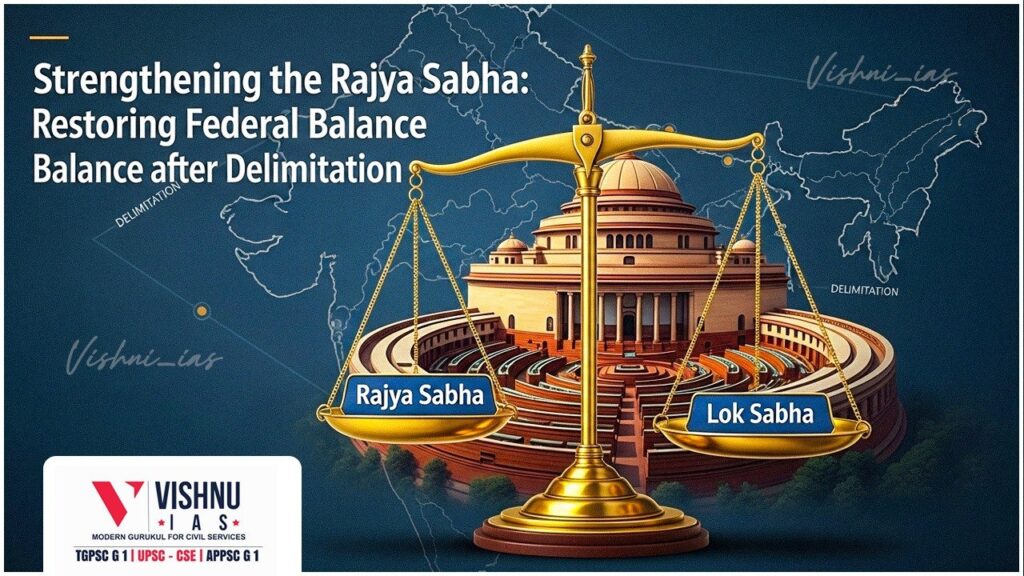
Strengthening the Rajya Sabha after delimitation has emerged as a crucial constitutional debate as India prepares for a major restructuring of political representation. Delimitation refers to the constitutional process of redrawing electoral boundaries and reallocating seats to reflect population changes. India’s inter-State allocation of Lok Sabha seats has been frozen since the 1971 Census, even as the population has nearly tripled from about 548 million to around 1.47 billion, creating a widening gap between demographic reality and political representation.
With the constitutional freeze set to lapse after the first Census post-2026, the next delimitation will substantially increase the numerical weight of faster-growing States. This has revived concerns about federal balance, since representation in the Lok Sabha is strictly population-based.
In this context, strengthening the Rajya Sabha, envisaged by the Constitution as the Council of States, assumes critical importance as a corrective institutional mechanism to preserve cooperative federalism, regional equity and political stability.
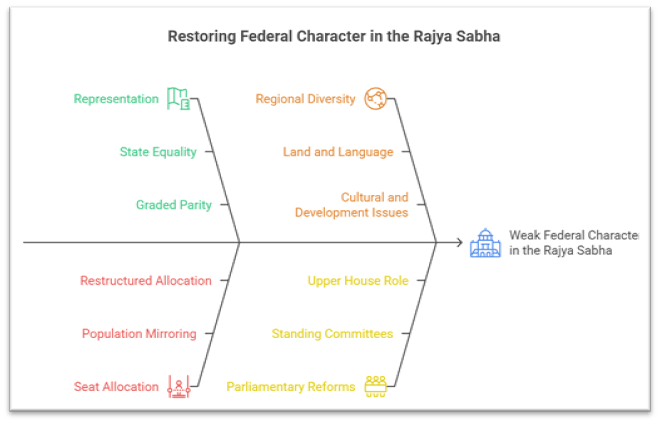
1. Restoring the Federal Character of the Rajya Sabha
Reaffirming the Council of States as a federal counterweight
- The Rajya Sabha was designed to represent States as political units rather than populations, providing a stabilising check on the majoritarian impulses of the Lok Sabha.
- As delimitation increases the dominance of a few populous States in the Lower House, a stronger Upper House can ensure that national legislation continues to reflect the interests of diverse regions.
- Example: In federations like the United States, equal representation of States in the Senate has historically moderated population-driven asymmetries and prevented regional marginalisation.
Revisiting the principle of seat allocation
- Currently, Rajya Sabha seats broadly mirror population, limiting its ability to offset Lok Sabha imbalances.
- A restructured allocation based on State equality or graded parity can restore its role as a true federal chamber.
- Case Study: Smaller Indian States and hill regions have often relied on the Rajya Sabha to voice concerns on resource sharing and environmental protection that might otherwise be overridden by numerical majorities.
Protecting regional diversity in law-making
- Legislation affecting land, language, culture or regional development requires sensitivity beyond population arithmetic.
- A strengthened Rajya Sabha can act as an institutional space for reconciling national objectives with State-specific realities.
- Government Initiative: Parliamentary reforms emphasising scrutiny through standing committees, where the Upper House plays a decisive role, already point in this direction.
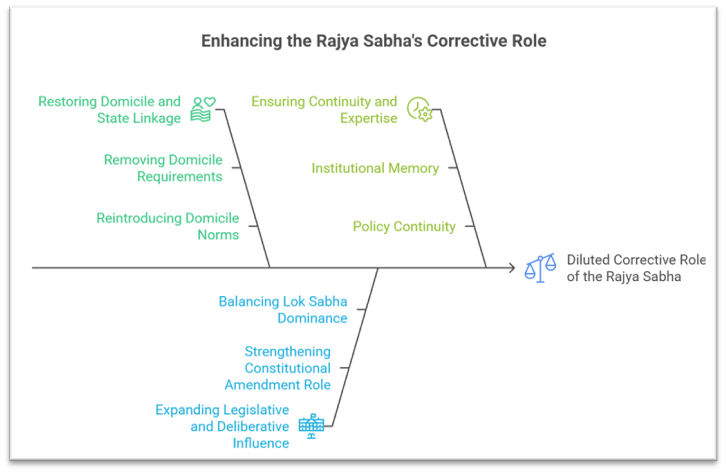
2. Institutional Reforms to Enhance the Rajya Sabha’s Corrective Role
Restoring domicile and State linkage
- Removing domicile requirements has diluted the representative connection between members and the States they are meant to represent.
- Reintroducing domicile norms would ensure that members articulate genuine State perspectives rather than party or national interests alone.
- Example: Regional debates on issues such as water-sharing or special category status have historically been more substantive when articulated by members deeply rooted in State politics.
Expanding legislative and deliberative influence
- The Rajya Sabha already has special powers over State List matters under Article 249, allowing Parliament to legislate in national interest.
- Strengthening its role in constitutional amendments, fiscal federal arrangements and inter-State issues can balance Lok Sabha dominance after delimitation.
- Government Initiative: Increasing reliance on joint parliamentary committees and pre-legislative consultations reflects a gradual shift towards consensus-oriented law-making.
Ensuring continuity and expertise
- As a permanent body with staggered terms, the Rajya Sabha offers institutional memory and policy continuity.
- In a post-delimitation scenario marked by sharper political competition, this continuity can stabilise governance.
- Example: Long-term debates on economic reforms and social legislation have often benefited from sustained scrutiny in the Upper House.
3. Rajya Sabha as a Platform for Cooperative Federalism
Balancing population with performance
- Delimitation based solely on population risks penalising States that invested early in health, education and women’s empowerment.
- A stronger Rajya Sabha can incorporate developmental performance and governance outcomes into national decision-making.
- Example: Southern and western States have frequently raised concerns about fiscal transfers and demographic responsibility, debates that gain traction in the Upper House.
Moderating coalition politics and regional dominance
- As delimitation reshapes coalition arithmetic, regional parties may find reduced leverage in the Lok Sabha.
- The Rajya Sabha can provide them a continued voice, preventing excessive concentration of power.
- Case Study: In periods of fragmented mandates, Upper House interventions have moderated abrupt policy shifts and fostered negotiated outcomes.
Enhancing deliberative democracy
- The Rajya Sabha’s emphasis on debate rather than confidence votes allows deeper discussion on complex federal issues.
- Strengthening procedural safeguards and debate time can enhance its role as a forum for reasoned consensus.
- Government Initiative: Efforts to digitalise parliamentary functioning and improve legislative research services indirectly strengthen the quality of Upper House deliberations.
Conclusion:
As India approaches a delimitation that will redefine political representation for decades, the challenge lies in reconciling demographic fairness with federal equity. Strengthening the Rajya Sabha offers a constitutionally sound and politically prudent corrective to population-driven imbalances in the Lok Sabha.
By restoring its federal character, reinforcing State linkage, and enhancing its deliberative authority, the Upper House can preserve unity amid diversity. With India’s population growth slowing nationally and fertility rates converging unevenly across regions, a robust Council of States can ensure that democracy measures not only numbers but also shared justice, cooperative federalism and long-term stability.
In doing so, it can transform delimitation from a source of division into an opportunity to renew the Republic’s federal compact.
Recap: