
India–EU Free Trade Agreement: Significance for Trade, Standards and Strategic Autonomy
Introduction
India’s engagement with the European Union (EU) in 2026 marks a qualitative shift from traditional bilateralism to bloc-level diplomacy, reflecting the EU’s character as a 27-member regulatory and economic union rather than a single national actor. With the India–EU Free Trade Agreement emerging as a strategic instrument, this partnership gains importance beyond tariffs, encompassing regulatory standards, value chains, and strategic autonomy.
With the EU accounting for roughly one-sixth of global GDP and merchandise trade and standing as India’s largest trading partner in goods, the proposed India–EU Free Trade Agreement emerges as a strategic instrument rather than a narrow tariff pact. In a global environment marked by fragmented supply chains, contested trade rules, and heightened geo-economic coercion, India’s engagement with the EU in 2026 acquires significance not only for trade expansion but also for shaping standards, value chains, and strategic autonomy amid shifting power balances.
1. India–EU Free Trade Agreement: Recasting Trade and Economic Integration
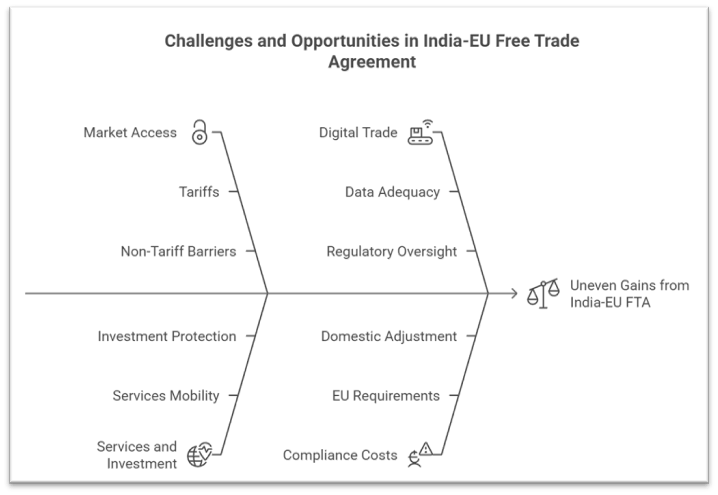
Market access and trade diversification
- The proposed FTA aims to deepen India’s access to the EU’s high-value consumer and industrial markets by addressing tariffs as well as non-tariff barriers, which currently constrain sectors such as pharmaceuticals, textiles, agri-products, and engineering goods.
- Example – India–EU trade composition: India’s exports to the EU are dominated by refined petroleum products, machinery, chemicals, and apparel, while EU exports to India centre on capital goods and high-end services, indicating scope for complementarity rather than substitution.
- Case Study – Supply chain reconfiguration: European firms seeking to reduce over-dependence on China have expanded sourcing from India in sectors like electronics assembly and specialty chemicals, a trend that an FTA could institutionalise.
Services, investment, and digital trade
- Beyond goods, the FTA negotiations include services mobility, investment protection, and digital trade, which are critical for India’s globally competitive IT, fintech, and professional services sectors.
- Case Study – IT and business services: Indian technology firms operating in Europe benefit from predictable visa regimes and data adequacy frameworks, which the agreement seeks to streamline without compromising regulatory oversight.
- This dimension supports India’s objective of export-led growth through services, aligning trade policy with domestic employment generation.
Compliance costs and domestic adjustment
- While expanded access promises growth, the agreement raises compliance burdens for small and medium enterprises due to stringent EU requirements on product safety, traceability, and sustainability.
- Case Study – Textile and leather sectors: Firms transitioning to cleaner production processes under European sustainability expectations illustrate the need for domestic capacity-building to prevent uneven gains.
- The FTA thus operates as both an opportunity and a reform catalyst, encouraging India to upgrade industrial standards while cushioning adjustment costs through targeted support.
2. Standards, Sustainability, and Regulatory Power
From tariffs to rules and norms
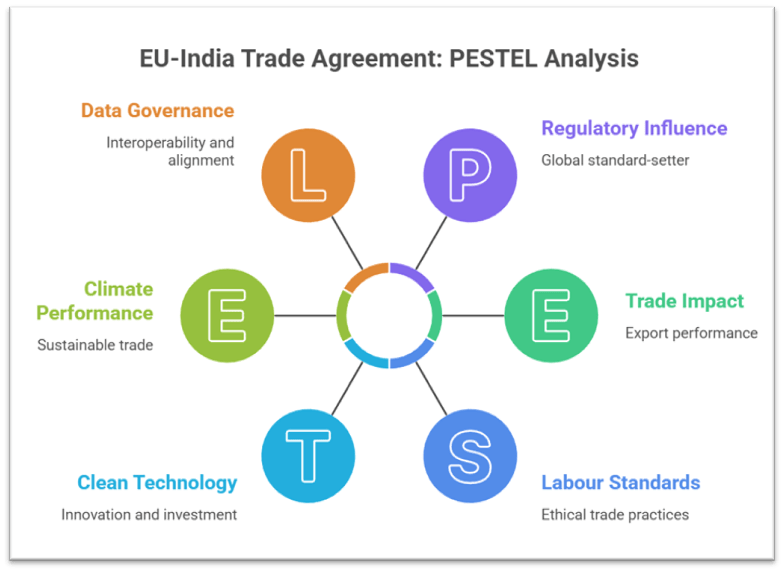
- The EU’s influence lies less in tariffs and more in its role as a global standard-setter on data protection, competition policy, and environmental regulation.
- Engagement in 2026 places India at the table where market access rules, carbon accounting, and digital governance norms are shaped, reducing the risk of passive rule-taking.
- Case Study – Data governance alignment: Dialogue on cross-border data flows illustrates how India seeks interoperability without fully replicating European regulatory models.
Climate and sustainability interface
- Instruments such as carbon border measures and due-diligence obligations affect Indian exports by linking trade to climate performance and labour standards.
- Example – Green industrial transition: Indian firms investing in renewable energy and cleaner production to retain European market access demonstrate how trade rules are reshaping domestic industrial strategies.
- Constructive engagement allows India to influence timelines and flexibilities, ensuring that sustainability standards support transition rather than become covert protectionism.
Institutional cooperation and capacity building
- Regulatory dialogue under the FTA framework extends to competition authorities, standard-setting bodies, and climate finance mechanisms, strengthening institutional learning on both sides.
- Case Study – Clean technology collaboration: Joint initiatives on hydrogen and circular economy practices show how standards cooperation can unlock investment and innovation.
- This transforms the relationship from transactional trade to long-term regulatory partnership.
3. Strategic Autonomy and Geo-economic Balancing
Hedging amid global trade uncertainty
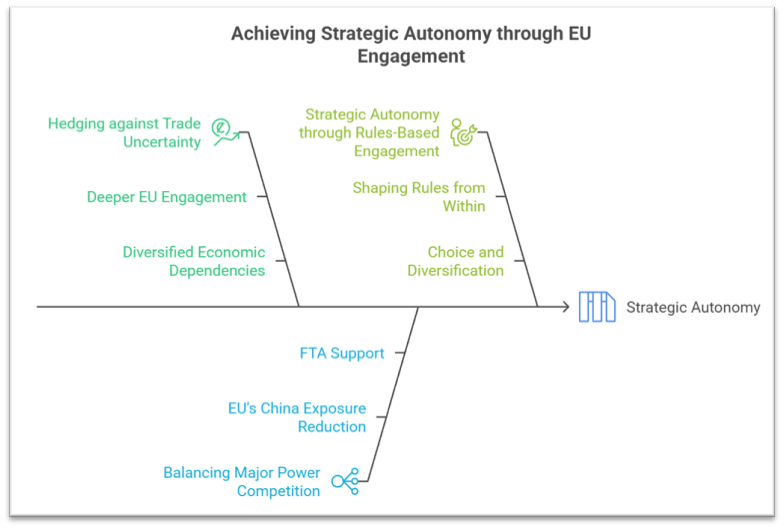
- Deeper engagement with the EU offers India insurance against unilateral trade pressures arising from shifting policies among major economies.
- By anchoring itself in European value chains, India diversifies economic dependencies, reinforcing its capacity to pursue independent policy choices.
- Case Study – Trade resilience: Indian exporters benefiting from stable EU demand during periods of volatility elsewhere highlight the stabilising role of diversified partnerships.
Balancing major power competition
- The EU’s strategy of reducing exposure to China and managing uncertainty in transatlantic relations converges with India’s emphasis on multi-alignment.
- The FTA supports India’s effort to remain engaged with multiple power centres while avoiding entanglement in binary geopolitical blocs.
- This approach strengthens India’s credibility as a bridge economy between advanced and emerging markets.
Strategic autonomy through rules-based engagement
- Rather than rejecting globalisation, India’s engagement with the EU reflects a strategy of shaping rules from within.
- Case Study – Investment screening and competition policy: Dialogues with European regulators help India refine domestic frameworks while retaining sovereign policy space.
- Strategic autonomy here is exercised through choice and diversification, not isolation.
Conclusion:
India’s engagement with the European Union in 2026, centred on the proposed India–EU Free Trade Agreement, represents a decisive move toward bloc-level economic diplomacy in a fragmented global order. By leveraging access to one of the world’s largest and most regulated markets, India can expand trade, influence evolving standards, and strengthen strategic autonomy through diversification.
The way forward lies in pairing external ambition with domestic readiness—investing in regulatory capacity, supporting enterprise adaptation, and sustaining dialogue on sustainability and digital governance. As global growth increasingly depends on resilient and rule-compatible partnerships, India’s calibrated engagement with the EU positions it to convert regulatory challenges into economic opportunity while preserving independent decision-making in an era of uncertainty.
Recap: