
Evaluate the Effectiveness of NATGRID in Enhancing India's Counter-Terrorism Efforts — Considering Its Recent Integration with NPR
The role of NATGRID in counter-terrorism has become increasingly significant in India’s security ecosystem, especially after its integration with the National Population Register (NPR). Evaluating its effectiveness requires analysing not only its operational strengths but also governance, legal safeguards, and societal implications.
Introduction
- The National Intelligence Grid (NATGRID) is a technology-driven intelligence-sharing architecture designed to enhance India’s counter-terrorism and internal security capabilities by enabling authorised agencies to seamlessly access and analyse disparate datasets.
- Conceived in the aftermath of the 26/11 Mumbai terror attacks, where post-incident inquiries highlighted failures in timely intelligence synthesis rather than absence of information, NATGRID aims to bridge institutional silos across security agencies. Its recent integration with the National Population Register (NPR)—a comprehensive database covering over one billion residents—marks a decisive shift in both scale and scope.
- This development necessitates a balanced evaluation of NATGRID’s effectiveness in counter-terrorism, weighed against constitutional safeguards, governance structures, and evolving technological risks, especially in a post-Puttaswamy (2017) privacy jurisprudence environment.
I. Strategic and Operational Effectiveness in Counter-Terrorism
a) Enhanced intelligence convergence and threat detection
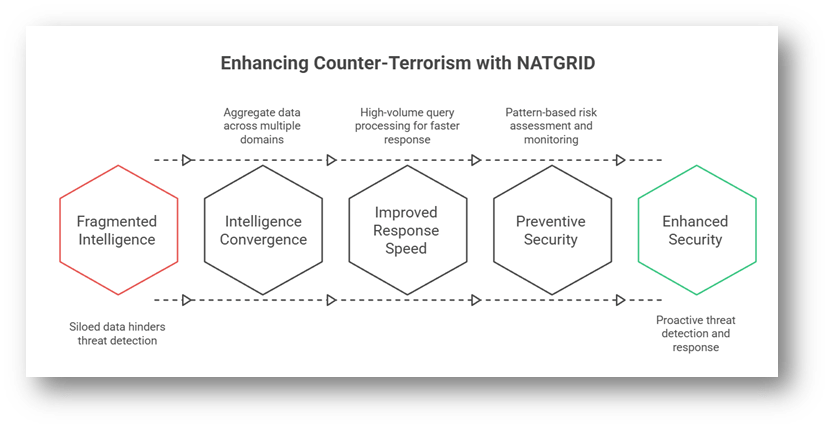
- NATGRID’s core value lies in its ability to aggregate fragmented intelligence across domains such as travel, financial transactions, telecommunications, and identity records, directly addressing the coordination gaps exposed during 26/11.
- Example: During the 26/11 attacks, multiple data points existed independently but were not synthesised in time. NATGRID’s query-based interface is designed precisely to prevent such failures.
b) Improved speed and scale of investigative response
- High-volume query processing allows agencies to respond faster to emerging threats, particularly in time-sensitive terror investigations.
- Case Study: In recent urban terror incidents, digital trails have become central to rapid suspect identification.
- Administrative reform: Expanding access to state police improves decentralised intelligence use.
c) Transition from reactive to preventive security
- Integration with NPR enables pattern-based analysis for pre-emptive monitoring.
- Example: Network mapping can help identify sleeper cells.
- This mirrors global counter-terror models post-9/11.
II. Structural, Legal, and Governance Constraints
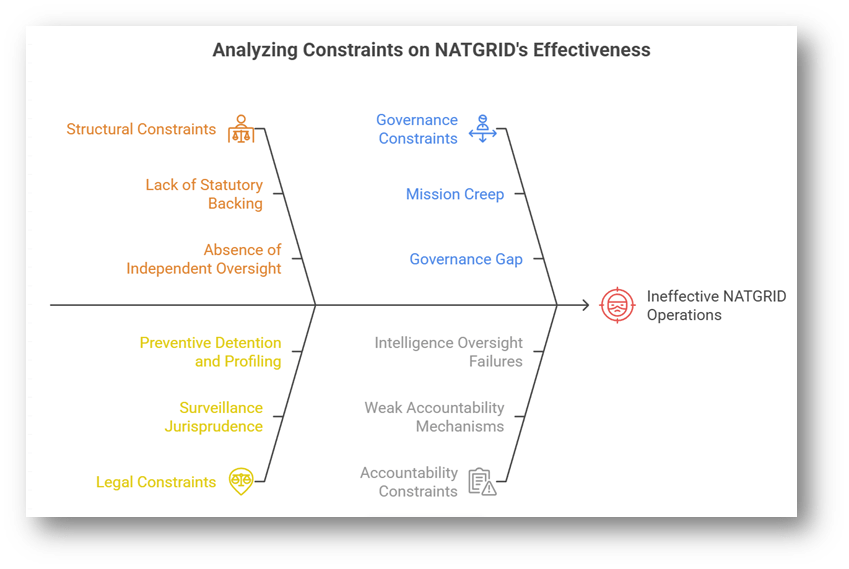
a) Absence of statutory backing and independent oversight
- NATGRID largely functions through executive power, lacking parliamentary statute.
- India lacks independent audit mechanisms for such intelligence platforms.
b) Risks of mission creep and everyday policing
- Expansion beyond terrorism risks over-surveillance.
- Example: Use of preventive detention laws in non-terror contexts.
- Public trust may decline without purpose limitation.
c) Weak accountability mechanisms despite technical safeguards
- Audit trails exist but lack external scrutiny.
- Past commissions highlight institutional inertia rather than lack of data.
III. Integration with NPR: Technological Promise and Societal Risks
a) Shift from event-based tracking to population mapping
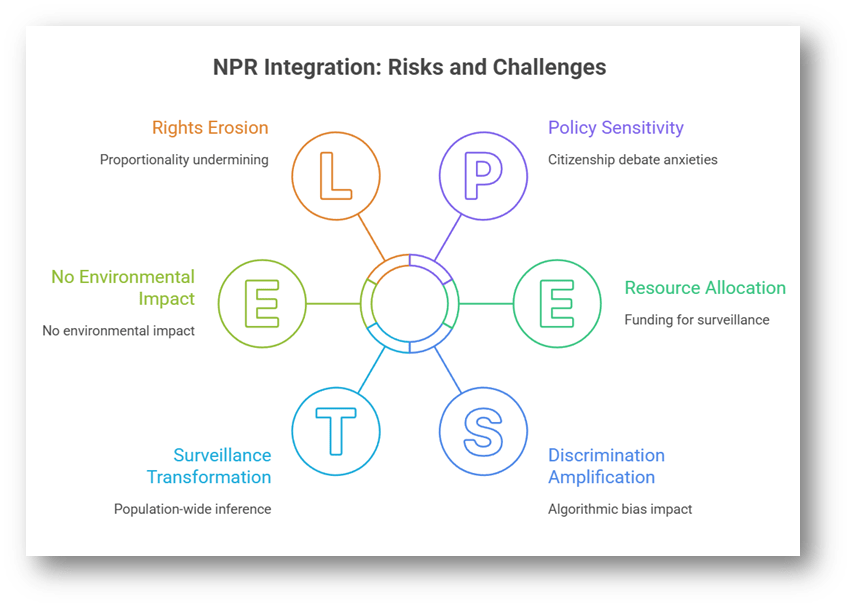
- Linking NATGRID with NPR fundamentally transforms surveillance capability.
- Example: Lineage and household mapping allow deeper relational analysis.
- This raises political and social sensitivity.
b) Algorithmic bias and discriminatory outcomes
- Predictive analytics risk replicating social prejudices.
- Misidentification can impose severe human rights consequences.
c) Scale-driven erosion of proportionality
- Routine querying risks normalising mass surveillance.
- Lack of judicial oversight exacerbates imbalance between liberty and security.
Conclusion:
- NATGRID has strengthened India’s counter-terrorism architecture by improving intelligence integration and response capability.
- However, NPR integration marks a structural transformation toward population-scale surveillance.
- Data abundance alone cannot replace accountable governance, professional policing, and democratic oversight.
- A security architecture grounded in rule of law, transparency, and trust is essential to ensure NATGRID remains an instrument of national safety rather than suspicion.
- NATGRID has strengthened India’s counter-terrorism architecture by improving intelligence integration and response capability.
- However, NPR integration marks a structural transformation toward population-scale surveillance.
- Data abundance alone cannot replace accountable governance, professional policing, and democratic oversight.
- A security architecture grounded in rule of law, transparency, and trust is essential to ensure NATGRID remains an instrument of national safety rather than suspicion.
Recap: