

India R&D Ecosystem: Structural Impediments and the Limited Role of Private Sector Research
Introduction:
- Research and Development (R&D) constitutes the backbone of a nation’s long-term economic competitiveness, technological sovereignty and strategic autonomy. It encompasses systematic activities undertaken to increase the stock of knowledge and translate it into new products, processes and services.
- Despite housing nearly one-sixth of the global population and a comparable share of the world’s human capital, India contributes only a small fraction of global research output and high-value innovation, reflecting a persistent structural weakness.
- India’s Gross Expenditure on R&D (GERD) has remained below 1% of GDP for decades, markedly lower than innovation-led economies, even as the country aspires to become a Viksit Bharat by 2047. This gap is not merely fiscal but deeply institutional, cultural and structural, with the private sector’s limited role emerging as a central constraint.
I. Structural Impediments within India’s R&D Ecosystem
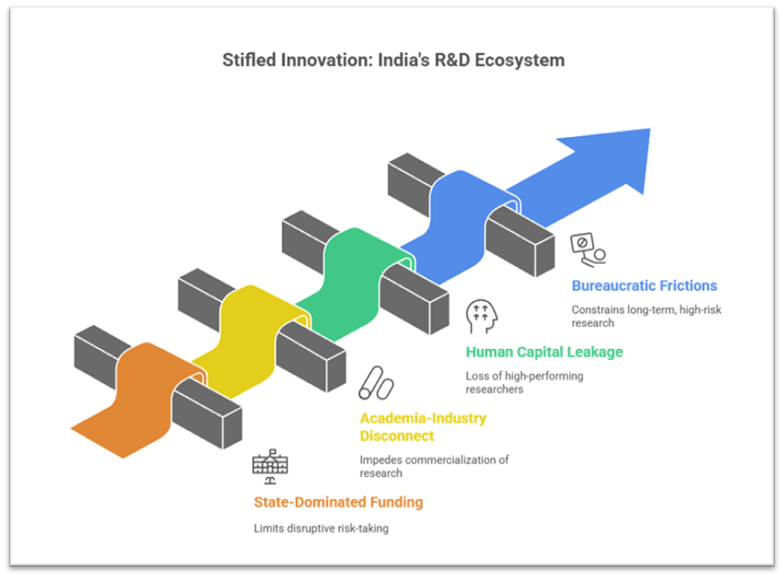
- State-dominated funding architecture and weak risk capital
- India’s R&D ecosystem remains government-led, with public institutions and government agencies accounting for a majority share of research funding, unlike innovation-driven economies where firms assume primary responsibility.
- This model prioritises mission continuity over disruptive risk-taking, resulting in incremental research rather than frontier breakthroughs.
- Example: Public laboratories under CSIR and DRDO have delivered strategic gains, such as indigenous missile systems and vaccines, yet comparable spillovers into civilian commercial technologies remain limited due to weak industry pull.
- Academia–industry disconnect and the “valley of death”
- Indian universities primarily function as teaching-oriented institutions, with limited incentives or infrastructure for translational research and commercialisation.
- Research output often remains theoretical, failing to cross the critical gap between laboratory validation and market deployment.
- Case Study: Unlike U.S. universities that incubated firms such as Google and Moderna through industry-linked research ecosystems, Indian institutions have only recently begun building technology transfer offices under initiatives like the National Innovation and Startup Policy.
- Human capital leakage and bureaucratic frictions
- While India produces a large pool of engineers and PhDs, high-performing researchers frequently migrate due to superior funding, infrastructure and career trajectories abroad.
- Domestic public R&D is further constrained by slow approvals, fragmented funding cycles and rigid procurement rules, undermining long-term, high-risk research.
- Example: India’s contributions to global AI and semiconductor research are often led by Indian-origin scientists working in foreign labs, highlighting the cost of inadequate domestic research ecosystems.
II. Private Sector Participation: India versus Global Innovation Economies
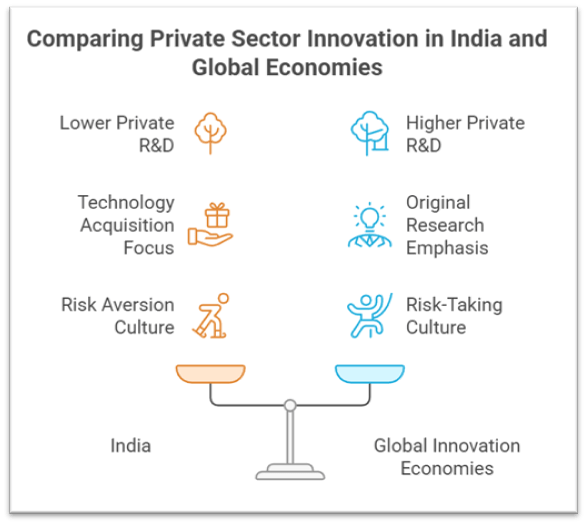
- Disproportionately low industry contribution
- In advanced innovation systems such as the United States, Japan, Germany and South Korea, the private sector contributes two-thirds or more of total R&D spending, reflecting industry-led innovation.
- In India, private industry contributes less than 40% of R&D expenditure, underscoring weak corporate commitment to long-term research.
- Example: A single multinational technology firm in East Asia investing more in R&D than India’s combined national spend illustrates the scale and intensity gap in corporate innovation.
- Preference for technology acquisition over creation
- Indian firms often rely on licensed technologies, imported capital goods and process optimisation, rather than investing in original research.
- This strategy delivers short-term efficiency but limits the creation of globally competitive intellectual property.
- Case Study: India’s pharmaceutical sector excels in generics manufacturing but lags in novel drug discovery, in contrast to firms in the U.S. and Europe that dominate patented therapeutics.
- Risk aversion and shallow innovation culture
- Family-owned conglomerates and short-term profitability pressures discourage high-risk, long-gestation R&D investments.
- Venture funding for deep-tech remains modest compared to consumer technology or services.
- Example: While India’s startup ecosystem thrives in fintech and e-commerce, sectors such as advanced materials, semiconductors and quantum technologies remain underrepresented.
III. Institutional and Policy Constraints Reinforcing the R&D Deficit
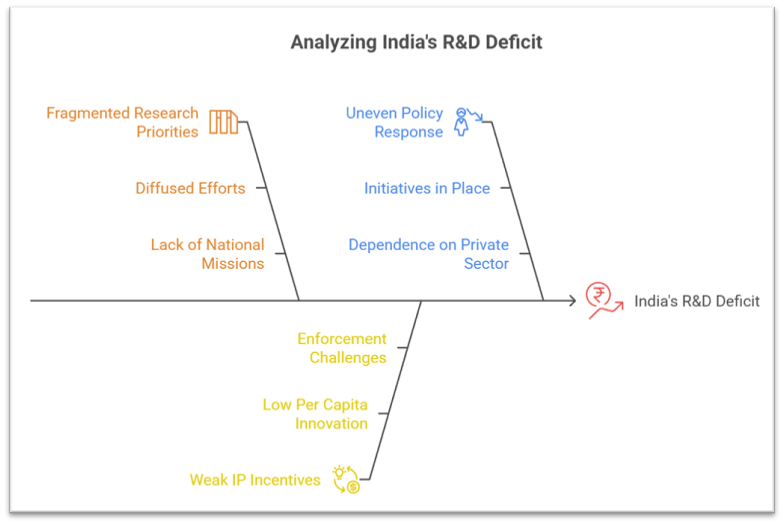
- Fragmented research priorities and lack of national missions
- India’s R&D efforts are often diffused across ministries and institutions, diluting impact.
- Global leaders focus on tightly coordinated national missions aligned with economic and security priorities.
- Example: The success of space and atomic energy programmes in India demonstrates the potential of mission-mode research when funding and governance are unified.
- Weak intellectual property (IP) incentives
- Although patent filings have increased, per capita innovation intensity remains low, reflecting limited domestic patenting and commercialisation.
- Enforcement challenges and modest financial returns reduce incentives for firms and researchers.
- Case Study: Countries like South Korea transformed from imitators to innovators by coupling R&D expansion with strong IP monetisation frameworks.
- Emerging but uneven policy response
- Initiatives such as the National Research Foundation, the Research Development and Innovation Fund, Production Linked Incentive schemes, and the Semiconductor Mission signal a strategic shift.
- However, their success depends on efficient disbursal, private sector co-investment and regulatory agility.
- Example: Early outcomes in electronics manufacturing suggest policy traction, but sustained private R&D commitment remains uncertain.
Conclusion:
- India’s R&D challenge is fundamentally structural rather than aspirational. While the country possesses vast human capital and growing market scale, chronic underinvestment, state-dominated funding, weak industry participation and institutional rigidities continue to constrain innovation outcomes.
- Compared to global innovation economies where firms drive research intensity, India’s private sector remains cautious, short-term oriented and under-engaged. The path forward lies in raising R&D expenditure to around 2% of GDP within the next decade, rebalancing funding towards industry leadership, strengthening academia–industry linkages, and fostering a robust intellectual property culture.
- With targeted national missions, predictable funding and a decisive shift in corporate mindset, India can convert demographic strength into technological leadership, ensuring that innovation becomes a central pillar of its economic and strategic rise by 2047.
Recap: