Special Intensive Revision: A Test Case and Necessary Reform in India’s Electoral Management
Introduction:
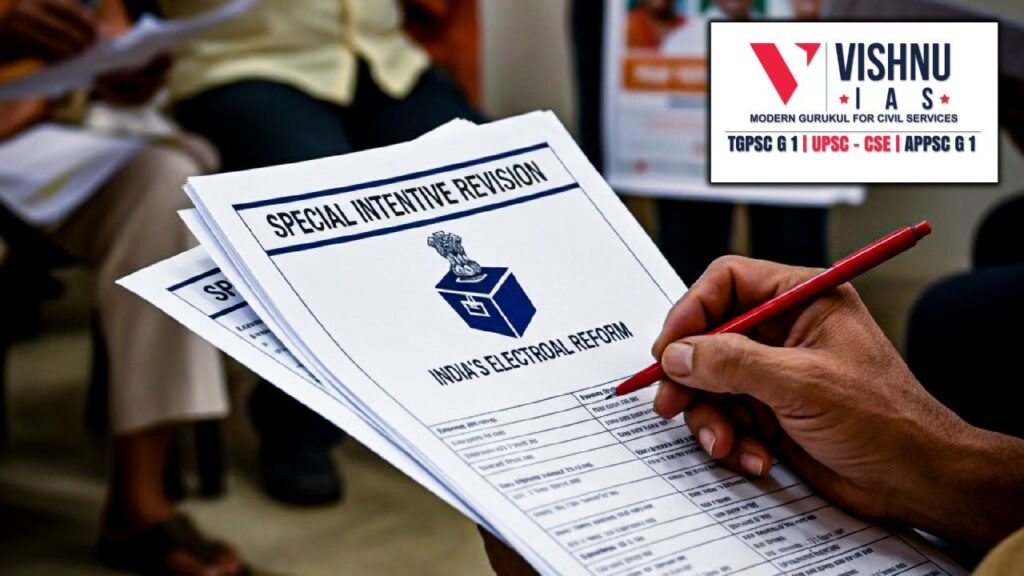
- The Special Intensive Revision (SIR) of Electoral Rolls is a time-bound, house-to-house verification and rationalisation of the electoral register initiated by the Election Commission of India (ECI) under its constitutional authority (Article 324) and statutory mandate (Section 21 of the Representation of the People Act, 1950).
- The SIR is designed to ensure that all eligible citizens are included in the rolls, while ineligible entries (due to death, migration, duplication or non-citizenship) are removed. The SIR is thus not a routine summary revision but a comprehensive clean-up and fresh validation exercise. The fact that the current phase will cover approximately 51 crore electors — more than half the country’s electorate — spanning 321 districts and 1,843 Assembly constituencies underscores its scale and significance.
- In this context, the SIR can be described as both a test case and a necessary reform in India’s electoral management: a test of the ECI’s capacity, processes, fairness and transparency; and a reform to address long-standing issues in electoral rolls such as duplication, migration, deceased entries and outdated data.
Body:
1. Test case for electoral management: capacity, precedent and challenges
1.1 Operational capacity and scale
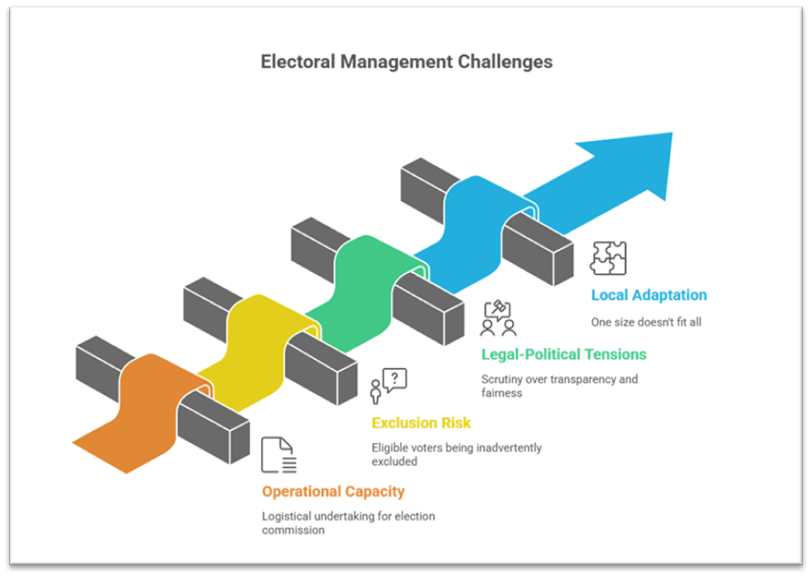
- The SIR involves mobilisation of roughly 5.33 lakh polling stations, an equivalent number of Booth Level Officers (BLOs) and over 7.64 lakh booth-level agents of political parties. This scale marks a major logistical undertaking for the ECI and state administrations.
- In Bihar, the ECI noted that of the ~7.9 crore electors as on 24 June 2025, 2.88 crore enumeration forms were already collected by 7 July (36.47 %). This demonstrates both the magnitude of data collection and the challenge of reaching all electors in a short span.
- The phased rollout into nine States and three UTs (including Tamil Nadu, Kerala, West Bengal, Uttar Pradesh, Madhya Pradesh, Rajasthan, Chhattisgarh, Goa, Gujarat; and UTs Andaman & Nicobar, Lakshadweep, Puducherry) starting 4 November 2025 provides the next large-scale operational test of the SIR model.
1.2 Precedent-setting and institutional reform
- The SIR is only the ninth such exercise in India’s 75-year electoral history and the first in 21 years (the last large-scale one being around 2002-05). That long gap underlines the need for a fresh revision after rapid urbanisation, migration and demographic change.
- A key precedent was set in Bihar, where the SIR completed its cycle (draft roll, claims/objections, final roll) and achieved reported “zero appeals” against wrongful deletions, according to the ECI. This outcome is being held up as proof-of-concept for the pan-India rollout.
- The SIR offers the ECI an opportunity to institutionalise newer processes: use of enumeration forms (Form-6 for addition, Form-7 deletion, Form-8 correction), at least three visits to each house by BLOs, clearer data linkage to previous rolls (eg the 2003 roll) and updated documentary proof regimes.
1.3 Challenges: exclusion risk, legal-political tensions and local adaptation
- One major challenge is the risk of eligible voters being inadvertently excluded — for instance due to migration, ill-documented residence, or faulty BLO verification. The opposition in Bihar alleged mass exclusion, dubbing it “vote theft”.
- The Supreme Court of India intervened, directing the ECI to publish names of approximately 65 lakh voters deleted in Bihar, with reasons for deletion. This highlights legal scrutiny over transparency and fairness.
- Local variation in migration, urbanisation and administrative capacity means “one size doesn’t fit all”: what worked in one state may not transfer seamlessly to another (e.g., states with high in-migration or border issues like West Bengal). Customisation of procedures remains a test for the ECI and states.
2. Necessary reform: ensuring accuracy, inclusivity and legitimacy of electoral rolls
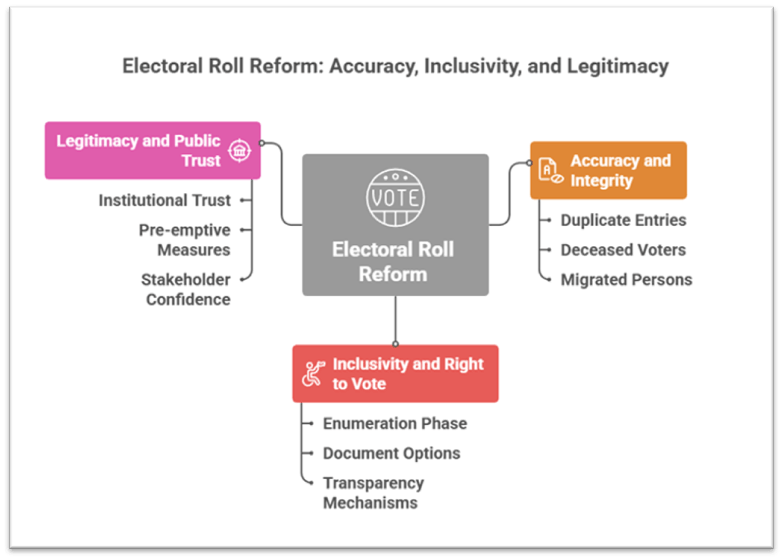
2.1 Accuracy and integrity of voter lists
- The fundamental objective of SIR is to eliminate duplicate entries, deceased voters, migrated persons and ineligible entries. For example, in Bihar the ECI identified approximately 26 lakh voters who had shifted constituencies and 7 lakhs registered at two places.
- The SIR links current electors to the reference roll (in Bihar’s case 2003) and demands proof of eligibility. For instance, the ECI reported that in Bihar ~52 % of existing electors were found on the 2003 roll, and another ~25 % were either children or relatives of those earlier electors.
- Such accuracy is essential for free and fair elections — clean rolls reduce risks of impersonation, ghost voting and manipulation. They undergird the legitimacy of electoral outcomes and strengthen democracy.
2.2 Inclusivity and right to vote
- While cleaning up the rolls, the SIR emphasises that eligible citizens must not be disenfranchised. The ECI has asserted that no document is to be collected from electors during the enumeration phase (house-to-house surveys) and the draft roll will include electors whose signed enumeration forms are received.
- The use of a wide list of 11 (later 12) documents (including Aadhaar, land allotment certificates, extract of the Bihar SIR roll) offers multiple routes to prove identity/residence, which the Supreme Court described as “voter-friendly”.
- Transparency mechanisms such as publishing the draft roll (in the current phase scheduled for 9 December 2025) and allowing claims/objections until 8 January 2026, followed by final roll on 7 February 2026, ensure procedural fairness and safeguard rights.
2.3 Legitimacy of electoral management and public trust
- The SIR enhances institutional trust by signalling that the ECI takes roll-maintenance seriously after two decades. A current, reliable roll is a cornerstone of credible election administration.
- By undertaking this exercise ahead of key state elections (e.g., Tamil Nadu, Kerala, West Bengal) it pre-emptively addresses concerns of outdated registers, thereby reducing scope for disputes about who is eligible to vote.
- The visible involvement of BLOs, agents of political parties, and transparent procedures (eg three visits per house, house-to-house enumeration) fosters stakeholder confidence. If executed well, SIR becomes a reference model for future roll updates and reinforces the democratic process.
3. Critical aspects, trade-offs and lessons for future electoral roll reforms
3.1 Trade-off between thoroughness and timeframe
- A genuinely intensive revision demands time and resources; but elections impose deadlines. For instance, the exercise in Bihar spanned ~June to September 2025; the pan-India phase is condensed into November to early February.
- Short timeframes may heighten risks of errors, inadequate field visits or incomplete data capture. The ECI must monitor quality of enumeration, BLO training and data validation to avoid trade-offs that compromise either accuracy or inclusivity.
3.2 State-specific complexities and tailored implementation
- States like West Bengal face additional issues of cross-border migration and citizenship scrutiny; others like Kerala and Tamil Nadu have high migration outflows; Uttar Pradesh has large elector populations and complex social dynamics.
- Implementation therefore cannot be uniform. For example, the ECI’s decision to exclude Assam from the current phase because of its “different legal track” for citizenship issues illustrates the need for adaptation.
- States must engage local stakeholders, conduct all-party meetings (as done in Chennai for SIR), and deploy bespoke strategies for high-mobility or border-adjacent constituencies.
3.3 Lessons for future electoral roll reforms and technology integration
- The SIR experience will generate data and insights for future periodic revisions. For instance, linking rolls to Aadhaar or leveraging databases (like the 2003 roll) may be institutionalised. The ECI must evaluate what worked (eg three visits, large agent involvement) and what needs improvement (eg document acceptance, rural coverage).
- Technology can enhance future roll-maintenance: up-to-date door-to-door enumeration modules, digital uploads (e.g., in Bihar ~11.26 % of forms were uploaded on ECINET in early phase) and integration of enrolment portals.
- Continuous updating (annual or biennial) may reduce the need for such infrequent large-scale overhauls. The SIR’s success would demonstrate that roll-management is not a one-off but an ongoing institutional responsibility.
Conclusion:
- The Special Intensive Revision of electoral rolls represents a necessary reform towards modernising India’s electoral register and ensuring the integrity, accuracy and legitimacy of electoral democracy. Simultaneously, it serves as a test case for the capacity of the Election Commission and state administrations to manage a nationwide, high-stakes operational exercise while balancing inclusivity and procedural fairness. Early indicators—such as large enumeration rates in Bihar and the setting of clear draft and final roll timelines—suggest positive momentum.
- However, the success of the SIR will ultimately depend on field-level execution, stakeholder confidence, transparent grievance redressal and minimal disenfranchisement. Going forward, lessons from this exercise should inform a transition to regular, incremental roll-updating mechanisms that reduce the need for massive episodic revisions and embed continuous roll-management into India’s electoral infrastructure.
Recap: