
Energy efficiency in India: The Indispensable Prerequisite for Integrating Solar & Wind (VRE)
Introduction
Energy efficiency in India • Energy efficiency refers to the reduction in the amount of energy required to produce the same service (e.g., cooling, lighting, industrial output) through more efficient technologies, processes, or behavioural changes. At the same time, variable renewable energy (VRE) such as solar and wind are characterised by output that fluctuates with weather and time of day.
- Today, India has achieved a significant milestone: non-fossil fuel sources account for about 50 % of the total installed capacity. Yet paradoxically, the grid emission factor (GEF) of India’s electricity system has increased from 0.703 tCO₂/MWh in 2020-21 to 0.727 tCO₂/MWh in 2023-24, indicating that the electricity plugged in is on average dirtier despite a cleaner capacity mix.
- This phenomenon raises a critical question: why is India’s grid getting more carbon-intensive even as renewable capacity grows? The core of the answer lies in recognising that capacity is not the same as generation, and that without sufficient demand-side efficiency and flexibility, VRE cannot fully replace coal-based generation. In this scenario, energy efficiency emerges as an indispensable prerequisite for integrating VRE into the grid.
Body
1. Technical dimension: matching generation, variability and grid emission
1.1 Capacity-generation mismatch
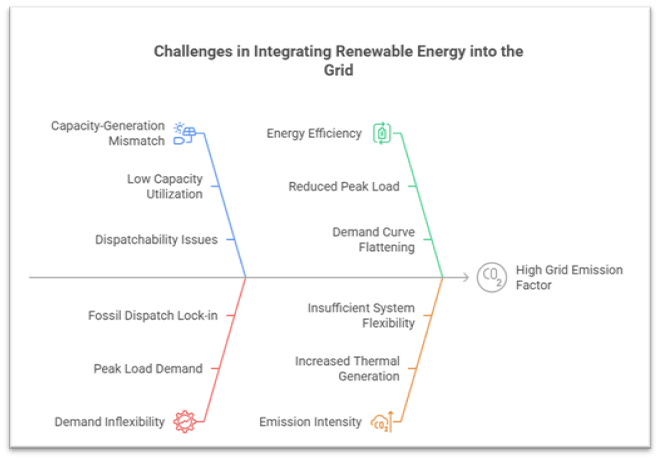
- Although renewables may command around 50 % of installed capacity, their actual generation share remains much lower (solar and wind plants often run at 15-25 % capacity utilisation, compared with 65-90 % for coal or nuclear). In India, renewables (including hydro) supplied around 22 % of total electricity in 2023-24, meaning fossil fuels still supplied the large majority.
- Because coal plants are more dispatchable, they continue to run during periods when renewables are low (evenings, nights, cloudy/windy-low days), thereby increasing the grid emission factor despite growing renewables.
- Technical inflexibilities in demand (peaks in evening when solar falls) and fossil dispatch lock-in aggravate the mismatch: the grid ends up relying on coal as the “shock absorber”.
1.2 Role of energy efficiency in grid flexibility
- Efficiency in appliances, motors, building cooling/heating systems and industrial processes can reduce absolute demand and especially reduce the peak load that must be met when VRE output is low. By lowering demand, fewer fossil plants need to be dispatched.
- Efficiency also changes the shape of the demand curve — flattening the peaks and shifting load towards times when renewables are available — thus enhancing alignment between supply and VRE generation.
- Without demand-side efficiency, VRE generation risk remains stranded: even if installed capacity is large, VRE may go unused (curtailed) or fossil plants remain on standby, reducing the emission reduction benefit.
1.3 Emission intensity implications
- According to the Central Electricity Authority (CEA) CO₂ Baseline Database, the weighted average emission factor increased to 0.727 tCO₂/MWh in 2023-24. This rise has been attributed to thermal (coal + lignite) generation increasing by about 10 % in that year even as renewable generation grew.
- The technical bottom-line: adding capacity is insufficient. Integration of VRE demands that the system becomes more efficient and flexible; otherwise emissions remain locked in. Efficiency reduces the need for fossil dispatch and thereby lowers the average emission per unit of electricity delivered.
2. Economic and institutional dimension: investments, markets and frameworks
2.1 Avoided capacity and cost savings via efficiency
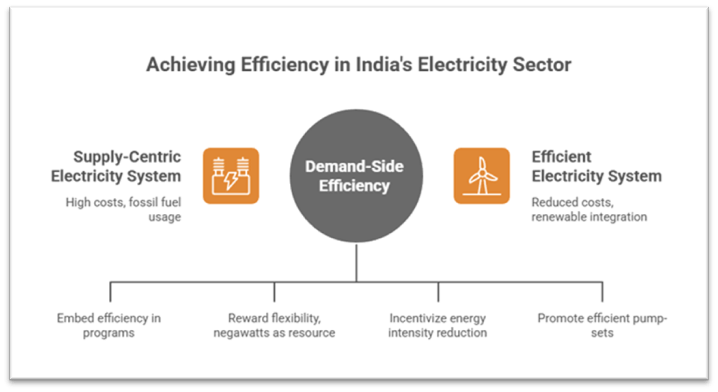
- Efficiency reduces the need for investment in generation, transmission and distribution assets, which is economically advantageous. The Bureau of Energy Efficiency (BEE) identifies demand-side management (DSM) as a key programme to reduce peak demand and defer new infrastructure.
- As India’s electricity demand grows strongly, relying purely on supply-side expansion (renewables + storage + transmission) without demand-side efficiency leads to higher system costs and more fossil usage.
2.2 Institutional mechanisms and schemes supporting efficiency
- India’s policy architecture includes the Perform, Achieve and Trade (PAT) Scheme under the National Mission for Enhanced Energy Efficiency (NMEEE) which incentivises large industrial consumers to reduce energy intensity.
- The BEE’s DSM programme, including the agriculture DSM scheme (AgDSM), seeks to change consumption patterns, especially in agriculture, by promoting efficient pump-sets and better scheduling.
2.3 Institutional coordination for VRE integration and efficiency
- The grid operator, policy-makers and distribution companies must coordinate to ensure that efficiency is embedded in sectoral programmes (for example, efficient motors in industry, star-rated appliances in buildings) and that markets reward flexibility (time-of-day tariffs, demand response). Without this coordination the institutional regime remains supply-centric.
- Market mechanisms that allow efficiency to participate (e.g., “negawatts” as a resource) enhance the economic case for demand-side action, which in turn supports VRE integration by reducing the need for fossil fallback.
3. Demand-side behavioural and structural dimension: shaping consumption patterns
3.1 Changing load shape and reducing peaks
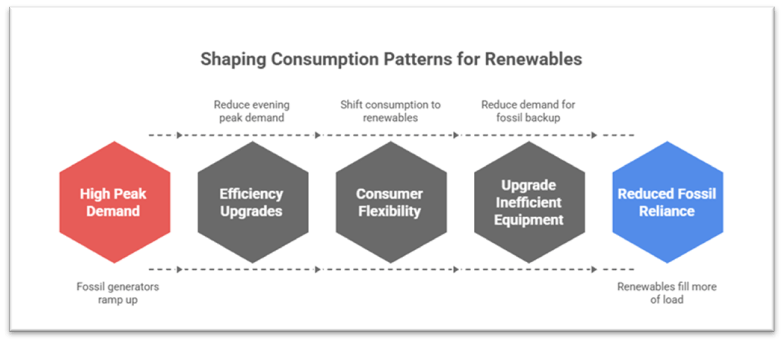
- Evening peaks, when solar output wanes and household demand rises (lighting, cooling, appliances) force fossil generators to ramp-up. Efficiency upgrades in buildings (insulation, efficient ACs/fans), efficient motors in industry, and efficient lighting can reduce these peaks.
- For example: promoting 4- and 5-star rated air conditioners reduces electricity drawn per unit of cooling; when adopted at scale the effect on national peak load is non-trivial.
3.2 Enabling consumer-side flexibility and participation
- Efficiency goes hand-in-hand with flexibility: consumers with efficient appliances, smart meters and possibly home-storage/battery systems can shift consumption to times when renewables are abundant (e.g., daytime solar) and reduce consumption when fossil-intensive.
- Consumer behaviour is influenced by pricing signals and incentives (tariffs, rebates) — but also by awareness and availability of efficient technologies. Efficient appliances must be market-available, affordable and trusted.
3.3 Lock-in risks and stranded asset risks on the demand-side
- If inefficient equipment remains in use, then even a clean supply-side will be offset by high demand for fossil backup. One of the arguments is that energy efficiency is the first fuel — doing less is cheaper than doing more.
- For example, old inefficient motors or pump-sets in agriculture or industry force higher electricity demand and reduce headroom for renewable integration. Upgrading these helps reduce demand growth and improves the margin for VRE to fill more of the load.
Conclusion:
- The argument that energy efficiency is an indispensable prerequisite for integrating VRE into India’s grid stands up strongly across technical, economic/institutional and demand-side behavioural dimensions. Efficiency reduces overall demand and in particular peak demand, flattens the load profile, enhances the match between renewable generation and consumption, and helps avoid falling back to coal-based generation when variability kicks in.
- By combining accelerated supply-side expansion of VRE, storage and transmission with a robust demand-side efficiency and flexibility strategy, India can steer the grid emission factor downward (CEA projects a fall to ~0.548 tCO₂/MWh by 2026-27 and ~0.430 tCO₂/MWh by 2031-32) and truly decarbonise the power sector. The energy transition thus demands that efficiency becomes the first fuel, and flexibility—not fossil backup—must power the future.
Recap: