
How Special Rupee Vostro Accounts Can Transform India’s Economic Engagement with Neighbouring Countries
The mechanism of Special Rupee Vostro Accounts (SRVAs) represents a new financial arrangement in which a foreign (correspondent) bank holds a rupee-denominated account with an authorised dealer bank in India, under the framework laid down by the Reserve Bank of India (RBI).
Through these accounts, cross-border trade and settlement can be denominated and invoiced in Indian Rupees (INR), and not necessarily mediated via the US Dollar or other global reserve currencies.
According to RBI data, as of early 2025, 123 correspondent banks from 30 trading-partner countries had opened 156 SRVAs across 26 Indian banks.
The objective is to advance two major goals: to deepen the international use of the Indian Rupee and to enhance India’s economic integration with trade partners.
Through SRVAs, Indian importers can make payment in INR directly to the correspondent bank of the partner country, and exporters can receive proceeds in INR from the balance in the SRVA.
Example: A neighbouring country sourcing goods from India may pay in INR rather than converting first into USD or another third-currency, thereby reducing foreign exchange conversion cost and risk.
Government initiative: The Master Direction under the Foreign Exchange Management (Manner of Receipt and Payment) Regulations allows trade settlement in INR for partner countries.
Benefit for India’s neighbours: They may gain access to a stable settlement currency in INR, backed by India’s sizeable economy, making bilateral trade more predictable and less vulnerable to global currency fluctuations.
Since payment flows are kept in rupee via the SRVA with an authorised dealer in India, the need for multiple currency conversions and correspondent banks in third countries is reduced.
Example: A Nepalese importer could settle their bill for Indian exports directly in INR rather than going through USD conversion and then remitting in NPR.
Government scheme: Indian banks such as Punjab National Bank publicise SRVA services for foreign banks, emphasising invoicing in INR, settlement in INR, and market-determined exchange rates with partner country currencies.
Impact: Transaction costs decline, timing improves, and this is particularly beneficial for smaller firms in neighbouring countries that face working-capital constraints or FX volatility.
With trade settlement in INR, partner countries might feel more confident in sourcing more from India or exporting more to India because foreign-exchange risk is better managed.
Example: Given India is a dominant trading partner for many South Asian neighbours (for instance India accounts for about 65% of Nepal’s international trade), the SRVA mechanism may stimulate additional trade flows.
Government initiative: The RBI’s policy permitting SRVAs formally recognises trade settlement in INR and allows use of the mechanism for current account and permissible capital account transactions under FEMA.
For India: this means deeper integration with neighbouring economies, greater export potential for Indian firms, and higher utilisation of Indian supply chains and services catering to the region.
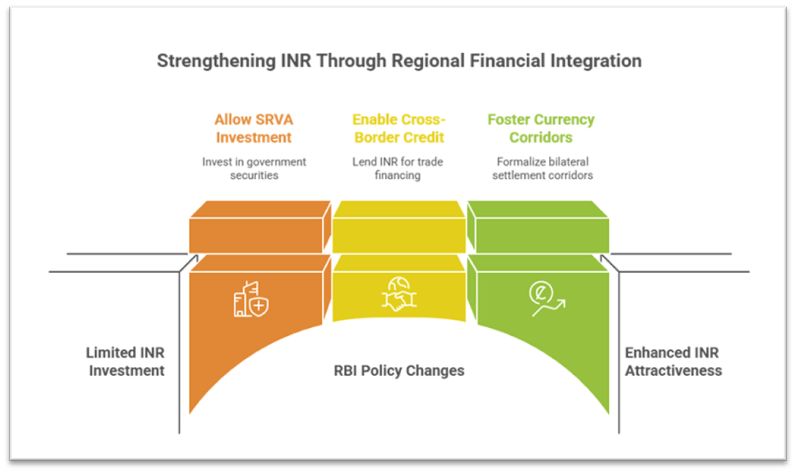
The RBI has permitted non-residents holding SRVAs to invest their surplus rupee balances in Central Government securities including Treasury bills.
Example: A bank in a neighbouring country holding an SRVA may place idle rupee balances into Indian government debt instead of letting them lie idle, thus converting trade-settlement balances into productive assets.
Government policy: The RBI circular of August 2025 allows surplus rupee funds in the SRVA to be used for payments for projects and investments.
Impact: This provides an investment channel for trade partners, deepens India’s debt market, and strengthens the attractiveness of INR among foreign banks and institutions. For neighbours, it offers an additional dimension of financial cooperation.
In the broader internationalisation push, the RBI is considering allowing authorised dealer banks to lend INR to non-residents (including from neighbours) for trade-related financing.
Example: A Bhutanese or Nepalese firm importing goods from India may get working-capital credit denominated in INR via the Indian bank through SRVA or associated mechanisms, thereby solving a typical financing bottleneck.
Government scheme: Though not yet fully operationalised, the proposal from RBI signals a move toward enabling institutional credit in INR across borders.
Benefit: For India’s neighbours, this could mean access to cheaper and more tailored financing, denominated in INR (thus eliminating FX risk into their domestic currency). For India, it expands influence in regional credit markets and aligns trade financing with its currency.
SRVAs provide a basis for creating more formalised bilateral currency settlement corridors, financial linkages, and even the start of INR-based regional networks rather than purely multilateral ones.
Example: While SRVA is primarily bank-to-bank, the infrastructure it creates may lead to formal arrangements tying neighbours’ central banks with India’s central bank for direct settlement.
Government initiative: The RBI has emphasised SRVA as a sequenced path “for increased use of the INR in international transactions”.
Strategic benefit: For India and its neighbours, this means less dependency on the US Dollar, more resilience against global financial shocks, and stronger regional financial integration.
Many of India’s neighbouring countries are vulnerable to global currency swings, hard-currency shortages and current account pressures.
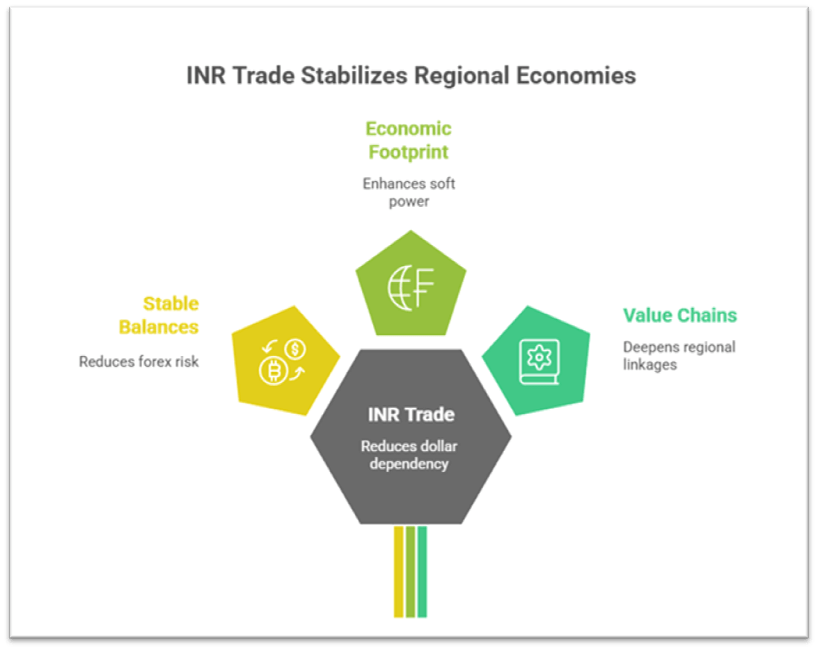
The ability to settle trade in INR via SRVAs reduces their exposure to the dollar.
Example: A country relying heavily on imports from India may face dollar shortages; settlement in INR eases this stress and supports its trade continuity.
Government initiative: India’s push for trade settlement in INR helps create a stable bilateral environment for neighbouring economies, enhancing mutual economic resilience.
Outcome: This can help neighbours stabilise their external balances, reduce forex risk, and support growth and employment. For India, it reinforces India’s role as a stabilising regional partner.
By offering innovative financial tools such as SRVAs and related credit/settlement facilities, India enhances its soft power and influence in the region.
Economic linkage becomes a tool of diplomacy.
Example: A Nepalese or Sri Lankan bank opening an SRVA with an Indian bank signals deeper economic integration and dependence on Indian banking corridors.
Government action: The external affairs, commerce and banking wings of India coordinate SRVA expansion with trade partners, with approvals across 30 countries.
Strategic benefit: For India, this builds a network of economic alliances; for neighbours, it provides access to India’s large market, capital, and trade system under relatively favourable terms.
With smoother rupee-settled trade and financing, regional value chains can deepen, especially between India and its neighbours.
This leads to shared manufacturing, services and technology linkages.
Example: A neighbouring country could import Indian intermediates, add value locally, and export either back to India or third markets, leveraging INR finance to scale up.
Government initiative: Initiatives such as regional trade agreements, infrastructure financing, and cross-border industrial corridors can pair with SRVA mechanisms to scale such value chains.
Result: For someone like Nepal, scaling ancillary industries, leveraging Indian investment and using INR-settled trade could contribute to employment, export diversification, and reduced external vulnerability; for India, it supports upstream and downstream industrial growth and regional market capture.
The introduction and expansion of Special Rupee Vostro Accounts represent a meaningful inflection in India’s economic engagement with its neighbours.
By enabling settlement in Indian Rupees, improving liquidity and investment channels, and deepening bilateral financial entrepreneurship, SRVAs provide a multi-dimensional tool for trade, finance and strategic cooperation.
In sum, if carefully operationalised and scaled, SRVAs could significantly transform India’s role as an economic anchor in its region, support its neighbours in achieving greater economic resilience, and advance the broader goal of Indian Rupee internationalisation.
1. Trade & Payments
a) Reduced dependence on intermediary currencies
b) Improved settlement speed and lesser transactional friction
c) Potential expansion of trade volumes and diversification
2. Financial Deepening & Investment
a) Improved rupee liquidity and investment avenues
b) Enabling cross-border credit and financing possibilities
c) Fostering regional currency corridors and bilateral financial architecture
3. Regional Economic Resilience & Strategic Partnerships
a) Reducing foreign-exchange vulnerability for small economies
b) Strengthening India’s economic-diplomatic footprint
c) Boosting regional investment, value-chain deepening and shared growth
Conclusion:
Recap: