
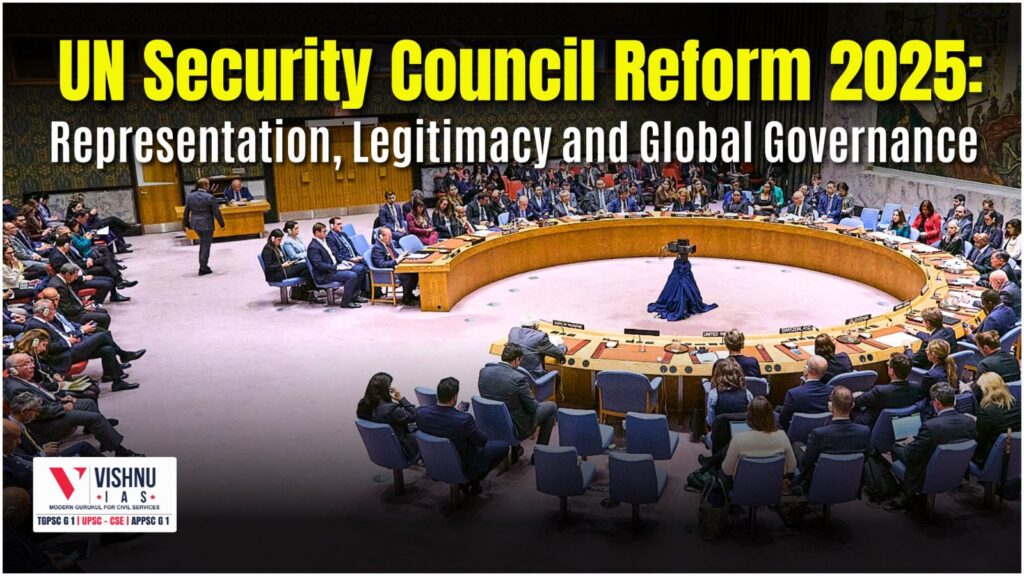
UN Security Council Reform: Critical Analysis in the Context of Contemporary Geopolitical Realities
Introduction
The United Nations Security Council Reform has become a crucial global discourse in the 21st century. The United Nations (UN) was established in 1945 with the primary responsibility of maintaining international peace and security under the Charter. Its principal organ for this purpose is the United Nations Security Council (UNSC), originally composed of five permanent members (P5) and ten non-permanent members.
Today, with 193 UN member states and global power, economic and demographic shifts, significant questions arise regarding the legitimacy, representativeness and effectiveness of the UNSC. For instance, the Asia-Pacific region houses some 58 per cent of the world’s population, yet it holds just one of the five permanent seats. This mismatch underpins the need for UN Security Council reform in light of contemporary geopolitical realities.
1. Evolving Geopolitical Landscape and Structural Misalignment
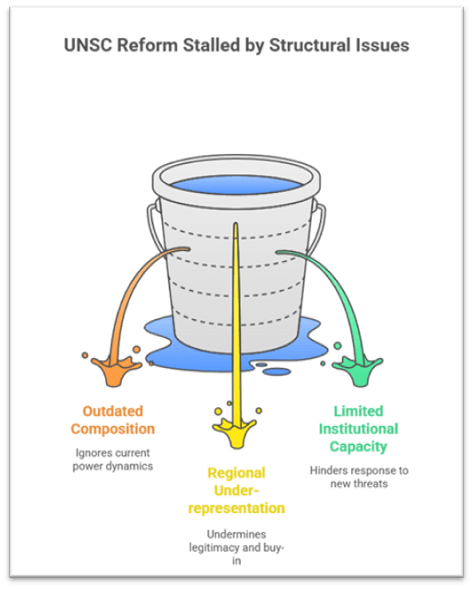
a) Outdated Composition Relative to Current Global Power Dynamics
The UNSC’s structure reflects the post-World War II era, dominated by the victors in 1945, and has not kept pace with the altered distribution of political, economic and demographic weight. Countries such as India — the world’s most populous democracy and a major contributor to UN peacekeeping — still lack a permanent seat despite their contemporary credentials. The G4 grouping (India, Brazil, Germany, Japan) advocates expanding the Council from 15 to 25–26 members (adding six permanent + four/five non-permanent) to reflect today’s realities.
b) Under-representation of Major Regions and Emerging Powers
Africa (54 countries) has zero permanent seats though it forms approximately 28% of UN membership. Latin America and the Caribbean and parts of Asia-Pacific are likewise inadequately represented in the permanent category. This under-representation undermines the legitimacy of the Council — if large regions feel excluded, decisions may be perceived as biased or lacking buy-in.
c) Complex and Transnational Security Challenges Demand Expanded Institutional Capacity
New threats such as cyber-warfare, climate-linked conflict, pandemics, and terrorism transcend traditional state-centric security frameworks. The UNSC’s original mandate and composition may limit its agility. When the Council remains locked in old models, its ability to address fast-moving crises is constrained—therefore structural reform is necessary to enhance responsiveness and resilience.
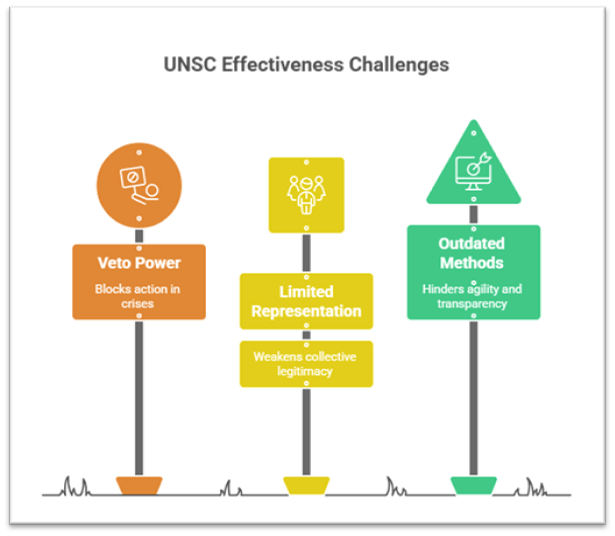
2. Effectiveness, Decision-making Gridlocks and Working-Methods Challenges
a) Veto Power and Paralysis in Key Crises
The P5 veto privilege has repeatedly blocked action in major humanitarian or security crises (for example, Syria, Yemen) because a member can protect its interests or those of its ally. The existence of veto powers for only five states creates disproportionate influence and has been cited as an obstacle to timely and decisive UNSC action.
b) Decisions Not Always Reflective of the Entire Membership’s Will
While the UN General Assembly reflects all 193 members, the UNSC remains a much smaller, less representative body. This gap weakens collective legitimacy. Some member states argue that adding members without veto power would be undemocratic—but under current realities, such representations could enhance legitimacy.
c) Reform of Working Methods to Enhance Agility, Transparency and Inclusiveness
There is a frequent call for the UNSC to modernise its internal working practices: streamline decision-making, empower field operations, and better integrate digital and multi-stakeholder tools. Reform is not only about seats but also about how the Council functions—agenda-setting, informal consultations, outreach to regional organisations and the broader UN system.
3. India’s and the Global South’s Perspective and Implications for India’s Foreign Policy
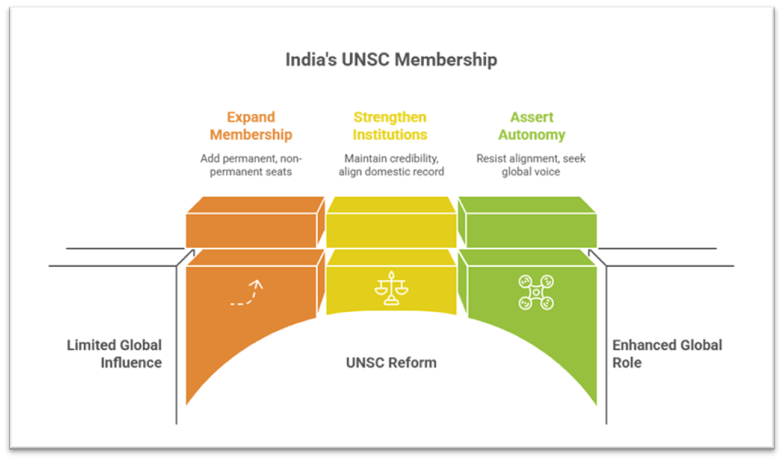
a) India’s Case for Permanent Membership in a Reformed UNSC
India emphasises its credentials: large population, world’s largest democracy, and major troop contributor to UN peacekeeping missions. Indian diplomacy asserts that only comprehensive expansion in both permanent and non-permanent categories can render the Council legitimate, responsive and effective. The G4 model tabled by India proposes geographic balance—two new permanent seats for African states, two for Asia-Pacific, one Latin America/Caribbean, and one Western Europe/others.
b) Strategic Autonomy and Middle-Power Diplomacy
In a multipolar, competitive world, India’s foreign policy emphasises sovereignty and strategic autonomy. It resists alignment with any single power bloc and seeks a voice in global governance rather than subordination. A reformed UNSC in which India holds a permanent seat would strengthen the Global South’s voice, aligning with India’s broader commitment to inclusive multilateralism and global governance reform.
c) Implications for India’s Global Role and Contribution
As India contributes significantly to UN peacekeeping, humanitarian operations and the Sustainable Development Goals agenda, a permanent UNSC seat would align its global contributions with decision-making authority. Reform could enhance India’s ability to shape norms on human rights, development, and sustainable security—areas of important bilateral and multilateral interest to India. However, India must also continue institutional strengthening, maintain credibility, and align its domestic record with international expectations to bolster its candidacy.
Conclusion:
The need for UN Security Council reform is both pressing and multifaceted. The Council’s structure remains rooted in a 1945 world, yet global power balances, regional dynamics, and the nature of security threats have radically changed. Expanding membership and revisiting working methods can enhance representativeness, legitimacy, and responsiveness.
According to India and its G4 partners, expanding to 25–26 members (including new permanent seats) is critical. For India, reform aligns with its aspiration to play a greater role in global governance and reflects its contributions to peace-keeping and development. The way forward lies in political will, consensus among member-states, flexibility on veto arrangements, and modernising the Council’s procedures.
Surveys and UN-member-state statements increasingly show broad support. India has stated that “a reformed Security Council that better reflects the geographical and developmental diversity of the United Nations today” is essential. While reform will not be easy, the stakes are high: a more representative, effective UNSC can better serve humanity’s collective aspirations for peace, justice, and cooperation.
Recap: