
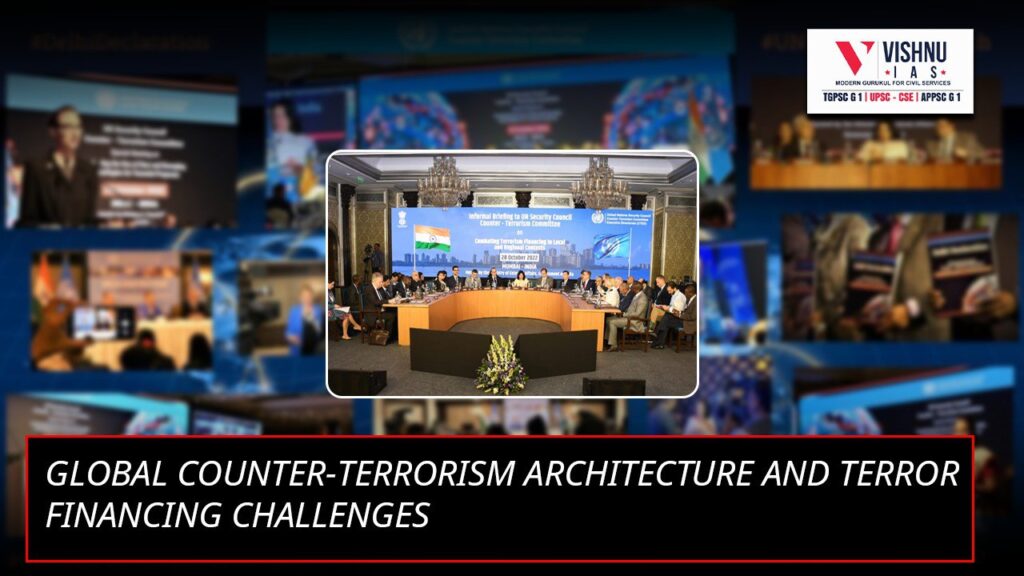
Evaluate the integrity and effectiveness of the global counter-terrorism architecture, citing recent developments at the UN and the issue of terror financing as evidence.
Introduction:
- Global counter-terrorism architecture refers to the collective international mechanisms, institutions, treaties, and cooperative frameworks aimed at preventing, combating, and eliminating terrorism. It includes the United Nations (UN), Financial Action Task Force (FATF), International Monetary Fund (IMF), regional groupings like SCO and SAARC, and national counter-terrorism frameworks.
- According to the Global Terrorism Index 2024, fatalities from terrorism globally declined by 10% compared to the previous year, but the spread of transnational terror financing networks, cyber radicalisation, and state-sponsored terrorism continues to pose significant challenges.
- The UN’s adoption of the Global Counter-Terrorism Strategy (2006, reviewed every two years) and the establishment of UNSC Resolution 1373 (2001) were seen as milestones. However, recent developments — such as Pakistan chairing UN counter-terrorism committees, IMF loans amid terror-financing concerns, and FATF’s grey-listing mechanisms — highlight growing debates over the credibility, neutrality, and effectiveness of these institutions.
Body:
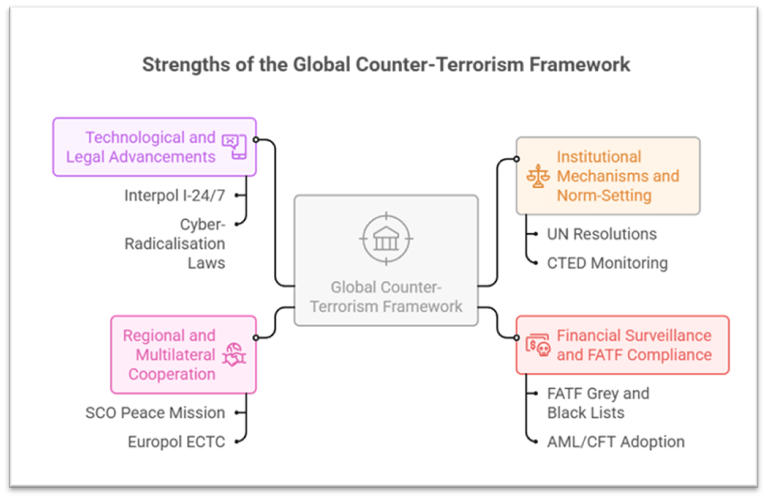
• I. Strengths of the Global Counter-Terrorism Framework
- 1. Institutional Mechanisms and Norm-Setting
- The UN has established binding resolutions (e.g., Resolution 1267 Sanctions Regime) that target individuals and entities linked to Al-Qaeda, ISIL, and associated groups.
- The Counter-Terrorism Committee Executive Directorate (CTED) monitors state compliance, ensuring that national laws criminalise terror financing.
- Case Study – Taliban Sanctions Regime: Freezing assets and restricting travel of Taliban leaders has been a tool for exerting pressure and curbing their global legitimacy.
- 2. Financial Surveillance and FATF Compliance
- FATF grey and black lists act as deterrents by restricting countries’ access to international capital markets. Over 23 nations, including Pakistan (2018–2022), were grey-listed leading to reported economic costs of billions in lost investment.
- The adoption of Anti-Money Laundering/Combating Financing of Terrorism (AML/CFT) standards across over 200 jurisdictions shows significant global alignment.
- Example – Sri Lanka: Post its grey-listing in 2017, Colombo amended its AML laws and established stronger financial intelligence units.
- 3. Regional and Multilateral Cooperation
- Platforms such as the Shanghai Cooperation Organisation (SCO) have adopted joint anti-terror exercises (e.g., SCO Peace Mission 2021).
- European Union’s Europol operates the European Counter Terrorism Centre (ECTC), enabling intelligence-sharing across member states.
- India’s bilateral initiatives — such as “No Money for Terror” Conference (2022, Delhi) — have pushed global discussions on terror financing.
- 4. Technological and Legal Advancements
- Digital platforms like Interpol’s I-24/7 Global Police Network enhance cross-border intelligence.
- Laws criminalising cyber-radicalisation (e.g., UK Counter-Terrorism and Border Security Act 2019) strengthen state capacity.
- Use of AI-based systems to track suspicious transactions has been piloted by central banks in countries like Singapore.
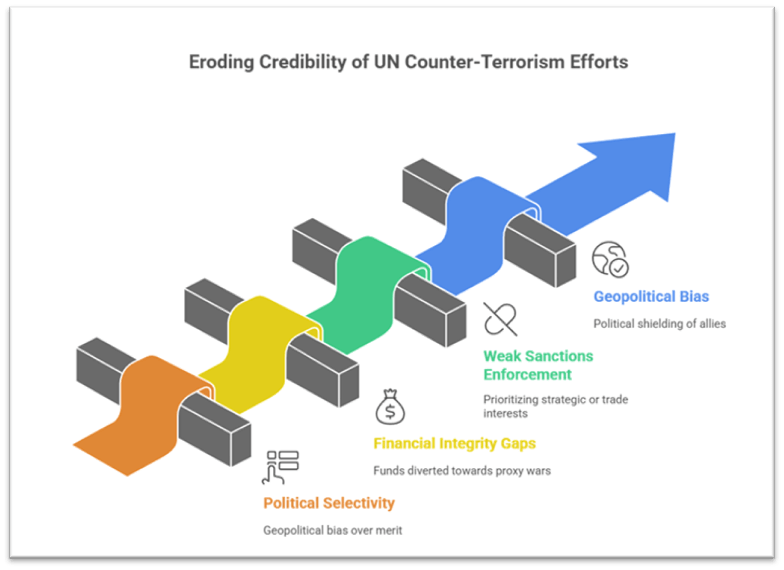
• II. Weaknesses and Integrity Concerns
- 1. Political Selectivity in Leadership Roles
- Instances of Pakistan heading the Taliban Sanctions Committee and Vice-Chairing the UN Counter-Terrorism Committee (2025) despite being linked to groups like LeT and JeM, weaken credibility.
- Past controversies, such as Libya chairing the UN Human Rights Commission and Saudi Arabia chairing UN Women’s Rights Commission, indicate geopolitical bias over merit.
- Example – Hafiz Saeed’s public presence in Pakistan despite UN designation reveals institutional loopholes.
- 2. Gaps in Financial Integrity and IMF Assistance
- The IMF’s approval of a $1 billion loan to Pakistan (2025) despite concerns of misuse for terror financing undermines conditionalities of financial discipline.
- Absence of strict monitoring allows states to divert funds towards proxy wars.
- Case Study – Yemen Conflict: Reports highlight misuse of external aid by groups for financing arms procurement.
- 3. Weak Enforcement of Sanctions
- UN sanctions often face inconsistent implementation, with many states prioritising strategic or trade interests.
- Example – Iran Sanctions: While sanctioned entities were targeted, parallel financial channels allowed fund flow into proxy groups.
- Inconsistent compliance leads to perception of “softness” on state-sponsored terrorism.
- 4. Geopolitical Bias and Great Power Politics
- Permanent members of the UNSC often veto sanctions or resolutions aligned against their allies.
- For instance, China’s repeated technical holds on UN designations of Pakistan-based terrorists (e.g., Masood Azhar until 2019) illustrates political shielding.
- Such manoeuvring delegitimises the collective security mandate of the UN.
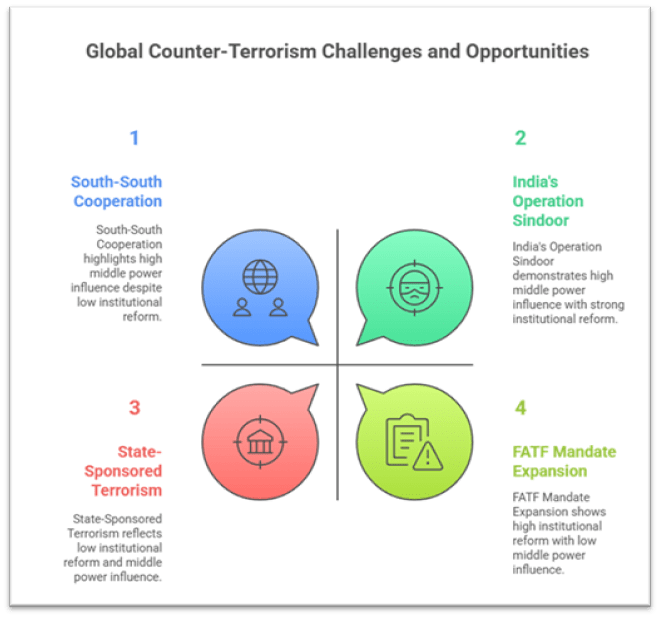
• III. Emerging Challenges and Opportunities
- 1. Evolution of Terror Financing Mechanisms
- Cryptocurrencies and hawala networks are increasingly used for covert funding. Europol’s 2024 report flagged rising use of Bitcoin by extremist groups in Europe.
- Case Study – ISIS: Reliance on oil smuggling and online crowdfunding campaigns showcased adaptability to sanctions.
- National laws are yet to uniformly regulate blockchain-based terror financing.
- 2. Rise of State-Sponsored Terrorism
- Proxy warfare, as seen in South Asia, highlights the limits of the global system in naming and penalising states.
- The Pulwama attack (2019) and subsequent international responses demonstrated both global solidarity and the inability to impose structural accountability on sponsoring states.
- The blurring line between “freedom fighters” and “terrorists” continues to divide member states.
- 3. Institutional Reforms Underway
- Proposals for UNSC reform and enhancing the autonomy of the UN Office of Counter-Terrorism seek to reduce political manipulation.
- Expansion of FATF’s mandate to scrutinise aid misuse is under discussion.
- Example – G20 Anti-Corruption and Anti-Terror Financing Tracks (2023, India Presidency) show the potential of plurilateral bodies to bypass UN deadlock.
- 4. Opportunities for Middle Powers and Regional Leaders
- Countries like India, Indonesia, and Nigeria are emerging as voices pushing accountability in counter-terrorism debates.
- India’s Operation Sindoor (2025) showcased capability to dismantle terror networks, creating space for India to demand higher global accountability.
- Strengthening South-South cooperation in intelligence sharing could reduce dependence on P5-dominated institutions.
Conclusion:
- The global counter-terrorism architecture represents a paradox: while it has evolved institutional mechanisms like FATF and UNSC sanctions that reduced overall terror incidents by nearly 10% in 2024, its credibility is compromised by geopolitical selectivity, weak enforcement, and tolerance of state complicity. The recent developments of Pakistan’s leadership in UN counter-terror bodies and IMF’s lenient financing highlight systemic gaps.
- A way forward lies in enhancing accountability mechanisms, enforcing performance reviews of committee chairs, integrating AI-enabled financial monitoring systems, and empowering regional groupings to bypass UN deadlock. Most importantly, reforms in global governance — particularly UNSC restructuring — are essential to depoliticise counter-terrorism.
- Ultimately, while progress has been made, the integrity of the global counter-terrorism framework remains fragile. Its effectiveness will depend on whether global institutions can move from geopolitical expediency to principled enforcement, ensuring that counter-terrorism is not compromised by diplomacy.
- The UN has established binding resolutions (e.g., Resolution 1267 Sanctions Regime) that target individuals and entities linked to Al-Qaeda, ISIL, and associated groups.
- The Counter-Terrorism Committee Executive Directorate (CTED) monitors state compliance, ensuring that national laws criminalise terror financing.
- Case Study – Taliban Sanctions Regime: Freezing assets and restricting travel of Taliban leaders has been a tool for exerting pressure and curbing their global legitimacy.
- FATF grey and black lists act as deterrents by restricting countries’ access to international capital markets. Over 23 nations, including Pakistan (2018–2022), were grey-listed leading to reported economic costs of billions in lost investment.
- The adoption of Anti-Money Laundering/Combating Financing of Terrorism (AML/CFT) standards across over 200 jurisdictions shows significant global alignment.
- Example – Sri Lanka: Post its grey-listing in 2017, Colombo amended its AML laws and established stronger financial intelligence units.
- Platforms such as the Shanghai Cooperation Organisation (SCO) have adopted joint anti-terror exercises (e.g., SCO Peace Mission 2021).
- European Union’s Europol operates the European Counter Terrorism Centre (ECTC), enabling intelligence-sharing across member states.
- India’s bilateral initiatives — such as “No Money for Terror” Conference (2022, Delhi) — have pushed global discussions on terror financing.
- Digital platforms like Interpol’s I-24/7 Global Police Network enhance cross-border intelligence.
- Laws criminalising cyber-radicalisation (e.g., UK Counter-Terrorism and Border Security Act 2019) strengthen state capacity.
- Use of AI-based systems to track suspicious transactions has been piloted by central banks in countries like Singapore.
- Instances of Pakistan heading the Taliban Sanctions Committee and Vice-Chairing the UN Counter-Terrorism Committee (2025) despite being linked to groups like LeT and JeM, weaken credibility.
- Past controversies, such as Libya chairing the UN Human Rights Commission and Saudi Arabia chairing UN Women’s Rights Commission, indicate geopolitical bias over merit.
- Example – Hafiz Saeed’s public presence in Pakistan despite UN designation reveals institutional loopholes.
- The IMF’s approval of a $1 billion loan to Pakistan (2025) despite concerns of misuse for terror financing undermines conditionalities of financial discipline.
- Absence of strict monitoring allows states to divert funds towards proxy wars.
- Case Study – Yemen Conflict: Reports highlight misuse of external aid by groups for financing arms procurement.
- UN sanctions often face inconsistent implementation, with many states prioritising strategic or trade interests.
- Example – Iran Sanctions: While sanctioned entities were targeted, parallel financial channels allowed fund flow into proxy groups.
- Inconsistent compliance leads to perception of “softness” on state-sponsored terrorism.
- Permanent members of the UNSC often veto sanctions or resolutions aligned against their allies.
- For instance, China’s repeated technical holds on UN designations of Pakistan-based terrorists (e.g., Masood Azhar until 2019) illustrates political shielding.
- Such manoeuvring delegitimises the collective security mandate of the UN.
- Cryptocurrencies and hawala networks are increasingly used for covert funding. Europol’s 2024 report flagged rising use of Bitcoin by extremist groups in Europe.
- Case Study – ISIS: Reliance on oil smuggling and online crowdfunding campaigns showcased adaptability to sanctions.
- National laws are yet to uniformly regulate blockchain-based terror financing.
- Proxy warfare, as seen in South Asia, highlights the limits of the global system in naming and penalising states.
- The Pulwama attack (2019) and subsequent international responses demonstrated both global solidarity and the inability to impose structural accountability on sponsoring states.
- The blurring line between “freedom fighters” and “terrorists” continues to divide member states.
- Proposals for UNSC reform and enhancing the autonomy of the UN Office of Counter-Terrorism seek to reduce political manipulation.
- Expansion of FATF’s mandate to scrutinise aid misuse is under discussion.
- Example – G20 Anti-Corruption and Anti-Terror Financing Tracks (2023, India Presidency) show the potential of plurilateral bodies to bypass UN deadlock.
- Countries like India, Indonesia, and Nigeria are emerging as voices pushing accountability in counter-terrorism debates.
- India’s Operation Sindoor (2025) showcased capability to dismantle terror networks, creating space for India to demand higher global accountability.
- Strengthening South-South cooperation in intelligence sharing could reduce dependence on P5-dominated institutions.
- The global counter-terrorism architecture represents a paradox: while it has evolved institutional mechanisms like FATF and UNSC sanctions that reduced overall terror incidents by nearly 10% in 2024, its credibility is compromised by geopolitical selectivity, weak enforcement, and tolerance of state complicity. The recent developments of Pakistan’s leadership in UN counter-terror bodies and IMF’s lenient financing highlight systemic gaps.
- A way forward lies in enhancing accountability mechanisms, enforcing performance reviews of committee chairs, integrating AI-enabled financial monitoring systems, and empowering regional groupings to bypass UN deadlock. Most importantly, reforms in global governance — particularly UNSC restructuring — are essential to depoliticise counter-terrorism.
- Ultimately, while progress has been made, the integrity of the global counter-terrorism framework remains fragile. Its effectiveness will depend on whether global institutions can move from geopolitical expediency to principled enforcement, ensuring that counter-terrorism is not compromised by diplomacy.
Recap: