India as the Voice of the Global South | Strategic Autonomy in Multilateral Forums
Introduction
India as the voice of the Global South has gained renewed salience, particularly after its G20 Presidency in 2023, when Prime Minister Modi convened the Global South Summit with participation from over 120 developing nations. Historically, India has projected itself as a champion of decolonization, equity, and sovereign decision-making — evident in its leadership of the Non-Aligned Movement (NAM), G77, and calls for South-South cooperation. The idea of strategic autonomy, defined as a nation’s ability to take sovereign foreign policy decisions free from external compulsion, has been central to this vision. However, in a world marked by U.S.-China rivalry, Russia’s assertiveness, and fragmented multilateralism, the pursuit of strategic autonomy both empowers and constrains India’s leadership role in representing the Global South.
India’s Role as Voice of the Global South
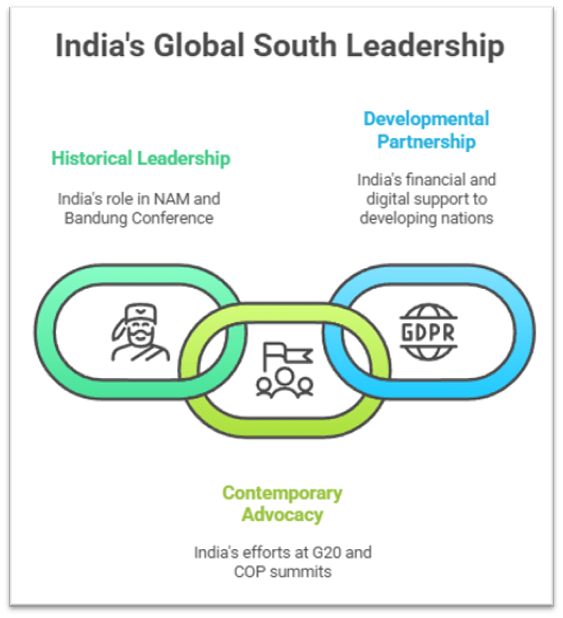
Historical Leadership in South-South Cooperation
- India spearheaded the Non-Aligned Movement (NAM) under Nehru, emphasizing autonomy from Cold War blocs.
- Actively engaged in Bandung Conference (1955), supporting Afro-Asian solidarity.
- Example: IBSA Dialogue Forum (India-Brazil-South Africa) illustrates India’s efforts in triangular cooperation among emerging economies.
Contemporary Global South Advocacy
- At the 2023 G20 Summit, India pushed for the African Union’s permanent membership, highlighting inclusivity.
- Advocated for climate justice and “common but differentiated responsibilities” at COP summits.
- Example: International Solar Alliance (ISA) led by India and France but largely benefiting developing countries.
Developmental Partnership Model
- India provides concessional lines of credit and grants through the Indian Development and Economic Assistance Scheme (IDEAS).
- Example: In Africa, over $12 billion in credit lines and $7.4 billion in projects have been committed.
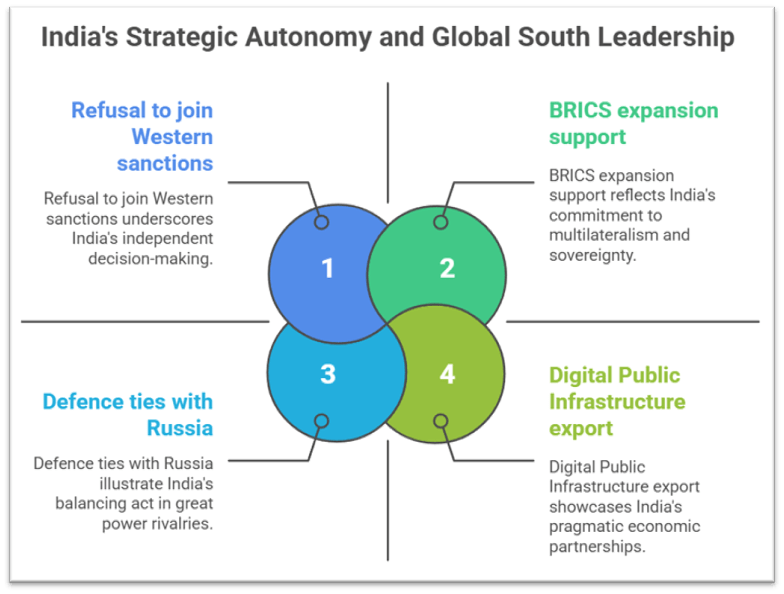
- Digital diplomacy through initiatives like Digital India stack exports (e.g., Unified Payments Interface support to Sri Lanka, Singapore, UAE).
Strategic Autonomy as an Enabler of Global South Leadership
Balancing Great Power Rivalries
- India maintains defence ties with Russia while expanding strategic cooperation with the U.S. and Quad partners.
- Example: India’s refusal to join Western sanctions against Russia despite criticism highlights credibility among Global South nations.
Pragmatic Multilateralism
- India is part of BRICS, SCO, and Quad simultaneously — showcasing flexibility.
- Example: BRICS expansion in 2024, supported by India, reflects responsiveness to Global South aspirations.
Economic & Technological Partnerships
- Strategic autonomy allows India to diversify partners in technology and energy, avoiding overdependence.
- Example: India’s engagement with U.S. (semiconductors) and Russia (nuclear energy cooperation at Kudankulam).
Challenges and Contradictions in India’s Dual Role
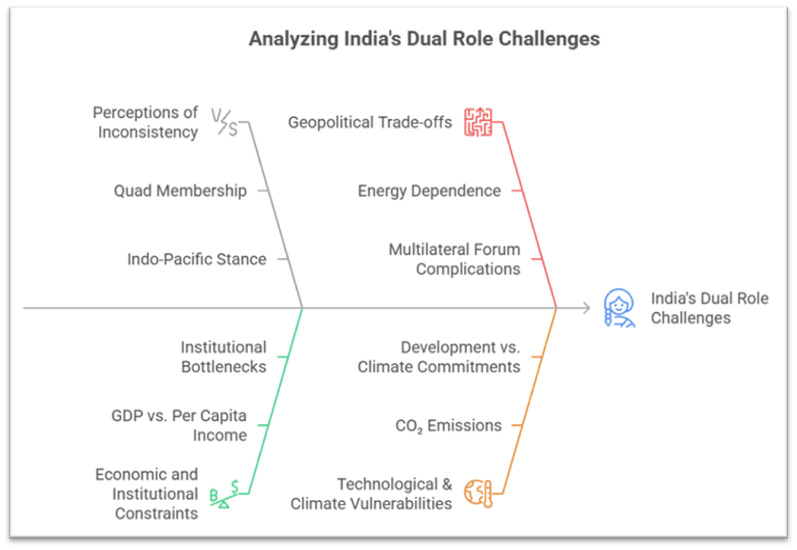
Perceptions of Inconsistency
India’s Quad membership is sometimes seen as alignment with U.S. containment strategy against China. For example, some ASEAN states view India’s Indo-Pacific stance as tilting Westward, weakening neutrality.
Economic and Institutional Constraints
India’s GDP ranks fifth globally but its per capita income remains under $2,700, limiting aid capacity compared to China. Vaccine Maitri faced criticism when domestic COVID-19 crises led to export halts.
Geopolitical Trade-offs
India’s energy dependence on Middle East and Russia constrains flexibility. Pressure from the U.S. on Russian oil imports complicates India’s multilateral positioning.
Technological & Climate Vulnerabilities
India champions renewable energy but remains the world’s third-largest CO₂ emitter, weakening its bargaining power in climate forums.
Conclusion:
India’s evolving role as the voice of the Global South is rooted in historical solidarity and amplified by its G20 Presidency and Global South Summits. Strategic autonomy enhances this leadership by granting India credibility as an independent, non-aligned power mediating between the West and developing nations. Yet, contradictions — economic limitations, rivalries, and domestic vulnerabilities — complicate this role. Going forward, India’s leadership will depend on building resilience, deepening South-South ties, and leveraging digital and green technologies to offer viable alternatives. With 70% of future global growth projected to come from emerging economies, India’s ability to anchor the Global South while retaining autonomy will shape a multipolar and equitable world order.
Recap: