
Centralization in Maritime Sector: Critically Analysing India’s Maritime State Development Council (MSDC)
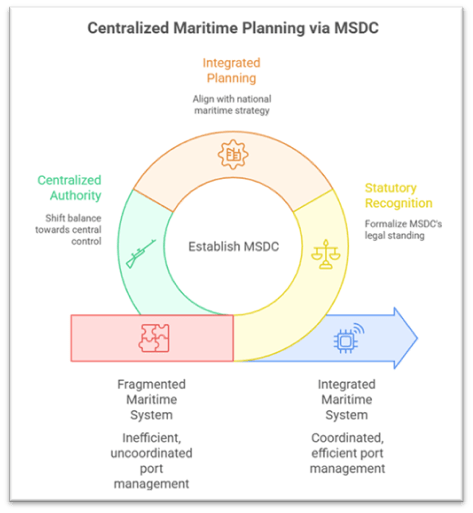
Centralization in maritime sector has become a defining theme of India’s recent legislative reforms. The Indian Ports Act, 2025, by giving statutory power to the Maritime State Development Council (MSDC), marks a significant shift in the federal balance between the Union and coastal States. This blog critically examines how the government’s approach reflects centralisation, its constitutional implications, and the potential challenges for State autonomy.
Introduction
- The recent Indian Ports Act, 2025 (formerly the Ports Bill, 2025), passed in the Rajya Sabha on August 18, 2025 and earlier in the Lok Sabha on August 12, 2025, marks a major overhaul of the colonial-era Indian Ports Act of 1908.
- Replacing a law that had governed India’s ports for over a century, the new Act aims to modernise port governance through integrated planning, environmental safeguards, digital transparency, and mechanisms for ease of doing business.
- Importantly, the Act establishes two key bodies— the Maritime State Development Council (MSDC) and State Maritime Boards—intended to foster coordination between the Union and coastal States.
- In fiscal terms, as of 2023–24, India had 12 major ports handling 53% of maritime cargo traffic, alongside 217 non-major ports, of which 66 handled cargo (47% of traffic) and the rest were largely fishing ports. These figures underscore the importance of non-major ports—managed traditionally by States—in the national maritime landscape.
Nature and Context of Centralisation Through the MSDC
1.1 Legal Foundation & Structure
The MSDC, chaired by the Union Minister of Ports, includes State ministers, Navy, Coast Guard, and senior officials. It advises on tariffs, strategy, and integrated planning, aligning with Sagarmala and PPP models.
1.2 Centralising Tendencies
Though advisory in form, the Council’s statutory status and Union dominance may override State discretion, drawing criticism from States like Tamil Nadu and Kerala.
1.3 Federal Balance & Constitutional Implications
Ports fall under the Concurrent List. By giving MSDC directive authority, the Centre risks diluting State powers.
1.4 International Models
Unlike Canada and the US, which balance federal oversight with regional autonomy, India’s model tilts towards central primacy.
Implications of MSDC for Coastal State Autonomy
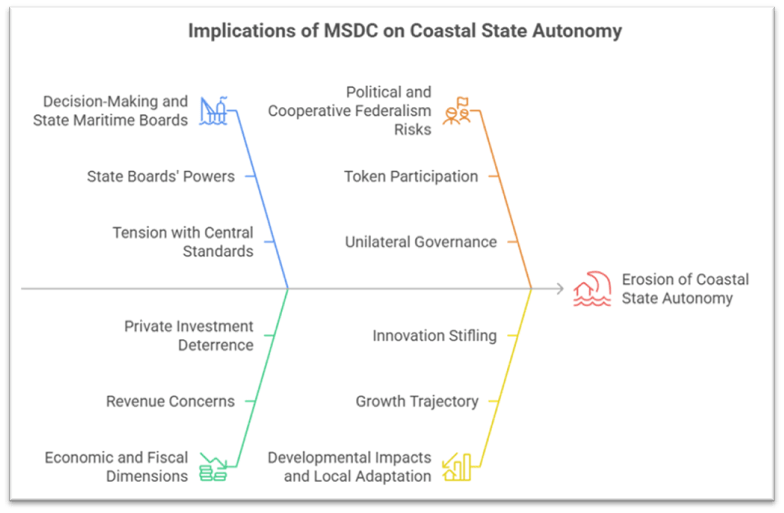
2.1 Decision-Making & State Maritime Boards
State Maritime Boards regulate non-major ports, but now within the framework set by MSDC standards, limiting flexibility.
2.2 Economic & Fiscal Dimensions
States fear reduced control over revenues, slower decisions, and lower private investments due to rigid central mandates.
2.3 Political & Cooperative Federalism Risks
Limited State representation risks tokenism, undermining genuine cooperative federalism.
2.4 Developmental Impacts
Non-major ports doubled their cargo share from 24% to 46% over two decades. Central dominance may stifle such local innovations.
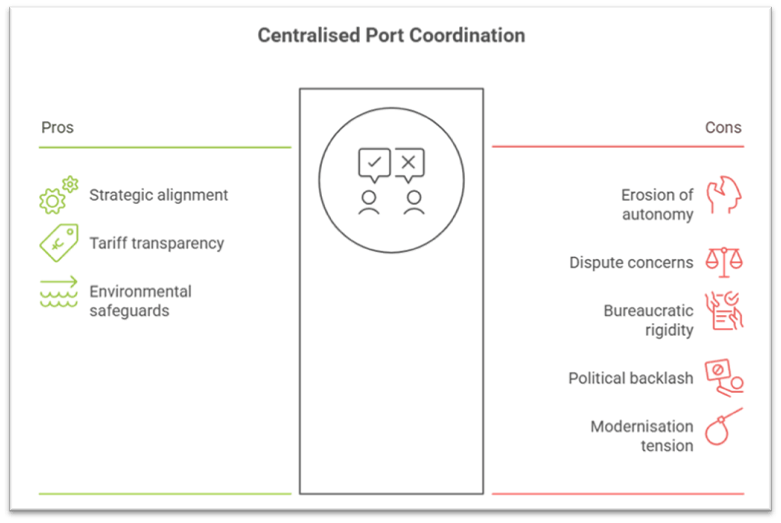
Pros & Cons — Balanced Evaluation
3.1 Pros
- Strategic alignment with Sagarmala and PM Gati Shakti.
- Standardised tariffs and digital transparency.
- Uniform environmental safeguards.
3.2 Cons
- Erosion of State autonomy.
- Reduced recourse to local dispute resolution.
- Bureaucratic rigidity ignoring regional realities.
- State-level political pushback.
3.3 Governance Dynamics
The Act reflects both efficiency goals and central control, straining cooperative federalism.
3.4 Evidence & Examples
State-driven port growth contrasts with MSDC’s new statutory dominance, changing federal dynamics significantly.
Conclusion
While the Indian Ports Act, 2025 strengthens transparency, compliance, and national coordination, its centralising thrust through MSDC raises serious concerns for State autonomy. Balancing modernization with cooperative federalism will be critical. A stakeholder review and mid-term assessment could help recalibrate the model, ensuring national priorities are met without undermining coastal States’ autonomy.
Recap: