
Japan as India’s Anchor Partner in the Indo-Pacific | UPSC Mains 2025 Insights
Introduction
- The Indo-Pacific has become the central theatre of geopolitics in the 21st century, accounting for nearly 65% of global GDP and 60% of global maritime trade (World Bank, 2024). In this evolving landscape, India seeks strategic partners to ensure stability, economic growth, and a rules-based order.
- Japan has steadily emerged as a key anchor partner for India, not only because of its economic commitments such as the recent ¥10 trillion ($68 billion) investment plan in India over the next decade, but also due to its alignment with India on strategic issues like supply-chain diversification, maritime security, and technological cooperation.
- With U.S. unpredictability under Trump 2.0 and persistent mistrust with China, Tokyo’s consistency makes it a reliable pillar of India’s Indo-Pacific strategy.
Economic Dimension of India-Japan Partnership
Massive Investment Commitments
- Japan’s ¥10 trillion investment plan (2025–2035) targets Indian infrastructure, manufacturing, clean energy, and digital economy, complementing schemes like PM Gati Shakti and Make in India.
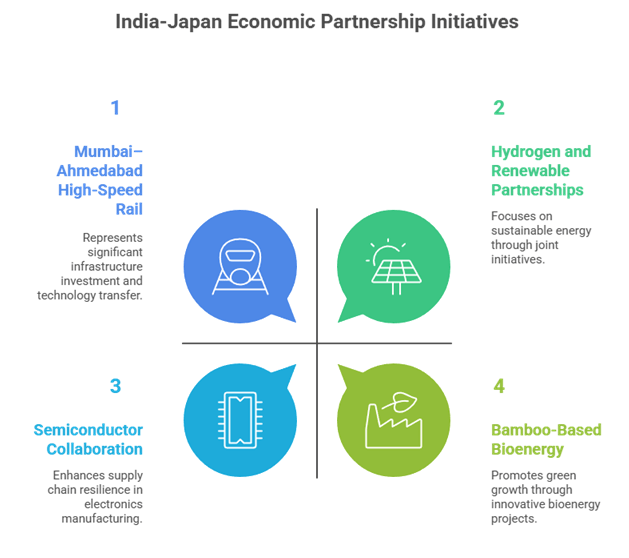
- Example: Mumbai–Ahmedabad High-Speed Rail (Shinkansen project) reflects technology transfer and long-term stake in Indian development.
- Case study: Japan International Cooperation Agency (JICA) remains the largest bilateral donor to India, surpassing $50 billion in soft loans since 2000.
Supply Chain Resilience
- Japan supports India under the Supply Chain Resilience Initiative (SCRI) with Australia, to reduce dependence on China.
- Example: India-Japan collaboration in semiconductors and critical minerals aligns with India’s PLI scheme for electronics manufacturing.
- Case study: Japanese firms like Suzuki, Toshiba, and Hitachi investing in India’s EV and battery ecosystem.
Clean Energy and Green Growth
- Japan’s focus on hydrogen and renewable partnerships complements India’s National Green Hydrogen Mission and International Solar Alliance (ISA).
- Example: Japan’s assistance in India’s smart grid and offshore wind projects underlines shared climate commitments.
- Case study: Joint India-Japan initiative in Northeast India for bamboo-based bioenergy.
Strategic and Security Dimension
Maritime Security and Naval Cooperation
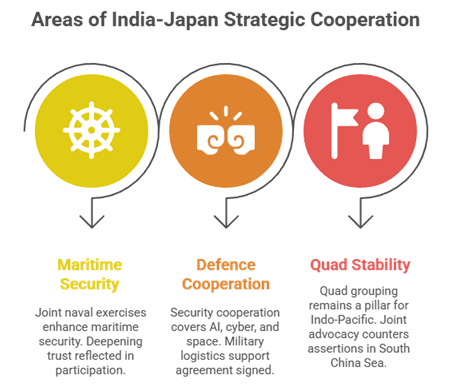
- India and Japan conduct the Malabar Exercise with the U.S. and Australia, reinforcing maritime security in the Indo-Pacific.
- Example: Japan’s permanent participation in Malabar since 2015 reflects deepening trust.
- Case study: Joint surveillance in the South China Sea and Indian Ocean Region (IOR) enhances deterrence against coercive behaviour.
Defence and Technology Cooperation
- Revision of the 2008 Joint Declaration on Security Cooperation now covers AI, cyber, and space defence.
- Example: India and Japan signed an Acquisition and Cross-Servicing Agreement (2020) for military logistics support.
- Case study: Japan’s transfer of US-2 amphibious aircraft technology (negotiations ongoing) illustrates trust-based security cooperation.
Quad and Indo-Pacific Stability
- Despite U.S. unpredictability, the Quad grouping (India, Japan, Australia, U.S.) remains a pillar for a free and open Indo-Pacific.
- Example: Japan’s leadership in Quad Vaccine Initiative showcased its diplomatic agility.
- Case study: India-Japan joint advocacy for UNCLOS-based maritime order counters unilateral assertions in the South China Sea.
Geopolitical and Diplomatic Dimension
Balancing China Relations
- India and Japan share concerns about China’s Belt and Road Initiative (BRI) and assertiveness.
- Example: Collaboration in Asia-Africa Growth Corridor (AAGC) as an alternative development model.
- Case study: Joint infrastructure projects in Sri Lanka, Bangladesh, and Africa as counter-narratives to BRI.
Navigating U.S. Uncertainty
- With Trump 2.0 reducing U.S. commitment to alliances, India sees Japan as a steady anchor.
- Example: Unlike Washington’s episodic Indo-Pacific focus, Tokyo ensures continuity in engagement.
- Case study: India-Japan “2+2 Ministerial Dialogue” institutionalises defence and foreign cooperation irrespective of U.S. flux.
Shared Democratic Values and Regional Leadership
- Both nations champion a rules-based order, democracy, and freedom of navigation.
- Example: Japan’s “Free and Open Indo-Pacific” (FOIP) vision overlaps with India’s Act East Policy and SAGAR doctrine.
- Case study: Japan’s role in Delhi-Mumbai Industrial Corridor (DMIC) and Northeast connectivity reflects alignment of economic vision with strategic goals.
Conclusion
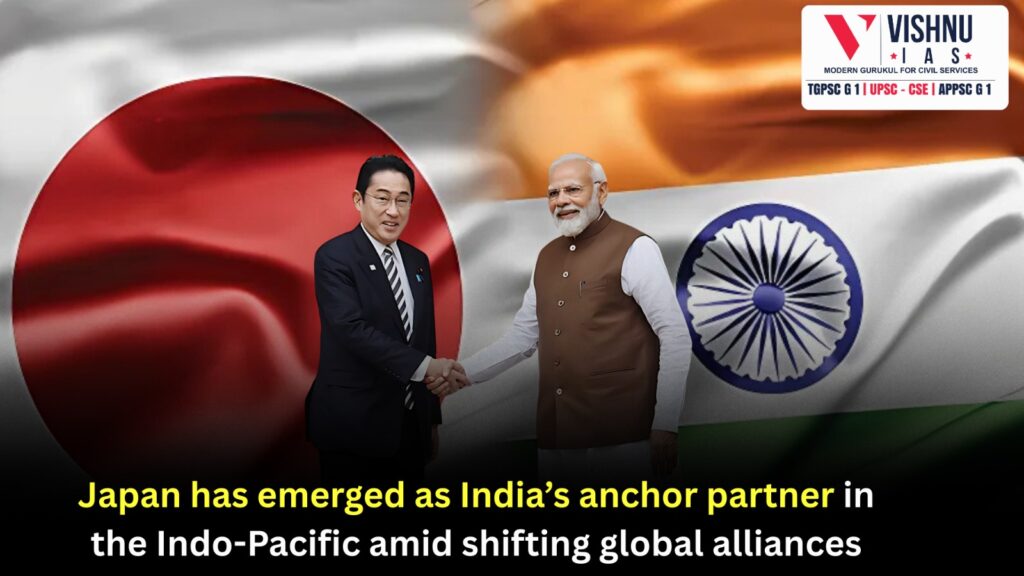
In sum, Japan has indeed emerged as India’s anchor partner in the Indo-Pacific amid shifting global alliances. The partnership rests not merely on investments or defence cooperation, but on a shared strategic outlook, democratic values, and consistent engagement. With U.S. unpredictability (Trump’s transactional approach) and China’s mistrust-laden engagement, Tokyo provides India with continuity, trust, and resources.
Looking ahead, India and Japan must:
- Expand cooperation in semiconductors, AI, and clean energy, building on Japan’s technological strength.
- Strengthen maritime domain awareness and trilateral/quadrilateral partnerships.
- Deepen joint development projects in South Asia and Africa to offer credible alternatives to BRI.
As per World Economic Forum (2024), by 2030, the Indo-Pacific will account for two-thirds of global growth, making partnerships decisive. In this context, Japan is not just a partner but a strategic ballast ensuring India’s flexibility with clarity in a volatile world order.
Recap: