

Transparency in Electoral Processes: The Cornerstone of Electoral Legitimacy
Transparency in electoral processes refers to the open, accountable, and verifiable conduct of activities related to elections, including voter registration, roll revisions, and polling, ensuring public trust and participation. It is fundamental to upholding the legitimacy of democratic outcomes, as it fosters confidence that every eligible citizen’s voice is heard without undue interference. The Election Commission of India’s (ECI) Special Intensive Revision (SIR) of electoral rolls in Bihar, announced on June 24, 2025, involving the verification of nearly 8 crore voters,
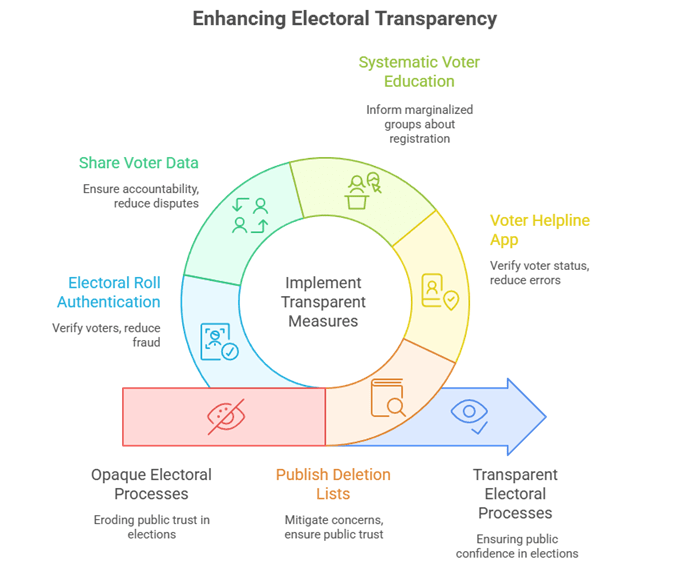
Government Initiative: The ECI’s Voter Helpline App, launched in 2019 and updated in 2024, allows citizens to verify their voter status, promoting transparency and reducing errors in voter lists.
Preventing Disenfranchisement of Marginalized Groups
Opaque voter roll revisions risk disproportionately affecting marginalized communities, such as Scheduled Castes and Scheduled Tribes who may lack documentation.
Case Study: The 2018 Assam National Register of Citizens (NRC) process, which excluded 19 lakh people, faced criticism for opacity, leading to fears of statelessness among marginalized communities, highlighting the need for transparent voter verification.
Government Initiative: The Systematic Voters’ Education and Electoral Participation (SVEEP) program, launched by the ECI in 2009, conducts outreach to ensure marginalized groups are informed about voter registration processes, though its effectiveness in SIR contexts remains limited.
Facilitating Political Party Oversight
Transparent sharing of voter deletion lists with political parties ensures accountability. The ECI’s claim of sharing booth-level deletion lists in Bihar, without specifying reasons, limits parties’ ability to verify the process, undermining democratic checks.
Example: In the 2020 Delhi elections, the ECI’s proactive sharing of detailed voter list updates with political parties reduced disputes, ensuring a smoother electoral process.
Government Initiative: The ECI’s Electoral Roll Management System (ERMS), upgraded in 2023, aims to streamline voter list updates and share data with parties, but its implementation in the SIR has been criticized for lacking granularity.
Safeguarding Electoral Integrity
Transparency in voter roll revisions prevents fraudulent deletions or additions, ensuring only eligible voters participate. The ECI’s failure to disclose the methodology behind the SIR’s 22 lakh deceased, 36 lakh shifted, and 7 lakh duplicate voter deletions raises questions about the process’s integrity.
Government Initiative: The Electoral Roll Authentication System (ERAS), introduced in 2022, uses Aadhaar linkage to verify voters, but its optional nature and privacy concerns limit its transparency benefits.
Challenges to Transparency in Electoral Roll Revisions
Lack of Public Disclosure
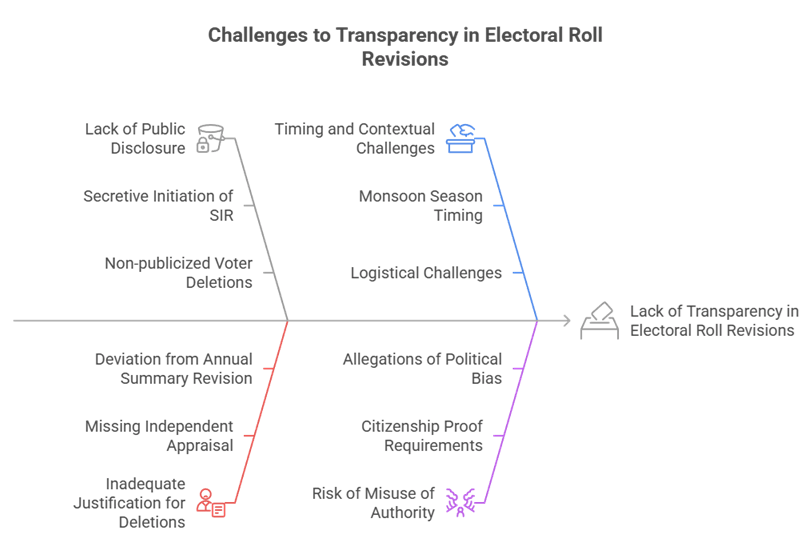
The ECI’s secretive initiation of the Notation Sound Effects Link Anything Need Help SIR in Bihar, without prior consultation, violates the principle of public access to information, a cornerstone of the Right to Information Act, 2005. This opacity fuels suspicions of arbitrariness.
Example: The 2016 Tamil Nadu elections faced criticism when voter deletions were not publicized, leading to protests and legal challenges, underscoring the need for open communication.
Inadequate Justification for Large-Scale Deletions
The ECI’s failure to provide detailed reasons for 65 lakh voter deletions in Bihar, coupled with the missing “independent appraisal” in its Supreme Court affidavit, undermines the rationale for such a massive exercise.
Timing and Contextual Challenges
Conducting the SIR during Bihar’s monsoon season, when flooding affects accessibility, questions the ECI’s planning and transparency in addressing logistical challenges, potentially excluding rural voters.
Risk of Misuse of Authority
The ECI’s wide powers under the Citizenship Act, 1955, to refer suspected foreign nationals, combined with the SIR’s citizenship proof requirements, raise fears of misuse without transparent oversight, potentially affecting electoral fairness.
Implications and Way Forward for Electoral Transparency
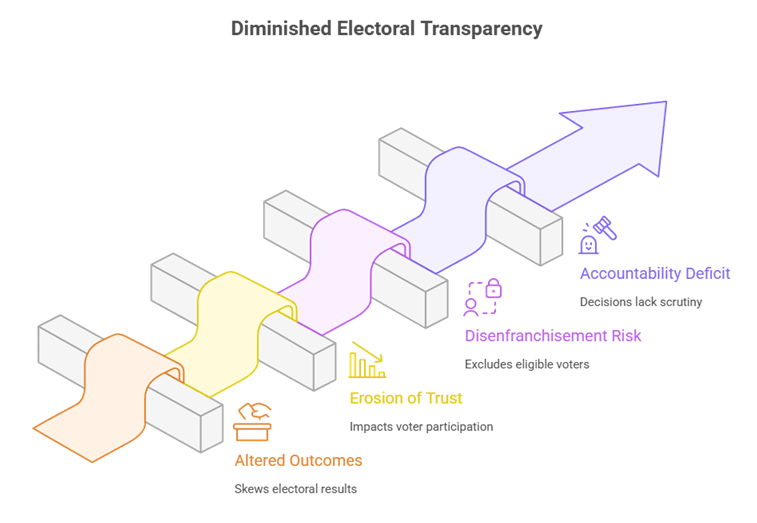
Large-scale voter deletions, like Bihar’s 65 lakh, can alter electoral outcomes, especially in constituencies with slim margins. Transparency ensures these changes are justified and verifiable.
Lack of transparency risks eroding public faith in democratic institutions. A 2024 ADR survey found that 72% of respondents distrust electoral processes lacking clear communication, impacting voter participation.
Strengthening initiatives like SVEEP and ERMS, ensuring timely public consultations, and adopting global best practices, such as Australia’s audit transparency, can restore trust.
Conclusion:
The statement “Transparency is the cornerstone of electoral legitimacy” holds true, as it underpins public trust, prevents disenfranchisement, and ensures fair electoral outcomes. Moving forward, the ECI must publish detailed deletion lists, disclose methodologies, and engage stakeholders proactively. By prioritizing transparency, the ECI can uphold electoral integrity, ensuring every citizen’s right to vote is protected in India’s vibrant democracy.
Recap: