
How Digital Technologies Are Transforming India’s Welfare State: Aadhaar, DBT & CPGRAMS
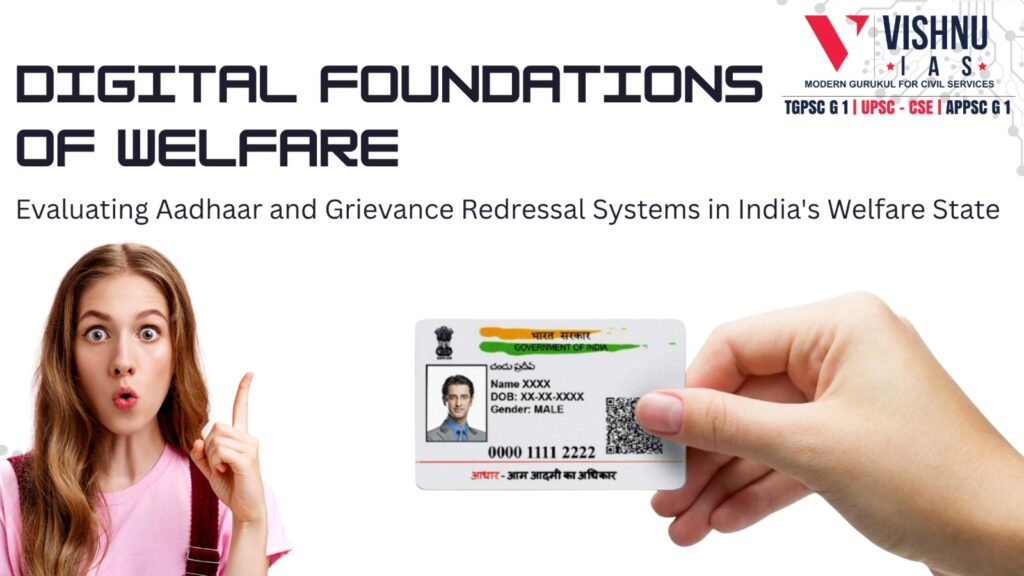
Digital Technologies in India's Welfare State have fundamentally reshaped governance structures over the past decade. Innovations such as Aadhaar, Direct Benefit Transfer (DBT), and centralized grievance redressal systems are improving transparency and efficiency while raising critical questions about accountability and inclusion.
Introduction:
- India’s welfare state has undergone a fundamental transformation over the last decade, driven by the integration of digital technologies such as Aadhaar, Direct Benefit Transfer (DBT), and centralized grievance redressal systems. These innovations, aligned with the “minimum government, maximum governance” model, have aimed to ensure efficiency, transparency, and accountability in public service delivery.
- According to the Economic Survey 2023-24, over 1.36 billion Aadhaar cards have been issued, and more than ₹34 lakh crore has been transferred under the DBT mechanism since its inception in 2013. The CPGRAMS (Centralized Public Grievance Redress and Monitoring System) has also disposed of over 21 lakh grievances in 2022-23 alone.
- However, while these digital initiatives promise efficiency, their increasing technocratic orientation raises concerns about political accountability, democratic deliberation, and the depersonalization of citizens into mere data points.
Body:
Welfare State: From Rights-Based to Technocratic Model
- From Citizen to Beneficiary
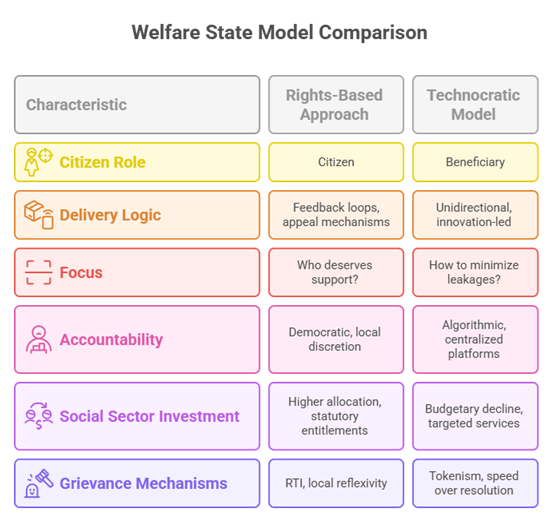
- Depoliticized Delivery: Welfare entitlements are now automated, measurable, and audit-compliant, moving away from citizen-centric rights-based approaches.
- Unidirectional Logic: Schemes like E-SHRAM and Aadhaar-linked LPG subsidy (PAHAL) showcase innovation-led delivery but often lack feedback loops or appeal mechanisms.
Case Study: The exclusion of over 2.7 million elderly pensioners in Jharkhand (2017–2019) due to Aadhaar-seeding errors underscores this issue.
- Technocratic Calculus: Emphasis has shifted from “who deserves support?” to “how to minimize leakages?”, leading to algorithmic governance.
- Efficiency vs Democratic Accountability
- Algorithmic Insulation: CPGRAMS flattens federal hierarchies into a ticket-based system, focusing on closure metrics rather than resolution depth.
- Democratic Deficit: Frontline bureaucrats and Gram Sabhas are bypassed in favour of centralized platforms, weakening local discretion.
Example: The One Nation One Ration Card (ONORC) system has faced implementation challenges due to regional portability and verification issues.
- Exclusion Risks: Lack of alternative mechanisms for those without digital access results in real-world exclusion.
Case: The Supreme Court’s Aadhaar verdict (2018) dissent by Justice D.Y. Chandrachud warned against “machinic decontextualization” of identity, risking fundamental rights.
- Receding Social Sector Investment
- Budgetary Decline: Social sector allocation fell to 17% of total expenditure in 2024–25, down from 21% average during 2014–2024.
- Impact on Rights-Based Regimes: Statutory entitlements like Right to Education (RTE) and National Food Security Act (NFSA) face funding stagnation.
- Post-Rights Paradigm: Welfare now operates more like targeted service delivery than universal rights-based provisioning.
- RTI & Grievance Mechanisms in Crisis
- RTI Pendency Crisis: As of June 2024, over 4 lakh RTI appeals are pending across 29 Information Commissions, with 8 CIC posts vacant.
Consequence: Weakens transparency and the citizen’s right to question welfare delivery.
- Tokenism in Redressal: CPGRAMS prioritizes speed of grievance disposal over resolution quality, centralizing visibility but not responsibility.
- Loss of Local Reflexivity: Gram Sabhas, SHGs, and Panchayats are not meaningfully integrated into grievance resolution.
Technological Gains in Welfare Administration
- Leakage Reduction and Inclusion
- Aadhaar-Enabled DBT: Helped plug leakages in schemes like PDS, MNREGA, LPG subsidies, saving an estimated ₹2.23 lakh crore since 2013.
- Elimination of Ghost Beneficiaries: Aadhaar-based deduplication removed 4 crore fake ration cards, enhancing credibility.
- Real-time Monitoring: Jan Dhan-Aadhaar-Mobile (JAM) Trinity enables real-time tracking of disbursements and usage patterns.
- Service Access and Interoperability
- ONORC Scheme: Ensures ration portability across 36 states/UTs, benefiting over 90 crore beneficiaries, especially migrant workers.
- Digital Health IDs: Under Ayushman Bharat Digital Mission, over 50 crore Health IDs have been generated to streamline access.
- E-Shram Portal: With over 29 crore informal workers registered, it enables targeted delivery of insurance, training, and skilling initiatives.
- Centralized Grievance Redressal
- CPGRAMS 7.0: Introduced predictive analytics, natural language processing (NLP), and real-time tracking of grievances.
- State Portals: Over 36 State/UT grievance portals now integrated into national dashboard, increasing visibility.
- Feedback Mechanisms: Integration of MyGov, UMANG, and DigiLocker platforms enables multi-channel engagement, though digital divide remains.
- Social Registries and Targeting
- SECC 2011 & Aadhaar Convergence: Created dynamic social registries, aiding in geotagging, poverty mapping, and predictive analytics.
- AI-led Beneficiary Identification: States like Odisha and Telangana use AI tools to triage beneficiaries for schemes like KALIA and Rythu Bandhu.
- Fraud Detection Systems: Aadhaar and data analytics detect duplicity and identity fraud in pension and subsidy schemes.
Challenges, Risks and Democratic Shortfalls
- Digital Divide & Exclusion
- Access Gap: Only 43% of rural women and 67% of SC/ST households have regular digital access (NFHS-5, 2023).
- Language & Literacy Barriers: Digital grievance platforms lack vernacular and voice-enabled features.
- No Offline Fall-backs: Digitally excluded beneficiaries lack alternatives.
Suggestion: Implement Right to Explanation & Appeal — as per UN Digital Governance Framework (2021).
- Surveillance & Privacy Concerns
- Data Over-collection: Multiple welfare portals collect biometric, financial, and geospatial data without a clear consent framework.
Case: Aadhaar leak reports in Andhra Pradesh and Punjab (2022–23) raised concerns on data governance.
- Lack of Data Protection Law Enforcement: The Digital Personal Data Protection Act (2023) is yet to be operationalized fully.
- Function Creep: Welfare databases used for policing or profiling, as highlighted in migrant surveillance during COVID-19 lockdown.
- Centralization vs Federal Autonomy
- Platformisation of Welfare: States lose autonomy as central dashboards dominate.
Observation: CPGRAMS and PMGDISHA centralize decisions even for state-level schemes.
- Homogenization of Welfare Logic: Ignores state-specific socio-political contexts.
Example: Aadhaar authentication failures in tribal-majority Chhattisgarh due to low biometric match rates.
- Need for Cooperative Federalism: Digital welfare must empower state innovation labs.
Best Practice: Kerala’s Kudumbashree integrates SHGs as digital intermediaries for last-mile delivery.
- Institutional Capacity & Reflexivity
- Weak Human Interfaces: Frontline staff are untrained in digital systems, causing data-entry errors and service delays.
Case: Assam NRC exclusion due to data mismatch highlights the risks.
- Lack of Impact Audits: No real-time audit of user experience or exclusion metrics.
Suggestion: Implement community-driven audits, linked to GPDPs and social audits.
- Rights Awareness Gap: Citizens lack legal literacy on digital rights and grievance redressal.
Way Forward: Promote legal aid clinics and civic tech education as endorsed by NITI Aayog (2024).
Conclusion:
- India's digital welfare transformation is a double-edged sword. While it enhances efficiency, transparency, and scalability, it also risks excluding the most vulnerable, flattening democratic spaces, and eroding local accountability.
- As Taleb’s theory on hyper-integrated systems warns, centralized systems work perfectly — until they fail catastrophically. Hence, India must reimagine digital welfare where citizens are not data points, but partners in governance.
Recap:
Welfare State: From Rights-Based to Technocratic Model
- From Citizen to Beneficiary
- Depoliticized Delivery: Welfare entitlements are now automated, measurable, and audit-compliant, moving away from citizen-centric rights-based approaches.
- Unidirectional Logic: Schemes like E-SHRAM and Aadhaar-linked LPG subsidy (PAHAL) showcase innovation-led delivery but often lack feedback loops or appeal mechanisms.
Case Study: The exclusion of over 2.7 million elderly pensioners in Jharkhand (2017–2019) due to Aadhaar-seeding errors underscores this issue. - Technocratic Calculus: Emphasis has shifted from “who deserves support?” to “how to minimize leakages?”, leading to algorithmic governance.
- Efficiency vs Democratic Accountability
- Algorithmic Insulation: CPGRAMS flattens federal hierarchies into a ticket-based system, focusing on closure metrics rather than resolution depth.
- Democratic Deficit: Frontline bureaucrats and Gram Sabhas are bypassed in favour of centralized platforms, weakening local discretion.
Example: The One Nation One Ration Card (ONORC) system has faced implementation challenges due to regional portability and verification issues. - Exclusion Risks: Lack of alternative mechanisms for those without digital access results in real-world exclusion.
Case: The Supreme Court’s Aadhaar verdict (2018) dissent by Justice D.Y. Chandrachud warned against “machinic decontextualization” of identity, risking fundamental rights.
- Receding Social Sector Investment
- Budgetary Decline: Social sector allocation fell to 17% of total expenditure in 2024–25, down from 21% average during 2014–2024.
- Impact on Rights-Based Regimes: Statutory entitlements like Right to Education (RTE) and National Food Security Act (NFSA) face funding stagnation.
- Post-Rights Paradigm: Welfare now operates more like targeted service delivery than universal rights-based provisioning.
- RTI & Grievance Mechanisms in Crisis
- RTI Pendency Crisis: As of June 2024, over 4 lakh RTI appeals are pending across 29 Information Commissions, with 8 CIC posts vacant.
Consequence: Weakens transparency and the citizen’s right to question welfare delivery. - Tokenism in Redressal: CPGRAMS prioritizes speed of grievance disposal over resolution quality, centralizing visibility but not responsibility.
- Loss of Local Reflexivity: Gram Sabhas, SHGs, and Panchayats are not meaningfully integrated into grievance resolution.
- RTI Pendency Crisis: As of June 2024, over 4 lakh RTI appeals are pending across 29 Information Commissions, with 8 CIC posts vacant.
Technological Gains in Welfare Administration
- Leakage Reduction and Inclusion
- Aadhaar-Enabled DBT: Helped plug leakages in schemes like PDS, MNREGA, LPG subsidies, saving an estimated ₹2.23 lakh crore since 2013.
- Elimination of Ghost Beneficiaries: Aadhaar-based deduplication removed 4 crore fake ration cards, enhancing credibility.
- Real-time Monitoring: Jan Dhan-Aadhaar-Mobile (JAM) Trinity enables real-time tracking of disbursements and usage patterns.
- Service Access and Interoperability
- ONORC Scheme: Ensures ration portability across 36 states/UTs, benefiting over 90 crore beneficiaries, especially migrant workers.
- Digital Health IDs: Under Ayushman Bharat Digital Mission, over 50 crore Health IDs have been generated to streamline access.
- E-Shram Portal: With over 29 crore informal workers registered, it enables targeted delivery of insurance, training, and skilling initiatives.
- Centralized Grievance Redressal
- CPGRAMS 7.0: Introduced predictive analytics, natural language processing (NLP), and real-time tracking of grievances.
- State Portals: Over 36 State/UT grievance portals now integrated into national dashboard, increasing visibility.
- Feedback Mechanisms: Integration of MyGov, UMANG, and DigiLocker platforms enables multi-channel engagement, though digital divide remains.
- Social Registries and Targeting
- SECC 2011 & Aadhaar Convergence: Created dynamic social registries, aiding in geotagging, poverty mapping, and predictive analytics.
- AI-led Beneficiary Identification: States like Odisha and Telangana use AI tools to triage beneficiaries for schemes like KALIA and Rythu Bandhu.
- Fraud Detection Systems: Aadhaar and data analytics detect duplicity and identity fraud in pension and subsidy schemes.
Challenges, Risks and Democratic Shortfalls
- Digital Divide & Exclusion
- Access Gap: Only 43% of rural women and 67% of SC/ST households have regular digital access (NFHS-5, 2023).
- Language & Literacy Barriers: Digital grievance platforms lack vernacular and voice-enabled features.
- No Offline Fall-backs: Digitally excluded beneficiaries lack alternatives.
Suggestion: Implement Right to Explanation & Appeal — as per UN Digital Governance Framework (2021).
- Surveillance & Privacy Concerns
- Data Over-collection: Multiple welfare portals collect biometric, financial, and geospatial data without a clear consent framework.
Case: Aadhaar leak reports in Andhra Pradesh and Punjab (2022–23) raised concerns on data governance. - Lack of Data Protection Law Enforcement: The Digital Personal Data Protection Act (2023) is yet to be operationalized fully.
- Function Creep: Welfare databases used for policing or profiling, as highlighted in migrant surveillance during COVID-19 lockdown.
- Data Over-collection: Multiple welfare portals collect biometric, financial, and geospatial data without a clear consent framework.
- Centralization vs Federal Autonomy
- Platformisation of Welfare: States lose autonomy as central dashboards dominate.
Observation: CPGRAMS and PMGDISHA centralize decisions even for state-level schemes. - Homogenization of Welfare Logic: Ignores state-specific socio-political contexts.
Example: Aadhaar authentication failures in tribal-majority Chhattisgarh due to low biometric match rates. - Need for Cooperative Federalism: Digital welfare must empower state innovation labs.
Best Practice: Kerala’s Kudumbashree integrates SHGs as digital intermediaries for last-mile delivery.
- Platformisation of Welfare: States lose autonomy as central dashboards dominate.
- Institutional Capacity & Reflexivity
- Weak Human Interfaces: Frontline staff are untrained in digital systems, causing data-entry errors and service delays.
Case: Assam NRC exclusion due to data mismatch highlights the risks. - Lack of Impact Audits: No real-time audit of user experience or exclusion metrics.
Suggestion: Implement community-driven audits, linked to GPDPs and social audits. - Rights Awareness Gap: Citizens lack legal literacy on digital rights and grievance redressal.
Way Forward: Promote legal aid clinics and civic tech education as endorsed by NITI Aayog (2024).
- Weak Human Interfaces: Frontline staff are untrained in digital systems, causing data-entry errors and service delays.
Conclusion:
- India's digital welfare transformation is a double-edged sword. While it enhances efficiency, transparency, and scalability, it also risks excluding the most vulnerable, flattening democratic spaces, and eroding local accountability.
- As Taleb’s theory on hyper-integrated systems warns, centralized systems work perfectly — until they fail catastrophically. Hence, India must reimagine digital welfare where citizens are not data points, but partners in governance.
Recap: