
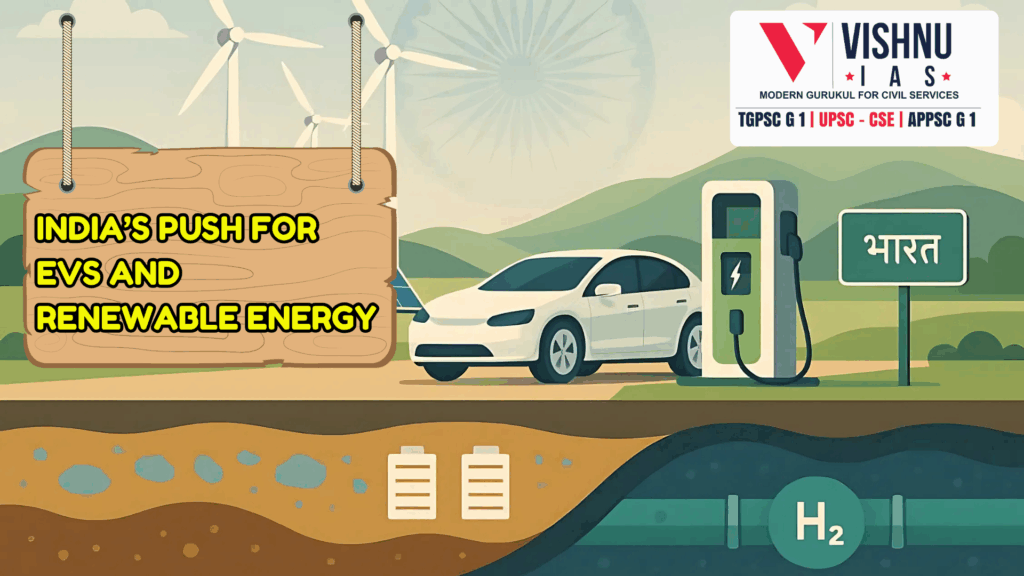
Battery Recycling in India: The Missing Link in EV and Renewable Energy Boom
India’s push for EVs and renewable energy, though commendable, risks exacerbating the battery waste crisis without strong recycling norms.
Introduction:
- India’s climate commitments, including the Net Zero target by 2070 and Nationally Determined Contributions (NDCs) under the Paris Agreement, have catalysed the rapid growth of Electric Vehicles (EVs) and renewable energy systems.
- According to NITI Aayog, India’s EV penetration is projected to reach 30% for private cars, 70% for commercial vehicles, and 80% for two- and three-wheelers by 2030. Additionally, India's renewable energy capacity exceeded 179 GW in 2024, constituting over 43% of the total installed power capacity (MNRE, 2024).
- However, the surging demand for lithium-ion batteries—used both in EVs and Battery Energy Storage Systems (BESS)—has given rise to an emerging battery waste crisis. As per a report by NITI Aayog and RMI India (2023), battery demand is expected to grow from 4 GWh in 2023 to 139 GWh by 2035. But in the absence of a robust recycling ecosystem, India risks severe environmental, economic, and public health challenges.
India’s Green Transition: Driving Battery Dependency
1. Electrification and EV Push
- Government policies such as FAME II, Production-Linked Incentive (PLI) for ACC batteries, and State EV Policies have created strong momentum for EV adoption.
- EV sales in India crossed 1.5 million units in FY 2023-24 (Vahan portal), showing a 45% year-on-year growth.
- Example: Delhi EV Policy 2020 has led to over 17% of all new vehicle sales being electric, the highest in the country.
2. Energy Storage for Renewables
- The growth in solar and wind energy necessitates grid stability and backup, driving adoption of Battery Energy Storage Systems (BESS).
- India aims to install 47.2 GW of BESS by 2032 (CEA Report, 2023).
- Example: SECI's 1000 MWh BESS tender awarded to firms like JSW Neo and Tata Power in 2024 reflects this acceleration.
3. Import Dependency on Critical Minerals
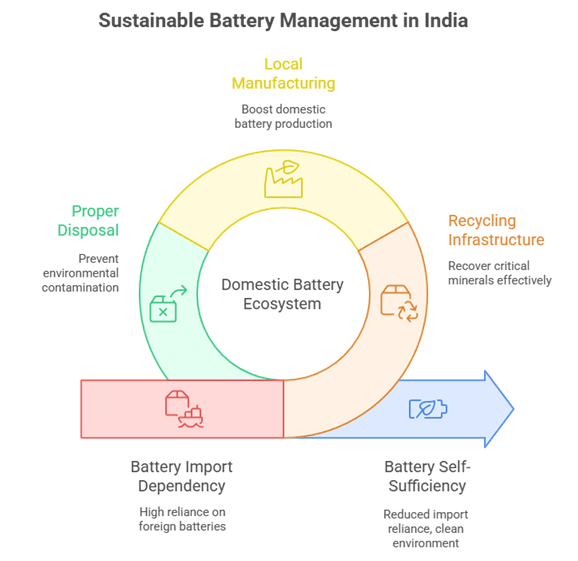
- India imports >90% of its lithium-ion battery cells from China and South Korea (IEA, 2023).
- The lack of domestic mineral refining makes recycling critical to reduce foreign exchange outflows.
- Case Study: Australia’s recycling ecosystem recovers 95% of lithium and cobalt from used batteries, reducing virgin mining dependency.
4. Informal Battery Disposal Practices
- Of the 1.6 million tonnes of e-waste generated in 2022, 700,000 tonnes were lithium battery waste (CPCB data).
- Improper disposal leads to soil and groundwater contamination, fires in landfills, and toxic air pollution.
- Example: Fire at the Ghazipur landfill (Delhi, 2022) was traced to discarded lithium batteries.
Challenges In Battery Recycling Ecosystem
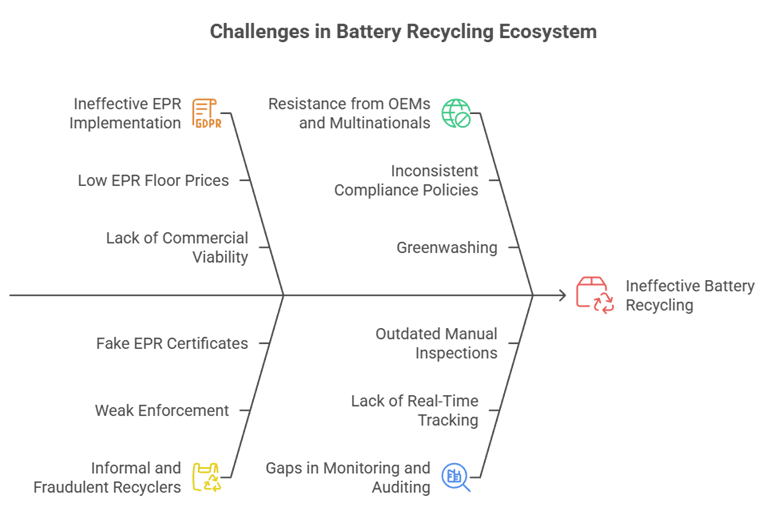
1. Ineffective Implementation of EPR Mechanism
- Battery Waste Management Rules (2022) mandate Extended Producer Responsibility (EPR).
- However, EPR floor prices set are too low to make recycling commercially viable, discouraging formal recyclers.
- Example: In contrast, the UK mandates £600/kg, while India’s proposed price is less than one-fourth, even after PPP adjustment.
2. Proliferation of Informal and Fraudulent Recyclers
- Due to weak enforcement, unregistered recyclers issue fake EPR certificates and dump hazardous waste, distorting the recycling market.
- Parallel: Plastic waste fraud where over 40% of EPR obligations were falsely reported (CSE, 2021).
- Consequence: Legitimate recyclers lose viability, and hazardous toxins leak into ecosystems.
3. Resistance from OEMs and Multinationals
- Global manufacturers often comply with norms in developed countries but not in India.
- This leads to greenwashing and pollution outsourcing.
- Example: In 2023, multiple consumer electronic giants were fined by MoEFCC for non-compliance with EPR mandates.
4. Gaps in Monitoring and Auditing
- Lack of real-time tracking, missing audit trails, and manual inspections weaken enforcement.
- Example: Germany’s EAR Foundation uses a digital registry of every battery for full traceability.
Policy Interventions and The Way Ahead
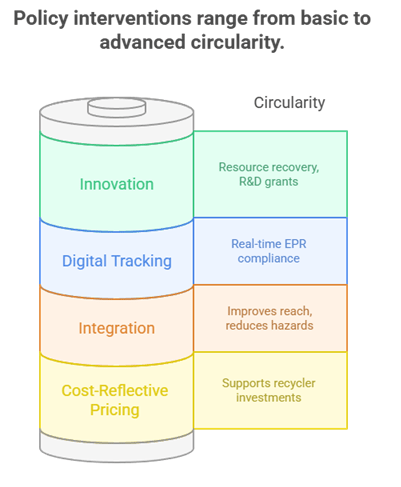
1. Rationalising and Raising the EPR Floor Price
- Support recyclers with cost-reflective pricing including collection, dismantling, and disposal costs.
- Adopt a dynamic pricing model based on metal recovery, inflation, and market maturity.
2. Integration and Formalisation of Informal Sector
- Over 90% of e-waste is handled by informal workers (ASSOCHAM-EY, 2023).
- Provide licensing, training, and capacity building.
- Example: Swachh Bharat Mission’s waste picker integration model.
3. Strengthening Institutional and Technological Mechanisms
- Use blockchain or RFID for tracking EPR compliance.
- Introduce battery passports for traceability and recovery tracking.
- Leverage “Recycle India” under Gati Shakti for recycling zones.
4. Promoting Circular Economy through Innovation
- Support urban mining and resource recovery startups.
- Example: Attero Recycling recovers 98% lithium and cobalt via patented tech.
- Launch a National Battery Recycling Mission with fiscal incentives and targets.
Conclusion:
- India's electrification and renewable energy goals are vital, but battery waste is a ticking time bomb.
- A strong EPR framework, better pricing, and inclusive policy can transform battery recycling into an engine of green growth.
- According to World Bank, battery recycling can save $3B+ and generate 150,000+ jobs by 2030.
- India's electrification and renewable energy goals are vital, but battery waste is a ticking time bomb.
- A strong EPR framework, better pricing, and inclusive policy can transform battery recycling into an engine of green growth.
- According to World Bank, battery recycling can save $3B+ and generate 150,000+ jobs by 2030.
By embracing battery recycling in India, the country can lead the world in sustainable innovation while avoiding an environmental crisis.
Recap: