
M.S. Swaminathan’s Vision for Mangrove Conservation and Climate Resilience
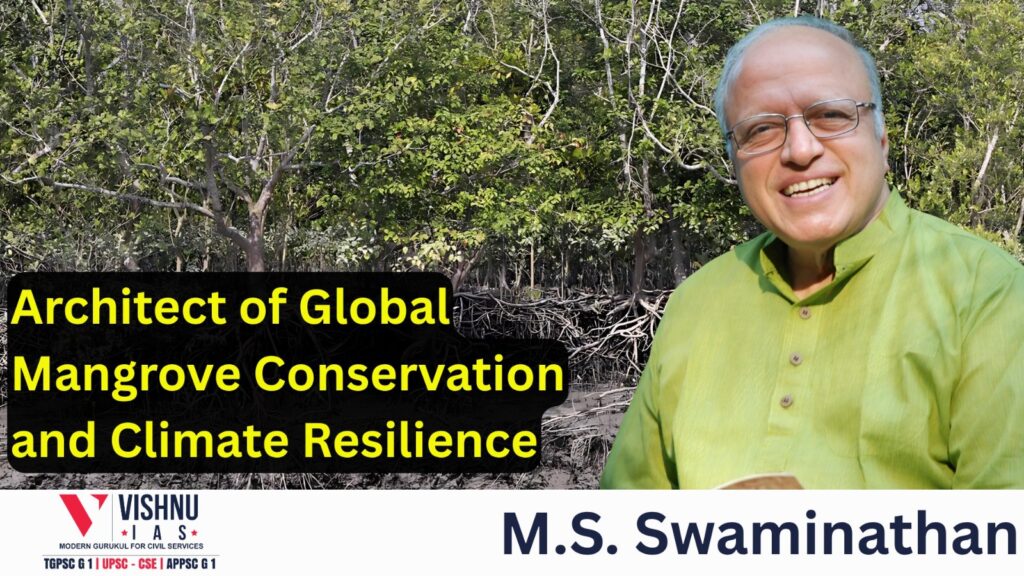
M.S. Swaminathan played a pivotal role in placing mangrove conservation at the heart of global climate resilience strategies. Until the late 1980s, mangroves were valued mostly by coastal communities for local uses. But Swaminathan's visionary leadership reshaped their identity into powerful ecological buffers for biodiversity, disaster risk reduction, and shoreline stability.
Visionary Advocacy and Conceptual Shift
- At the 1989 Tokyo conference on "Climate Change and Human Responses," Swaminathan warned about rising sea levels, cyclonic activity, and their threats to agriculture and livelihoods.
- He emphasized the critical role of healthy mangroves in buffering storm surges, replenishing groundwater, and capturing carbon emissions.
- He advocated gene transfer from mangroves to crops like rice to enhance salinity tolerance, linking ecosystem conservation with food security.
Building Institutional and Policy Frameworks
- In 1990, Swaminathan became the Founding President of the International Society for Mangrove Ecosystems (ISME) in Okinawa.
- He helped draft the "Charter for Mangroves," incorporated into the 1992 UNCED World Charter for Nature.
- Under his leadership, ISME published the first World Mangrove Atlas and spearheaded expert workshops and restoration manuals for global use.
Establishing Global Conservation Infrastructure
- Swaminathan initiated GLOMIS (Global Mangrove Database and Information System), a searchable tool with data on species, projects, and researchers.
- In 1992, surveys across South and Southeast Asia helped establish Mangrove Genetic Resource Centres, now protected zones governed by national bodies.
- This network supports ex-situ conservation and climate adaptation research.
Pioneering Scientific and Participatory Restoration in India
- India’s mangrove degradation, particularly in the Sundarbans, was driven more by altered water flows than local communities.
- In 1993, Swaminathan partnered with the Tamil Nadu Forest Department to study hydrological shifts and devised the “fishbone canal” technique.
- This method revived natural tidal patterns, aiding sediment deposition and mangrove regeneration in Tamil Nadu, Odisha, Andhra Pradesh, and West Bengal.
- It evolved into a Joint Mangrove Management model, formally supported by India’s Forest Ministry in 2000, unlocking wider funding and scalability.
Demonstrating Impact and Legacy
- After the 1999 Odisha super cyclone and the 2004 tsunami, restored mangroves proved their protective value, reducing fatalities and damage in affected regions.
- According to India’s State of Forest Report 2023, mangrove cover has grown by 16.68 km² since 2019—now totaling 4,991.68 km²—much due to Swaminathan's foundational work.
Conclusion:
M.S. Swaminathan transformed perceptions of mangroves from marshy wastelands to essential tools for climate resilience, ecosystem protection, and sustainable development. His integrated approach—combining policy, science, community engagement, and institution-building—ensured that mangrove conservation became a core part of global environmental governance. His legacy thrives in healthier coastlines, empowered communities, and a greener, more resilient planet.