
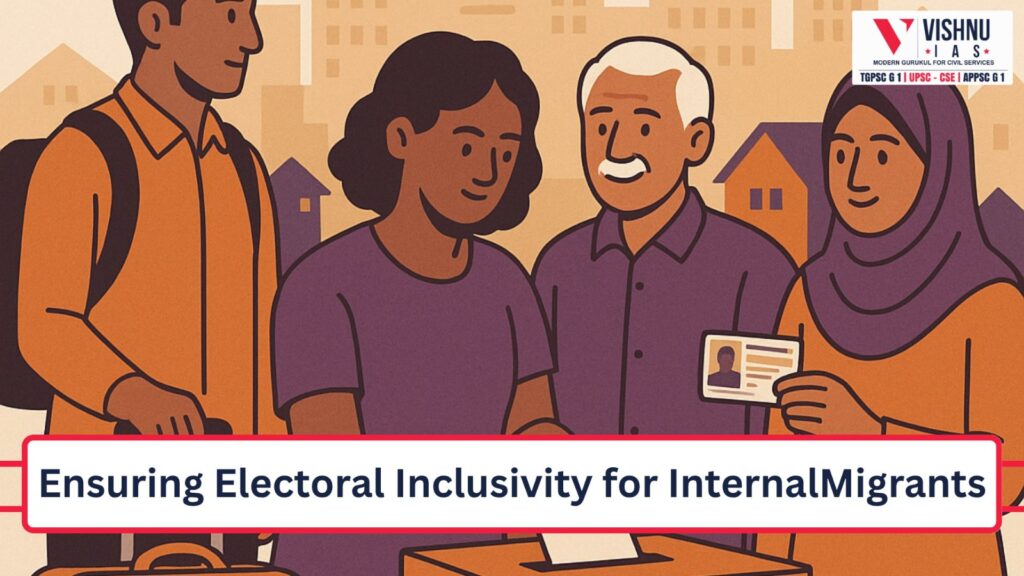
Ensuring Electoral Inclusivity for Internal Migrants in India
Electoral inclusivity for internal migrants in India is increasingly under threat as outdated legal frameworks and rigid administrative practices fail to accommodate the realities of internal migration. The electoral system, established under the Representation of the People Act of 1950, assumes a largely stationary electorate—a notion that conflicts with the modern, mobile Indian population.
Historical and Legal Fault Lines
- India's electoral laws were designed under the assumption that voters live and vote in their birthplace.
- The Representation of the People Act prioritizes residency over citizenship, thus excluding mobile populations from effective political participation.
- Internal migrants—often circular in nature—fall into legal uncertainty, unfit for voter registration in either rural or urban locales.
Administrative Gaps and the Role of the ECI
- The Election Commission uses snapshot residency checks, which fail to consider internal migration patterns.
- In Bihar’s Special Intensive Revision, 1.2 million names were deleted due to non-residency, notably affecting districts like Gopalganj and Sitamarhi.
- With under 25% awareness among migrants during revision periods, procedural protections become ineffective.
Socio-Economic Realities of Internal Migration in India
- Migration is driven by economic necessity, not choice, and often seasonal or circular in nature.
- Despite maintaining strong ties with home communities, migrants fail to meet legal criteria for voter registration.
- This systemic exclusion deepens social inequality, affecting those who drive urban economies the most.
International Comparisons
- United States: Enables absentee and mail-in voting for mobile populations, maintaining active registration across states.
- Philippines: Overseas workers vote via absentee ballots with turnout rates exceeding 60%.
- Australia: Uses mobile polling stations for remote and transient populations, achieving participation rates over 90%.
Criticism of the Current Framework
- Neutrality is mistaken for fairness, ignoring how procedures disadvantage mobile citizens.
- Voter roll purges continue without addressing structural problems related to mobility.
- Political actors benefit from migrant disenfranchisement instead of pushing for reforms.
Legal Challenges
- Residency as Sole Criterion: Excludes migrants working or studying outside their constituency.
- Outdated Legal Assumptions: The framework is based on a rural, immobile population.
- No Absentee Provisions: Internal migrants cannot vote outside their home areas.
- Constitutional Ambiguity: Citizenship is legally defined but blurred with residency in practice.
Administrative Challenges
- Rigid Verification: Snapshot audits result in unjust deletions without flexible alternatives.
- Lack of Awareness: Less than 25% of migrants know about the revision process.
- Limited Resources: ECI lacks the infrastructure to track mobile populations effectively.
- Procedural Focus: The system favors checklist compliance over voter inclusion.
Measures to Enhance Electoral Inclusivity for Internal Migrants
- Legislative Reforms: Enable dual-roll registration and introduce absentee voting provisions.
- Flexible Administration: Deploy mobile verification teams and use digital e-KYC tools.
- Targeted Outreach: Work with employers, NGOs, and institutions to raise awareness via SMS, radio, and multilingual campaigns.
- Innovative Voting Pilots: Test postal ballots and e-voting in high-migration states; use pop-up polling stations at workplaces and campuses.
Conclusion:
India's outdated electoral laws and rigid procedures are out of sync with the reality of internal migration. Achieving electoral inclusivity for internal migrants requires a multi-pronged strategy—legal reform, flexible administrative processes, and targeted outreach. By aligning its democratic systems with contemporary socio-economic mobility, India can ensure that every citizen, regardless of location, has a voice in the electoral process.