

Introduction:
- Gender inequality refers to the unequal treatment or perceptions of individuals based on their gender, manifesting in disparities across health, education, economic opportunity, and political representation.
- Despite India’s status as the world’s fifth-largest economy, a digital powerhouse, and home to the world’s largest youth population, it continues to underperform significantly on global gender equality metrics. The World Economic Forum's Global Gender Gap Report (2025) ranks India 131 out of 148 countries, with especially low scores in Economic Participation (143rd) and Health & Survival sub-indexes.
- Persistent gender disparities are not merely social concerns but are structural bottlenecks to India’s economic and demographic trajectory. The McKinsey Global Institute (2015) projected that closing gender gaps could add $770 billion to India’s GDP by 2025 — a lost opportunity that speaks volumes.
Body
:
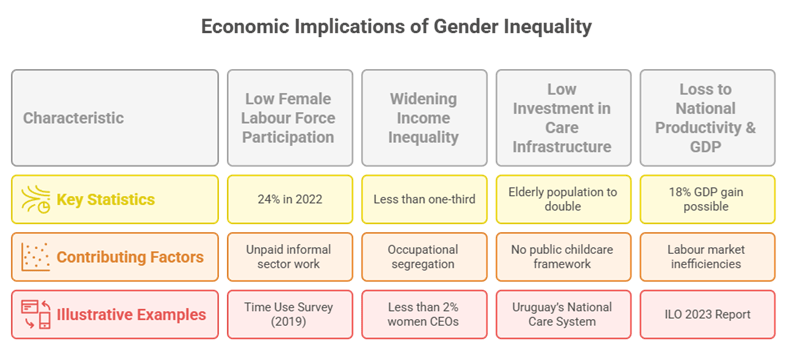
Economic Implications of Gender Inequality
- Low Female Labour Force Participation (FLFP)
- Stark Gender Gaps: FLFP stood at 24% in 2022 (PLFS), compared to 57% in Bangladesh and over 60% in China.
- Undervalued Informal Sector Work: Most women engage in unpaid or underpaid subsistence activities, largely invisible in GDP calculations.
- Case Study: Time Use Survey (2019) shows Indian women perform 7 times more unpaid domestic work than men, leading to economic invisibility of caregiving roles.
- Widening Income Inequality & Gender Wage Gaps
- Pay Disparity: Women earn less than one-third of male income (WEF 2025).
- Occupational Segregation: Women often concentrated in low-paying, care, or domestic work, absent from leadership and technology sectors.
- Example: India has less than 2% women CEOs in NSE-listed firms despite high female graduation rates in STEM fields.
- Low Investment in Care Infrastructure
- No Public Childcare Framework: Hinders women's re-entry into workforce post-maternity.
- Neglected Elder Care Services: India’s elderly population set to double by 2050, with many dependent widows.
- International Best Practice: Uruguay’s National Care System integrated care into economic planning with positive workforce outcomes.
- Loss to National Productivity & GDP
- Gender GDP Gap: McKinsey estimated 18% GDP gain if women participated equally in the economy.
- Labour Market Inefficiencies: Educated but unemployed female youth points to mismatch in policy and skill development.
- Case Study: ILO 2023 Report found that gender parity could add $6 trillion to global GDP, with India being a key contributor.
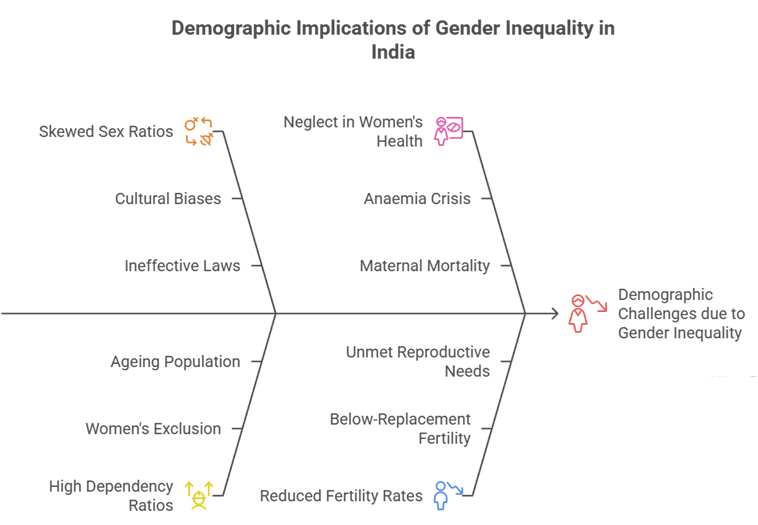
Demographic Implications of Gender Inequality
- Skewed Sex Ratios & Son Preference
- Sex Ratio at Birth: India’s ratio of 929 girls per 1,000 boys (NFHS-5) is far below natural norms (~952).
- Cultural Biases: Persist despite laws like PCPNDT Act, 1994 banning sex determination.
- Example: Haryana’s Beti Bachao Beti Padhao campaign saw temporary improvements but has since stagnated.
- High Dependency Ratios Due to Women's Exclusion
- Demographic Dividend Risks: Without women in the workforce, India’s young population becomes an underutilized asset.
- Ageing Population Pressure: Elderly population (esp. widowed women) projected to rise to 19.5% by 2050 (UNFPA).
- Example: Japan’s ageing crisis has been managed better due to high female participation in formal work, unlike India.
- Neglect in Women's Health & Nutrition
- Anaemia Crisis: 57% of women anaemic, reducing cognitive function, productivity, and safe childbirth.
- Maternal Mortality: India’s MMR is 103/100,000 live births (2023) — down from 130 (2016), but progress uneven.
- Case Study: Aspirational Districts Program has shown improvement in MMR and anaemia only where targeted health investments were made.
- Reduced Fertility Rates and Shrinking Workforce
- Below-Replacement Fertility: India’s TFR now at 1.95 (NFHS-5), below replacement level.
- Unmet Needs in Reproductive Health: Rural and poor women have lower access to contraception and family planning.
- Implication: A shrinking younger population coupled with rising elderly care needs will burden public finance.
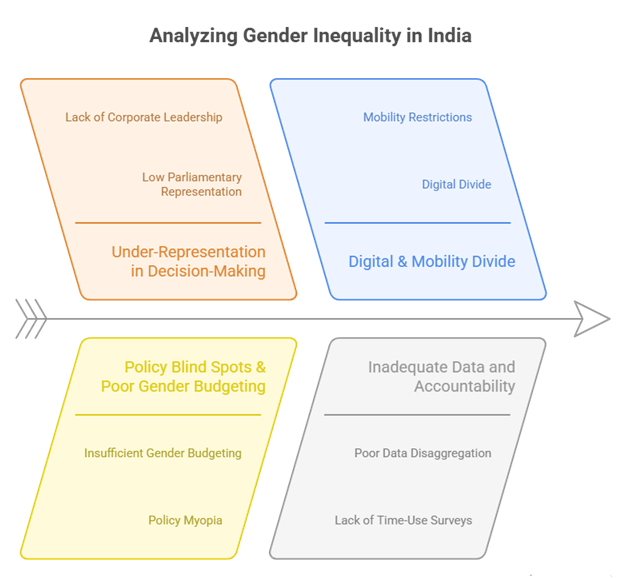
Structural & Policy-Level Challenges
- Under-Representation in Decision-Making
- Parliamentary Representation: Women hold just 15% seats in Lok Sabha.
- Corporate Leadership: Only 1.7% of BSE 500 companies have women CEOs.
- Case Study: Rwanda leads with 61% female MPs, enabling gender-responsive governance.
- Policy Blind Spots & Poor Gender Budgeting
- Gender Budgeting Share: Remains below 5% of total expenditure.
- Policy Myopia: Care work, digital access, and mobility rarely addressed in economic policies.
- Example: National Employment Policy draft lacks strong gender lens despite consultations.
- Digital & Mobility Divide
- Digital Divide: Only 33% of women in rural India own a smartphone.
- Mobility Restrictions: Unsafe public transport reduces job access and enrolment in skilling programs.
- Example: Mahila Samakhya program (pre-2017) helped increase mobility and access to info — now defunct.
- Inadequate Data and Accountability
- Poor Data Disaggregation: Most public data doesn’t distinguish intersectional gaps (rural, caste, disability).
- Time-Use Surveys: Conducted only once in 2019, not institutionalized.
- Example: South Korea uses annual time-use and care work accounting for budget design.
- Schemes/Initiatives:
- National Data & Analytics Platform (NITI Aayog) – Could be expanded for gender-disaggregated tracking.
- Digital Public Infrastructure (like Aadhaar & UPI) – Opportunity for inclusive social protection delivery if leveraged well.
Conclusion:
- India stands at a critical juncture where persistent gender inequality is no longer a social justice concern alone, but a macro-economic and demographic threat. The failure to invest in women’s health, education, and participation undermines both current economic output and long-term stability.
- If India is to realize its demographic dividend and achieve its $5 trillion economy target, it must reposition women as central agents of growth, not peripheral beneficiaries.
Recap
- Stark Gender Gaps: FLFP stood at 24% in 2022 (PLFS), compared to 57% in Bangladesh and over 60% in China.
- Undervalued Informal Sector Work: Most women engage in unpaid or underpaid subsistence activities, largely invisible in GDP calculations.
- Case Study: Time Use Survey (2019) shows Indian women perform 7 times more unpaid domestic work than men, leading to economic invisibility of caregiving roles.
- Pay Disparity: Women earn less than one-third of male income (WEF 2025).
- Occupational Segregation: Women often concentrated in low-paying, care, or domestic work, absent from leadership and technology sectors.
- Example: India has less than 2% women CEOs in NSE-listed firms despite high female graduation rates in STEM fields.
- No Public Childcare Framework: Hinders women's re-entry into workforce post-maternity.
- Neglected Elder Care Services: India’s elderly population set to double by 2050, with many dependent widows.
- International Best Practice: Uruguay’s National Care System integrated care into economic planning with positive workforce outcomes.
- Gender GDP Gap: McKinsey estimated 18% GDP gain if women participated equally in the economy.
- Labour Market Inefficiencies: Educated but unemployed female youth points to mismatch in policy and skill development.
- Case Study: ILO 2023 Report found that gender parity could add $6 trillion to global GDP, with India being a key contributor.
- Sex Ratio at Birth: India’s ratio of 929 girls per 1,000 boys (NFHS-5) is far below natural norms (~952).
- Cultural Biases: Persist despite laws like PCPNDT Act, 1994 banning sex determination.
- Example: Haryana’s Beti Bachao Beti Padhao campaign saw temporary improvements but has since stagnated.
- Demographic Dividend Risks: Without women in the workforce, India’s young population becomes an underutilized asset.
- Ageing Population Pressure: Elderly population (esp. widowed women) projected to rise to 19.5% by 2050 (UNFPA).
- Example: Japan’s ageing crisis has been managed better due to high female participation in formal work, unlike India.
- Anaemia Crisis: 57% of women anaemic, reducing cognitive function, productivity, and safe childbirth.
- Maternal Mortality: India’s MMR is 103/100,000 live births (2023) — down from 130 (2016), but progress uneven.
- Case Study: Aspirational Districts Program has shown improvement in MMR and anaemia only where targeted health investments were made.
- Below-Replacement Fertility: India’s TFR now at 1.95 (NFHS-5), below replacement level.
- Unmet Needs in Reproductive Health: Rural and poor women have lower access to contraception and family planning.
- Implication: A shrinking younger population coupled with rising elderly care needs will burden public finance.
- Parliamentary Representation: Women hold just 15% seats in Lok Sabha.
- Corporate Leadership: Only 1.7% of BSE 500 companies have women CEOs.
- Case Study: Rwanda leads with 61% female MPs, enabling gender-responsive governance.
- Gender Budgeting Share: Remains below 5% of total expenditure.
- Policy Myopia: Care work, digital access, and mobility rarely addressed in economic policies.
- Example: National Employment Policy draft lacks strong gender lens despite consultations.
- Digital Divide: Only 33% of women in rural India own a smartphone.
- Mobility Restrictions: Unsafe public transport reduces job access and enrolment in skilling programs.
- Example: Mahila Samakhya program (pre-2017) helped increase mobility and access to info — now defunct.
- Poor Data Disaggregation: Most public data doesn’t distinguish intersectional gaps (rural, caste, disability).
- Time-Use Surveys: Conducted only once in 2019, not institutionalized.
- Example: South Korea uses annual time-use and care work accounting for budget design.
- Schemes/Initiatives:
- National Data & Analytics Platform (NITI Aayog) – Could be expanded for gender-disaggregated tracking.
- Digital Public Infrastructure (like Aadhaar & UPI) – Opportunity for inclusive social protection delivery if leveraged well.