
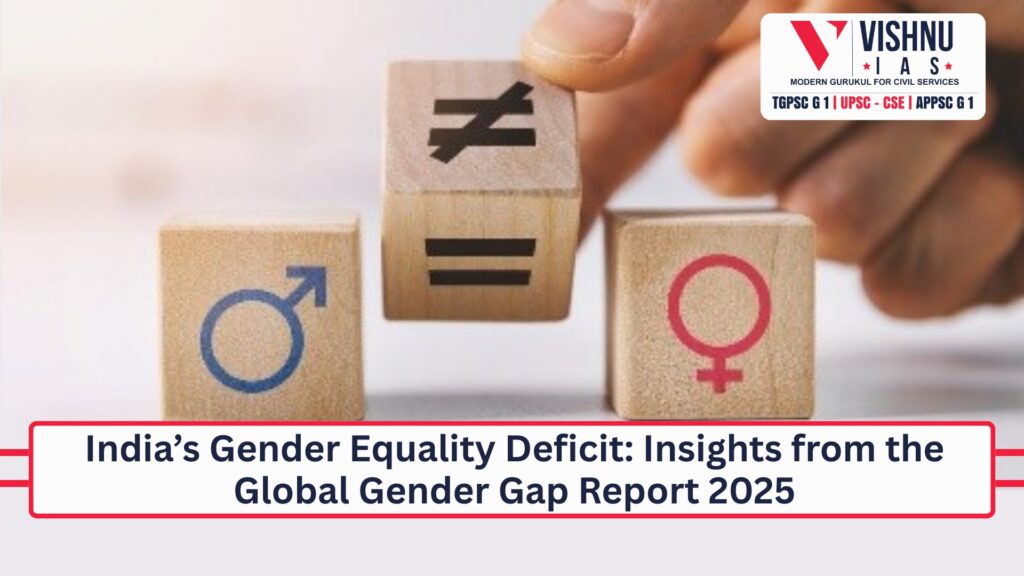
India's Gender Equality Deficit: Key Findings from the Global Gender Gap Report 2025
India's Gender Equality Deficit continues to threaten national growth and social cohesion, as revealed by the Global Gender Gap Report 2025. Despite being a rising digital and economic powerhouse with the world’s largest youth population, India ranks 131st out of 148 countries. This ranking reflects deep-seated disparities in health, economic participation, and social inclusion that hinder progress and equity.
Health and Survival
- Disproportionate Sex Ratio at Birth: India remains among the lowest globally in terms of female-to-male birth ratios, pointing to an enduring son preference.
- Disparity in Life Expectancy: For the first time, women’s healthy life expectancy is lower than men’s, reflecting a neglect of reproductive and preventive health services.
- Anaemia Epidemic: NFHS-5 reveals that 57% of women aged 15–49 suffer from anaemia, compromising their health, productivity, and safety during childbirth.
Economic Participation and Opportunity
- Global Ranking: India stands at 143rd on the Economic Participation subindex, with women earning just one-third of men’s earnings.
- Labor Force Decline: Female workforce participation has stalled at 25%, with much of their labor unaccounted for in GDP metrics.
- Missed GDP Potential: A McKinsey report (2015) estimated that gender parity could have added USD 770 billion to India’s GDP by 2025—an opportunity largely missed.
Unpaid Care Work and Social Inclusion
- Time-Use Disparity: Women perform unpaid domestic and caregiving work nearly seven times more than men, limiting their access to paid opportunities.
- Invisible Economy: National accounting systems exclude vital unpaid services such as childcare and eldercare, resulting in skewed policy decisions.
- International Models: Uruguay and South Korea show how investment in care infrastructure boosts female workforce participation and economic outcomes.
Political and Decision‐Making Representation
- Under‐Representation: Women hold under 15% of influential positions in governance, perpetuating blind spots in policymaking.
- Gender Budgeting: Despite some fiscal acknowledgment, funding for key areas like women’s health and care systems remains fragmented and insufficient.
Demographic Imperatives
- Aging Population: By 2050, 20% of India’s population will be senior citizens, many of them women facing heightened dependency and healthcare issues.
- Declining Workforce: Fertility rates below replacement level and low female labor force participation will increase dependency burdens on public systems.
Conclusion
The Global Gender Gap Report 2025 acts as a crucial signal: addressing India's Gender Equality Deficit is essential for sustainable economic and social development. Bridging the gap calls for structural investments in women’s health, fair labor laws, and caregiving support systems. Ignoring these inequalities risks not only demographic imbalance but also India’s long-term prosperity and global credibility.