
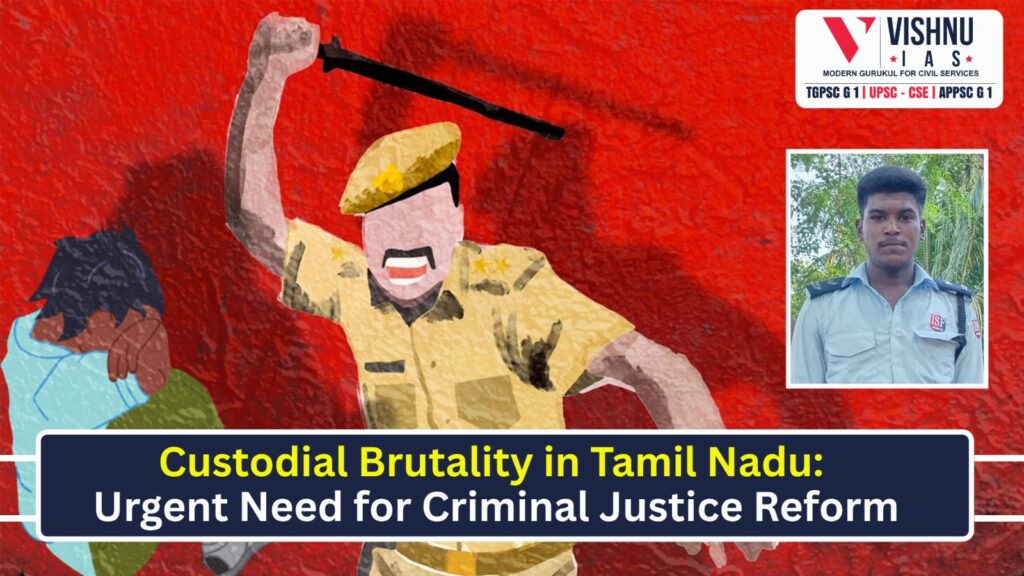
Custodial Brutality in Tamil Nadu: The Urgent Call for Criminal Justice Reform
Custodial brutality in Tamil Nadu has become a serious human rights concern, demanding immediate attention and criminal justice reform. From the brutal autopsy revelations of Ajith Kumar to the tragic deaths of Vignesh, Raja, and others, a disturbing pattern has emerged, reflecting deep flaws in law enforcement practices.
Context
A sequence of custodial fatalities in Tamil Nadu—from the autopsy of Ajith Kumar, which revealed 44 wounds, to the cases of Vignesh, Raja, and an autorickshaw driver—exposes the deep-seated brutality present within police custody. The substantial expenditure on vehicles, surveillance, and crowd control sharply contrasts with the almost nonexistent investment in officer welfare, training, and accountability. This disparity has normalized the use of force over the principle of fairness and has significantly diminished public confidence in law enforcement.
Challenges Encountered
- Ongoing fatalities in custody, leaving the families of survivors without recourse.
- Elevated stress and trauma levels among officers, leading to increased aggression in the absence of emotional support.
- Training programs that are outdated, failing to incorporate ethics, human rights, and trauma-informed investigative practices.
- Erosion of public trust as communities perceive a preference for force over equity and due process.
Existing Legal Loopholes
- There is an absence of a specific statute addressing anti-custodial violence, which would require investigations and impose penalties.
- Investigative processes are frequently prolonged, characterized by a lack of transparency and absence of defined timelines.
- Interrogations are performed without video recording, which facilitates the potential for evidence manipulation and unmonitored mistreatment.
- Oversight is restricted to internal police units, with no independent review from civil society organizations.
Imbalance in Resource Allocation
- The budget for law enforcement in Tamil Nadu places a greater emphasis on hardware rather than on human resources.
- There is little to no funding allocated for district mental health units and compulsory counseling services.
- The number of lathis and surveillance equipment surpasses that of psychologists and trauma support personnel.
Training and Welfare Gaps
- The training curriculum has remained stagnant since before 1990, failing to include essential topics such as ethics, human rights law, and de-escalation techniques.
- There are no quarterly training sessions or scenario-based ethical drills provided for current officers.
- The lack of established mental wellness programs allows for unchecked burnout among personnel.
Technology Gaps
- CCTV systems in detention facilities are often non-functional or can be easily turned off.
- The absence of real-time audits and digital records of interrogations protects misconduct from being examined.
Cultural Concerns
- The police uniform is perceived exclusively as a symbol of authority instead of a representation of service.
- The idolization of "strong" tactics undermines the cultivation of empathy and restraint in everyday policing.
Suggested Reforms
- Financial Reallocation: Allocate a minimum of 5% of the yearly policing budget to create district mental health units and mandate quarterly counseling sessions.
- Comprehensive Training: Implement educational modules focusing on human rights, trauma-informed investigations, community policing, and ethical practices, supplemented by regular training exercises.
- Legislative Precision: Pass a law against custodial violence that includes time-sensitive investigations, compulsory video-recorded interrogations, and independent oversight committees.
- Technological Protections: Install and regularly audit tamper-resistant CCTV systems in all detention facilities; ensure the maintenance of digital logs that are accessible to oversight organizations.
- Cultural Transformation: Revamp the police uniform to represent a commitment to service; establish recognition programs for officers who exemplify empathy and adherence to human rights.
Conclusion
Custodial brutality in Tamil Nadu exposes grave legal gaps and institutional neglect of officer welfare. A holistic overhaul—spanning legislation, budgetary priorities, training, technology and culture—is urgently needed. Only then can the state fulfil its moral contract and ensure justice without bloodshed.