

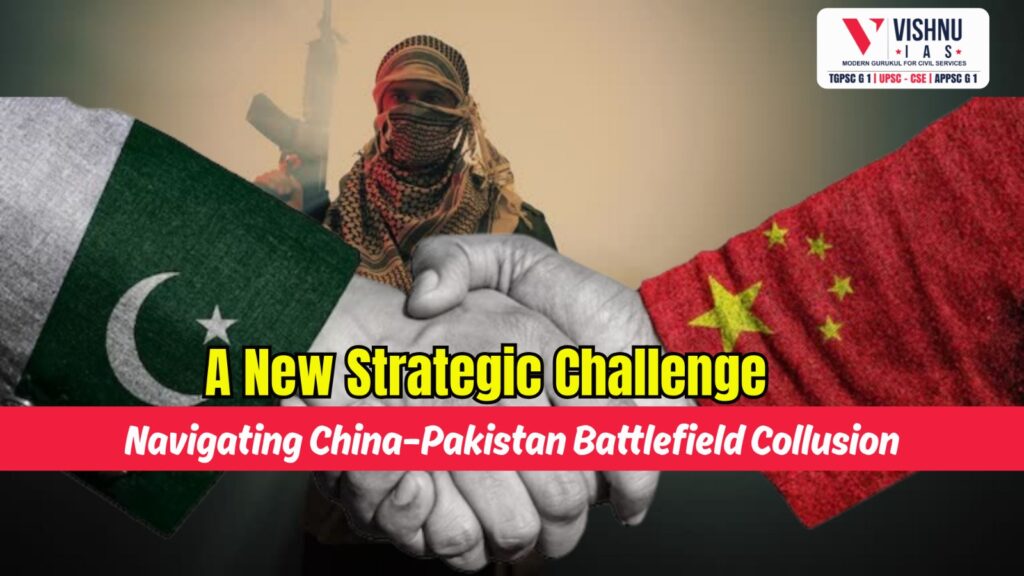
A New Strategic Challenge: China–Pakistan Battlefield Collusion and Its Impact on India
Context:
During Operation Sindoor (May 7–10, 2025), India witnessed unprecedented China–Pakistan battlefield collusion. Unlike past conflicts where China remained a background supporter, this time it supplied cutting-edge hardware, real-time ISR, diplomatic cover, and propaganda amplification—forcing India to confront a more complex, layered adversary.
1. Diplomatic Collusion and Signalling
China reflected Pakistan’s perspective regarding the Pahalgam terror incident, postponed its denunciation, and advocated at the UN to soften the language directed at Islamabad.
Impact on India:
- India’s attempts to foster a global consensus against cross-border terrorism were compromised.
- The potential for new diplomatic isolation threatens to extend crises and diminish New Delhi’s influence in multilateral discussions.
2. Informational Warfare
Chinese state-affiliated media have intensified the promotion of Pakistani assertions regarding the downing of Indian aircraft; social media influencers have disseminated biased narratives favoring the Pakistan army; experts from China have cautioned about the potential for nuclear escalation.
Impact on India:
- The ongoing spread of misinformation poses a threat to domestic morale and public perception, potentially leading to their deterioration.
- Global audiences might scrutinize India's proportionality, thereby complicating international backing for its security measures.
3. Military Hardware and Tactical Integration
Pakistan has deployed J-10C fighter jets equipped with PL-15 missiles, HQ-9 air defense systems, and BeiDou-guided munitions—all of which are integrated via Chinese ISR and early-warning platforms.
Impact on India:
- Indian air and missile defense systems are confronted with new threat envelopes, which diminish their reaction time.
- The effectiveness of conventional deterrence is weakened, necessitating swift enhancements in air, missile, and electronic warfare capabilities.
4. Strategic and Operational Implications
The threat of a "two-front war" has evolved into a "one-front reinforced war," characterized by Pakistan's offensive being supported by Chinese assistance without the direct deployment of troops.
Impact on India:
- Military forces and logistical resources must now be distributed to address a foe whose capabilities have grown to include more than just Pakistan.
- The strain on resources increases along both the western and northern borders, making it more challenging to maintain effective deterrence.
5. Preparing for the Future
Operation Sindoor served as a practical exhibition for China's defense sector; Pakistan anticipates an increase in J-35 stealth aircraft, KJ-500 AEW&C systems, and HQ-19 ballistic missile defense systems.
Impact on India:
- India is required to counteract the reduction in defense budgets, allocate resources towards network-centric warfare, drones, and domestic ISR capabilities to bridge the developing gaps.
- The necessity for strategic unpredictability—integrating both kinetic and non-kinetic strategies—becomes crucial to deter collaborative aggression that remains beneath the nuclear threshold.
Conclusion
China’s direct battlefield collaboration with Pakistan marks a pivotal escalation in South Asian security dynamics. By understanding its multi-dimensional impact—diplomatic, informational, military and operational—India can recalibrate strategy, strengthen conventional capabilities and devise flexible responses that preserve credible deterrence in this complex, collusive environment.