
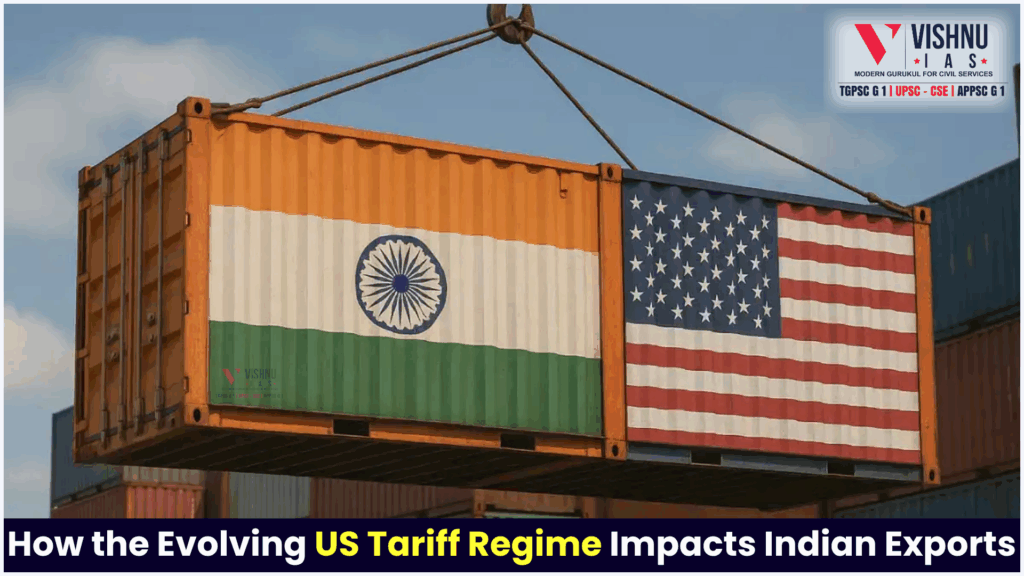
How the Evolving US Tariff Regime Impacts Indian Exports: A Roadmap for MSME Resilience
Tags: US tariff regime, Indian exports, MSMEs, trade policy, export resilience
In the backdrop of intensifying global geopolitical tensions and shifting trade priorities, the United States' evolving tariff regime is significantly reshaping global trade patterns. The US remains India’s largest export destination, accounting for nearly 20% of its merchandise exports (Ministry of Commerce, 2024). Key Indian export sectors are particularly vulnerable to tariff shifts, especially those dominated by MSMEs, which constitute nearly 45% of India’s total exports (MSME Ministry Annual Report, 2023–24).
Recent reciprocal tariff policies, bilateral trade reviews, and ongoing US trade negotiations with India, China, and others have introduced uncertainties. These have disrupted business planning and exposed Indian exporters to risks such as margin compression, demand volatility, and dumping threats. However, amidst these challenges lie opportunities for structural transformation and export resilience.
Impact of the Evolving US Tariff Regime on India’s Key Export Sectors
- Gems, Jewellery, and Apparel: Vulnerable due to high input costs and low demand elasticity. Hand-knotted carpet exports declined 12% in FY24 due to anticipated tariffs.
- Pharmaceuticals: Face regulatory barriers like stricter FDA norms acting as non-tariff barriers.
- Electronics & Auto Components: Exposed to antidumping investigations and shrinking demand.
- MSME Challenges: Limited scalability, compliance burden, credit crunch, and lack of trade law awareness.
- Strategic Uncertainty: Tariff announcements lack clarity, affecting forecasting and competitiveness.
- Dumping Threats: Surge in imports from overcapacity economies, especially China and ASEAN nations.
Policy Measures to Enhance Export Resilience in India
- Bilateral Trade Engagement: Prioritize zero-tariff deals with the US, UK, EU, and Australia. Use platforms like the WTO to negotiate fair terms.
- Support for MSMEs: Expand interest equalisation, ECGC, and ZED schemes; strengthen compliance and digitization via ONDC, TIES, and DEH programs.
- Domestic Industrial Boost: Broaden the scope of PLI schemes and safeguard against dumping through DGTR’s faster actions.
- Macro Stability: Invest in logistics (Gati Shakti), trade infra (Sagarmala), and calibrated monetary support to ease capital pressures.
Strategic Export Roadmap: Vision 2047
India must capitalise on new market opportunities through FTAs with the EU and EFTA, strengthen South-South cooperation, and enhance export readiness via skill building, women-led MSMEs, and digitised trade platforms.
Long-term reforms such as tariff rationalisation, integrated industrial policy, and enhanced MSME competitiveness are crucial for transforming shocks into structural strengths.