
Lokpal as a Constitutional Filter: Balancing Investigative Independence and Executive Protection
Lokpal as a constitutional filter has emerged as a crucial governance debate in India’s anti-corruption discourse, particularly in the context of corruption probes against public servants and the tension between investigative autonomy and executive protection.
Introduction
Corruption poses a systemic challenge to constitutional governance, undermining rule of law, public trust, and administrative efficiency. India’s anti-corruption framework has expanded over decades, reflected in the Prevention of Corruption Act, the establishment of vigilance institutions, and the creation of the Lokpal as an independent ombudsman.
Yet, despite improvements in detection and prosecution capacity, perception-based indices and governance assessments continue to show that discretionary power combined with weak accountability remains a vulnerability.
Within this context, the proposal to use independent screening bodies such as the Lokpal as a “constitutional filter” before initiating corruption probes seeks to address a long-standing tension: safeguarding honest decision-making while ensuring investigative autonomy free from executive interference.
I. Constitutional and Institutional Rationale for an Independent Screening Filter
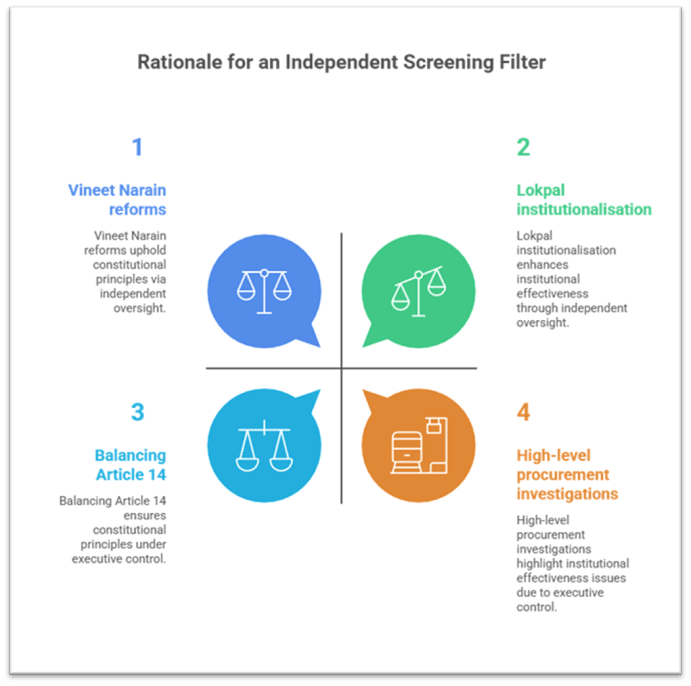
Balancing Article 14 and Rule of Law Principles
An independent filter aims to preserve equality before law by preventing selective or politically motivated investigations while ensuring that no public servant is placed beyond scrutiny.
Example – Vineet Narain reforms: Insulation of investigative agencies from executive pressure was recognised as essential to uphold constitutional morality, a logic that supports independent screening rather than executive clearance.
Addressing Conflict of Interest in Executive Sanction
When the executive grants or denies approval, especially for decisions taken within the same administrative hierarchy, institutional bias and departmental solidarity can weaken anti-corruption enforcement.
Case Study – High-level procurement investigations: Past delays in sanction for probes into defence and infrastructure contracts highlighted how executive control can stall inquiries where political or bureaucratic interests overlap.
Locating Lokpal within the Constitutional Ecosystem
The Lokpal’s design incorporates independence, multi-member composition, judicial representation, and fixed tenure, aligning it with other constitutional watchdogs that act as neutral arbiters.
Government Initiative – Lokpal institutionalisation: The operationalisation of inquiry wings and linkage with existing vigilance mechanisms reflects intent to create a credible screening layer rather than a parallel executive authority.
II. Effectiveness of Lokpal as a ‘Constitutional Filter’
Screening Frivolous Complaints without Blocking Genuine Cases
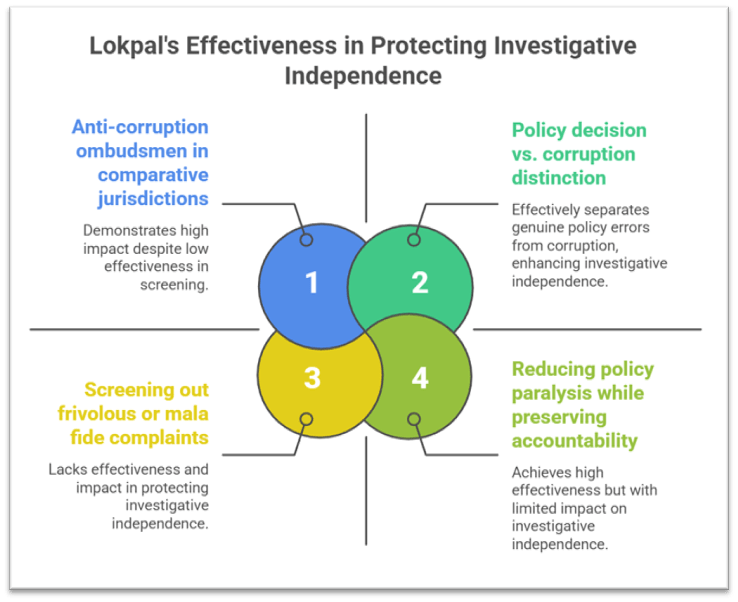
An independent filter can conduct a prima facie assessment, allowing investigators to proceed swiftly where credible evidence exists while preventing harassment of officials for bona fide policy decisions.
Example – Policy decision vs corruption distinction: Infrastructure clearances or fiscal incentives often require expert screening to separate errors of judgment from quid-pro-quo corruption.
Strengthening Credibility and Public Confidence
Decisions taken by a neutral authority enhance legitimacy, reducing allegations of political vendetta or bureaucratic shielding.
Comparative Insight: Jurisdictions with independent anti-corruption ombudsmen show stronger conviction sustainability due to improved evidentiary quality at the screening stage.
Reducing Policy Paralysis while Preserving Accountability
Fear of retrospective investigation can deter timely decision-making. An independent filter reassures officials that good-faith actions will not automatically trigger criminal probes.
Government Initiative – Mission-mode governance: Banking recapitalisation and infrastructure reforms benefited from clearer accountability frameworks distinguishing corruption from commercial risk.
III. Limitations and Risks
Procedural Delays and Capacity Constraints
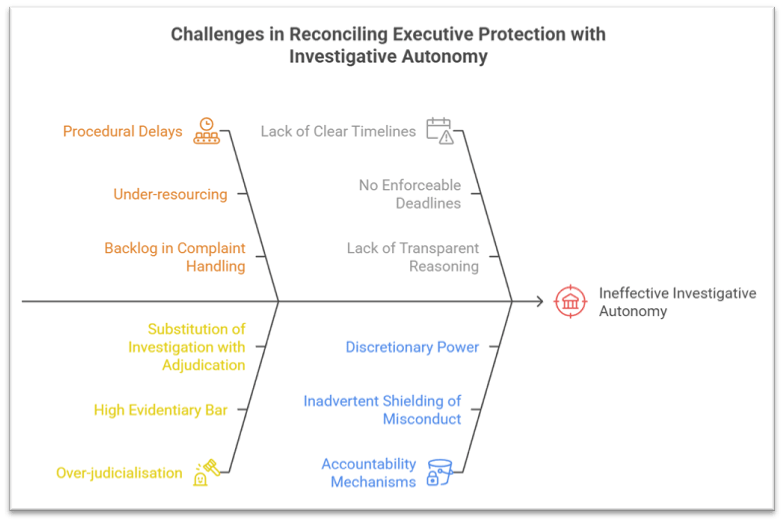
If under-resourced, the Lokpal may become an additional bureaucratic layer, slowing investigations rather than facilitating them.
Risk of Over-Judicialisation
Excessive scrutiny at the screening stage may raise the evidentiary threshold too high, effectively substituting investigation with adjudication.
Need for Statutory Timelines and Accountability
Without enforceable deadlines and transparent reasoning, even an independent filter can inadvertently shield misconduct.
Government Initiative – Time-bound vigilance norms: Digital case-tracking and statutory timelines can prevent independence from turning into inertia.
Conclusion:
Using independent bodies like the Lokpal as a constitutional filter is a feasible and normatively sound mechanism to reconcile investigative independence with protection against executive overreach. It offers a middle path between unfettered police discretion and executive-controlled sanction.
However, its success depends on institutional capacity, statutory clarity, and time-bound decision-making. Strengthening staffing, domain expertise, and digital transparency can ensure that screening enhances rather than obstructs anti-corruption enforcement.
An empowered yet restrained independent filter can reinforce clean administration, confident decision-making, and the integrity of India’s constitutional framework.
Recap: