
Introduction
The global artificial intelligence (AI) landscape is experiencing unprecedented transformations, driven by geopolitical shifts and economic policies. The recent imposition of substantial tariffs following the 2024 U.S. presidential election has fundamentally altered the structure of global technology supply chains. While these measures were intended to protect domestic industries, they have triggered significant disruptions, increasing costs and compelling companies to rethink their operational strategies.
For emerging economies like India, these global changes present a mix of challenges and opportunities. Positioned strategically between the two technological superpowers, the United States and China, India has the potential to strengthen its position as a critical player in the evolving AI ecosystem. This editorial explores the implications of the restructuring supply chains, analyzes India’s strategic advantages, and discusses the path forward for leveraging these opportunities effectively.
The Impact of Tariffs on AI Infrastructure
Rising Costs of Critical Components
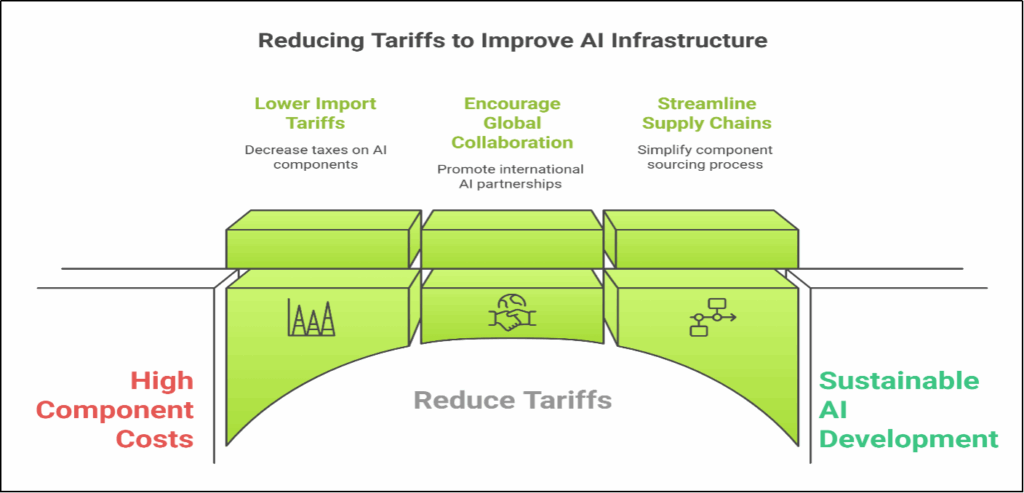
- The latest wave of U.S. tariffs has dramatically raised the costs of importing essential AI hardware components. Key items, such as specialized AI accelerators and advanced logic chips, now face tariffs as high as 27%. This increase has made the United States one of the costliest places to develop AI infrastructure.
- In 2024 alone, the U.S. imported electronics worth $486 billion, with $200 billion allocated to data processing machines. A significant portion of these imports originated from tariff-affected countries, including China, Taiwan, and Vietnam. The elevated costs risk discouraging domestic AI development and may drive companies to seek alternative production hubs, paradoxically increasing reliance on countries like China.
Historical Context and Current Trends
- The U.S. has a history of protectionist measures, such as the Trump-era tariffs between 2018 and 2020, which caused price surges for semiconductor components. The current wave of tariffs has expanded in scope, further discouraging investments and disrupting supply chains crucial for AI innovation.
Economic Consequences of Protectionism
Economic inefficiency and reduced innovation are notable consequences of protectionist policies.
- Economic inefficiency: Tariffs artificially fragment supply chains, creating inefficiencies that reduce global output growth by an estimated 0.4% over five years.
- Reduced innovation: By shielding domestic firms from competition, tariffs limit the pressure to innovate and restrict access to cutting-edge technologies.
- Global inequality: Protectionist measures exacerbate the technology transfer gap, increasing disparities in AI capabilities between developed and developing countries.
The Economics of Tariffs and Global Supply Chains
Theoretical Foundations
- Tariffs aim to stimulate domestic production by encouraging import substitution. However, Ricardian trade theory underscores the importance of comparative advantage in global trade. The production of AI hardware, which requires specialized expertise and distributed technical capabilities, suffers from inefficiencies when global supply chains are segmented by protectionist policies.
Impact on AI Innovation Cycles
- The rapid pace of AI innovation depends on seamless collaboration across borders. Tariffs introduce uncertainty and increase costs, slowing technological progress. Empirical studies have shown that reversing such tariffs could result in cumulative output gains of up to 4%, highlighting the opportunity cost of these protectionist policies.
Capital Substitution Effects
- Tariff-induced cost increases are pushing companies to optimize existing computational resources. Techniques like algorithmic efficiency, model compression, and hardware advancements are becoming more critical. This trend is expected to continue, as companies prioritize efficiency over raw computational power.
India’s Strategic Position in the AI Race
India as the “Third Option”
India’s IT sector has grown steadily in recent years, with exports increasing at 3.3%–5.1% annually. The country is now positioning itself as a strategic alternative to the U.S. and China in the global AI race. Several factors contribute to India’s growing prominence:
- Government support:Significant investments in AI and semiconductor development, including initiatives like AMD’s $400 million design campus in Bengaluru.
- R&D expansion:An increasing number of multinational research centers and collaborations underscore India’s role in the global technology landscape.
Comparative Advantages
India boasts several advantages that can help it capitalize on this restructuring:
- Cost-effective labor: India produces approximately 1.5 million engineering graduates annually, many of whom specialize in AI and digital engineering.
- Specialized expertise:The country’s knowledge base in software development and AI algorithms complements its growing hardware capabilities.
- Favorable demographics: A large, young workforce and growing digital infrastructure create an environment conducive to innovation.
Challenges to Overcome
Despite its strengths, India faces significant challenges:
- Dependence on imports:The country relies heavily on imported hardware components, making it vulnerable to global supply chain disruptions.
- Infrastructure gaps:Limited semiconductor manufacturing capacity and data center infrastructure hinder India’s ability to scale its AI ambitions.
- Policy limitations:Regulatory frameworks need to evolve to support sustained growth in the AI sector.
Decentralized AI Development and Emerging Trends
Shift Toward Application-Specific Hardware
- The rise of application-specific integrated circuits (ASICs) is transforming the AI hardware landscape. By 2028, over 50% of AI workload accelerators are expected to be custom ASICs, up from 30% in 2023. This shift reflects the industry’s focus on efficiency and specialization.
Opportunities in Decentralization
- The decentralization of AI development creates opportunities for countries like India. As companies seek alternatives to traditional supply chains, India can attract investments in manufacturing, research, and development. Decentralized models also align well with India’s strengths in software and algorithm development.
India’s Path Forward
Leveraging Opportunities
To capitalize on its strategic position, India must:
- Attract investments:Incentivize global companies to establish manufacturing facilities and R&D centers in India.
- Enhance regulatory frameworks:Develop policies that support innovation while ensuring data protection and ethical AI development.
- Utilize talent effectively:Invest in upskilling the workforce to meet the demands of emerging AI technologies.
Addressing Challenges
India must address its vulnerabilities to sustain its growth:
- Build infrastructure:Expand domestic semiconductor fabrication and data center capacity to reduce dependency on imports.
- Foster innovation:Encourage international collaborations and partnerships to stay competitive in the rapidly evolving AI landscape.
- Balance partnerships:Maintain strategic relationships with both the U.S. and China to leverage their technological strengths without over-reliance.
Conclusion
The global restructuring of AI supply chains, driven by tariffs and geopolitical shifts, presents a unique opportunity for India. By leveraging its strengths in talent, cost-effectiveness, and strategic location, India can establish itself as a global AI leader. However, realizing this potential requires addressing critical infrastructure gaps, fostering innovation, and adopting forward-looking policies.
India stands at the cusp of a transformative era in AI development. By acting decisively and strategically, the country can shape a future where it is not just a participant but a leader in the global AI ecosystem.