
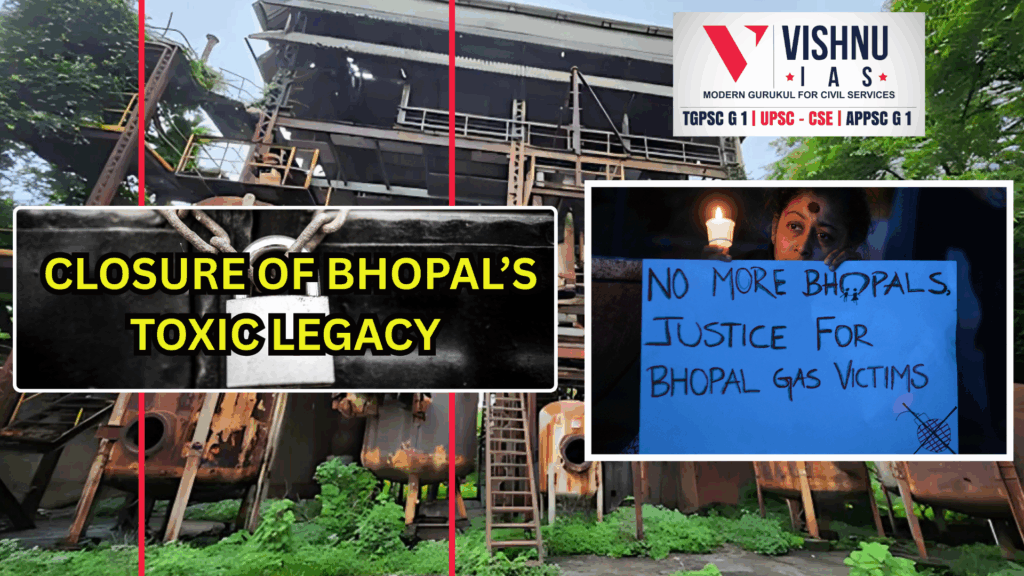
Closure of Bhopal’s Toxic Legacy: Environmental Remediation Through Pithampur Incineration
Meta Description: The closure of Bhopal’s toxic legacy through Pithampur’s incineration of 337 tonnes of waste marks a critical milestone in India's environmental justice. Learn how legal action, activism, and technology combined for sustainable remediation.
Introduction
The closure of Bhopal’s toxic legacy through the incineration of 337 tonnes of waste in Pithampur marks the conclusion of a significant phase in the city’s enduring struggle for environmental justice. This endeavor, which cost ₹126 crore and took six months to complete, resulted from extensive legal battles and governmental interventions. It highlights that while technical solutions have always been available, what was absent was consistent political commitment and public advocacy.
Judicial and Administrative Interventions
- For over a decade, the Madhya Pradesh High Court, the Supreme Court of India, and the Union Environment Ministry were consistently urged to ensure the safe disposal of the chemical remnants left by Union Carbide.
- It was only after a series of persistent court orders and official directives that state authorities took action to allocate resources for transporting the waste to a licensed private facility.
- This significant enforcement illustrates how legal principles can drive executive action, even in the absence of political motivation.
Technical Execution and Timeline
- Upon being moved to Pithampur, the 337 tonnes of waste were subjected to high-temperature incineration while adhering to stringent emission regulations.
- Authorities conducted community outreach sessions to alleviate public concerns regarding dioxin and furan emissions.
- After six months of continuous operations, more than 800 tonnes of ash were produced, which is now intended for "scientific landfills"—specialized facilities equipped with impermeable liners and leachate management systems.
- This detailed methodology exemplifies the practicality and intricacy involved in addressing legacy pollutants.
Political Will versus Civil Society Pressure
- Notwithstanding the technical precision of the solution, it was the persistent efforts of survivors' organizations and activists that maintained the momentum.
- Legal petitions submitted by the families of victims compelled the courts to reassess the overlooked fatalities and the compensations that had not been adjusted for inflation.
- Conversely, both state and central governments frequently adopted a passive stance, underscoring the capacity of grassroots mobilization to surpass bureaucratic stagnation in obtaining environmental remedies.
Ongoing Environmental and Health Challenges
- The incinerated waste only resolves a portion of the issue.
- The previous plant location continues to contain polluted soil, buried artifacts, and contaminated groundwater.
- Ongoing monitoring, scientific landfilling practices, and committed funding sources will be crucial to avert leachate migration and secondary contamination.
- In the meantime, local hospitals are experiencing a lack of toxicology specialists, and the advisory committee appointed by the Supreme Court has convened rarely, resulting in inconsistent surveillance of survivors.
Responsibility, Compensation, and Institutional Reforms
- Despite The Dow Chemical Company being identified as the primary offender, the Supreme Court has dismissed its curative petitions—prompting inquiries into new liability assessments.
- Both state and federal governments are urged to accelerate unresolved settlement claims and contemplate the creation of a statutory entity that combines health care, relief distribution, and environmental restoration.
- This organization could guarantee that survivors obtain specialized medical treatment, financial support, and a definitive schedule for site remediation.
Conclusion
The incineration at Pithampur represents a significant achievement in Bhopal's persistent quest for justice, highlighting the relationship between law, technology, and activism. However, genuine closure necessitates ongoing monitoring of landfills, extensive health services for survivors, and enforceable institutional reforms. It is only through these measures that the residents of Bhopal can ultimately transcend the lasting impact of this tragedy.