
Vishnu Vardhan

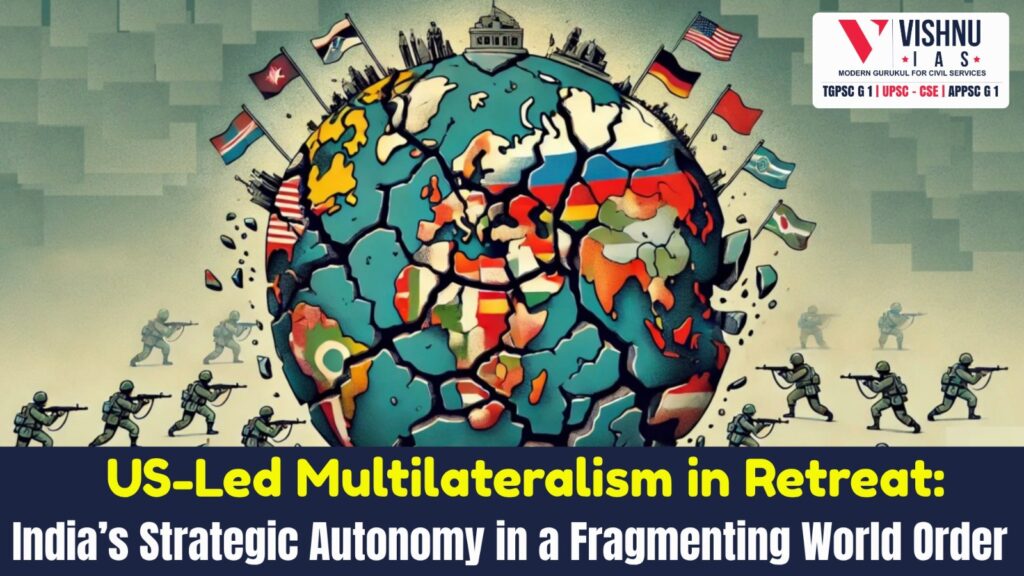
As multilateralism erodes due to the United States’ strategic retreat, India is redefining its strategic autonomy through regional diplomacy, digital leadership, and South-South cooperation.

India’s Strategic Autonomy in a Post-Multilateral World: US Retreat and Global Order Shifts

India’s Strategic Autonomy in a Post-Multilateral World: US Retreat and Global Order Shifts India’s Strategic Autonomy in a Post-Multilateral World: US Retreat and Global Order Shifts SYLLABUS: GS2 – INTERNATIONAL RELATIONS Strategic Autonomy has emerged as a key pillar of India’s foreign policy, especially in the backdrop of the declining multilateral order once shaped and […]

India’s Strategic Autonomy in a Post-Multilateral World: US Retreat and Global Order Shifts Read More »

Explore how the Supreme Court’s 2025 privacy verdict exposed the challenges of criminalising adolescent consensual relationships under the POCSO Act. Discover data, case law, and the urgent need for balanced reform.

Criminalising Adolescent Consensual Relationships: Supreme Court’s POCSO Verdict Calls for Reform

Criminalising Adolescent Consensual Relationships: Supreme Court’s POCSO Verdict Calls for Reform Criminalising adolescent consensual relationships under the POCSO Act has long sparked debate in India. The Supreme Court’s 2025 verdict in Re: Right to Privacy of Adolescents has brought the issue to the forefront, urging a rethinking of how child protection laws intersect with adolescent

Criminalising Adolescent Consensual Relationships: Supreme Court’s POCSO Verdict Calls for Reform Read More »

Is India’s Carbon Credit Trading Scheme effective for industrial decarbonisation? Explore its design, challenges, and role in meeting India’s 2070 net-zero goals.

Evaluating India’s Carbon Credit Trading Scheme: Decarbonisation Pathway to Net-Zero Targets

Evaluating India’s Carbon Credit Trading Scheme: Decarbonisation Pathway to Net-Zero Targets India’s Carbon Credit Trading Scheme (CCTS) represents a key market-based mechanism to accelerate industrial decarbonisation and help achieve the nation’s net-zero carbon emissions goal by 2070. With high-emission sectors in focus, the scheme aligns climate policy with economic growth, but its effectiveness requires evaluation

Evaluating India’s Carbon Credit Trading Scheme: Decarbonisation Pathway to Net-Zero Targets Read More »

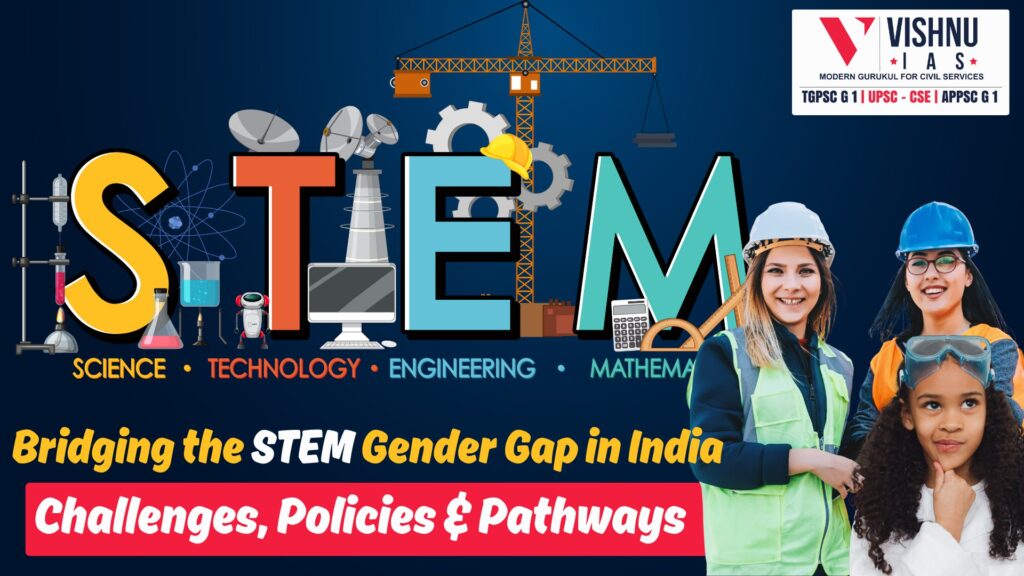
Illustration of STEM (Science, Technology, Engineering, Mathematics) with female engineers and students, promoting gender equality in STEM careers in India, by Vishnu IAS.

Strengthening Women in STEM Careers in India: Challenges, Strategies & Government Initiatives

Strengthening Women in STEM Careers in India: Challenges, Strategies & Government Initiatives Women in STEM careers in India face a stark mismatch between academic achievement and workforce participation. While 43% of STEM graduates are women, only 27% are employed in the STEM sector. Addressing this gap is vital for achieving gender equality in STEM and

Strengthening Women in STEM Careers in India: Challenges, Strategies & Government Initiatives Read More »

Illustration of a raised fist surrounded by various religious symbols and diverse people, representing India's secularism and its foundation in equality, constitutional values, and religious harmony.

India’s Secularism: Evolution, Principles, and Contemporary Significance

Context : India’s secularism, while formally established by the 42nd Amendment in 1976, has its origins in the edicts of Emperor Ashoka and the principles of the freedom struggle. The aversion of Jawaharlal Nehru to organized religion, along with the discussions during the Constituent Assembly, solidified the concept of state impartiality towards all religions. Judicial

India’s Secularism: Evolution, Principles, and Contemporary Significance Read More »

A professional woman holds a sign reading "Gender Equality" with male and female gender symbols in the background, highlighting the theme of persistent gender inequality and its impact on India's economic and demographic stability.

Persistent Gender Inequality in India: Economic and Demographic Consequences

Introduction: Gender inequality refers to the unequal treatment or perceptions of individuals based on their gender, manifesting in disparities across health, education, economic opportunity, and political representation. Despite India’s status as the world’s fifth-largest economy, a digital powerhouse, and home to the world’s largest youth population, it continues to underperform significantly on global gender equality

Persistent Gender Inequality in India: Economic and Demographic Consequences Read More »

Three wooden blocks showing male, female, and equality symbols representing India’s gender disparity highlighted in the Global Gender Gap Report 2025, with Vishnu IAS branding

India’s Gender Equality Deficit: Key Findings from the Global Gender Gap Report 2025

India’s Gender Equality Deficit: Key Findings from the Global Gender Gap Report 2025 India’s Gender Equality Deficit continues to threaten national growth and social cohesion, as revealed by the Global Gender Gap Report 2025. Despite being a rising digital and economic powerhouse with the world’s largest youth population, India ranks 131st out of 148 countries.

India’s Gender Equality Deficit: Key Findings from the Global Gender Gap Report 2025 Read More »

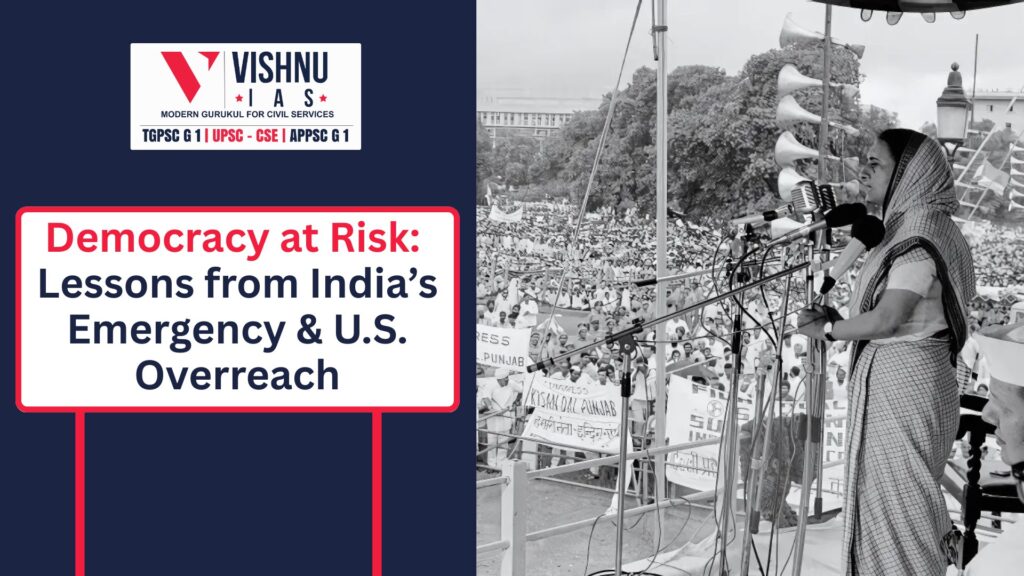
Historic photo of Indira Gandhi addressing a public rally during India's Emergency era, illustrating the risks of executive overreach in constitutional democracies, with a modern context comparing U.S. political parallels.

Safeguarding Constitutionalism: How the U.S. and India Reshape Democratic Resilience

Safeguarding Constitutionalism: How the U.S. and India Reshape Democratic Resilience Safeguarding constitutionalism is not merely a legal requirement but a civic obligation in every democratic society. The comparative experiences of the United States and India demonstrate the fragility and strength of democratic resilience when confronted with internal crises and executive overreach. Context On July 4,

Safeguarding Constitutionalism: How the U.S. and India Reshape Democratic Resilience Read More »

BRICS Leaders at XV Summit: A New Era of Global Governance

BRICS and Global Governance: Challenging the Western-Dominated Financial Order

BRICS and Global Governance: Challenging the Western-Dominated Financial Order BRICS global governance efforts are gaining momentum in response to a shifting geopolitical landscape and growing dissatisfaction with the Western financial order. The alliance has evolved into a dynamic bloc redefining multilateral frameworks and global economic structures. Introduction The BRICS grouping—comprising Brazil, Russia, India, China, and

BRICS and Global Governance: Challenging the Western-Dominated Financial Order Read More »

Illustration showing custodial brutality by police in Tamil Nadu with a call for criminal justice reform

Custodial Brutality in Tamil Nadu: Urgent Call for Criminal Justice Reform

Custodial Brutality in Tamil Nadu: The Urgent Call for Criminal Justice Reform Custodial brutality in Tamil Nadu has become a serious human rights concern, demanding immediate attention and criminal justice reform. From the brutal autopsy revelations of Ajith Kumar to the tragic deaths of Vignesh, Raja, and others, a disturbing pattern has emerged, reflecting deep

Custodial Brutality in Tamil Nadu: Urgent Call for Criminal Justice Reform Read More »

Scroll to Top