
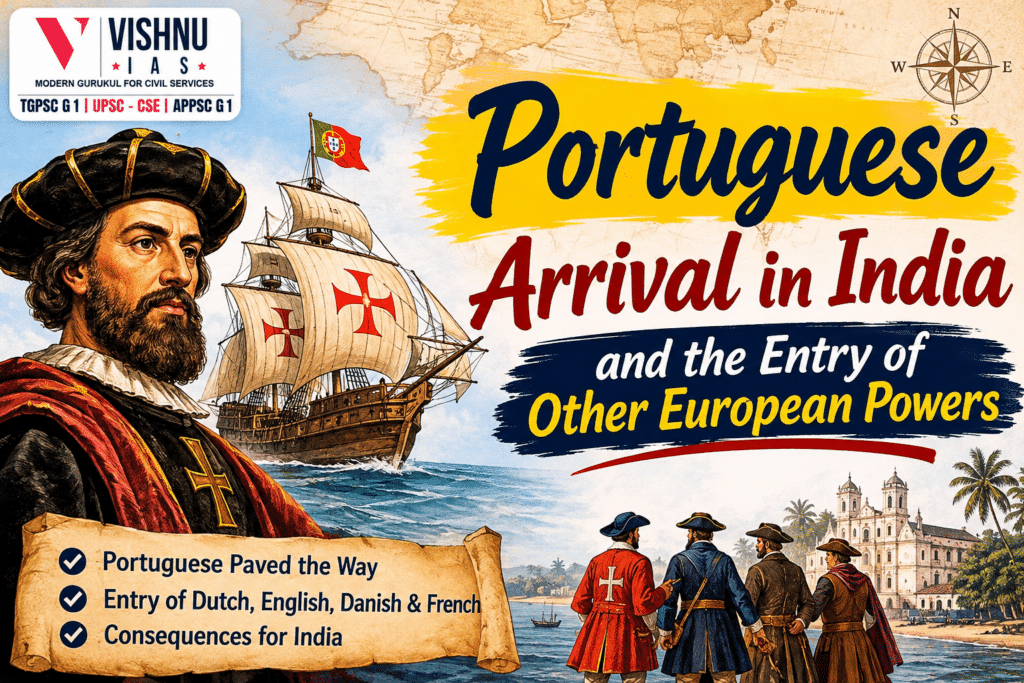
Portuguese Arrival in India and the Entry of Other European Powers
The Portuguese Arrival in India marked a turning point in Indian history. The arrival of Vasco da Gama at Calicut in 1498, via the Cape of Good Hope, marked the beginning of a new phase in India's maritime and commercial relations with Europe. The Portuguese established the first European trading and colonial presence in India, paving the way for other European powers to enter the subcontinent.
Portuguese Paved the Way for Other European Powers
1. Discovery of the Sea Route
- The Portuguese established a direct maritime route between Europe and India, reducing dependence on traditional land and Mediterranean trade routes.
2. Commercial Opportunities
- The lucrative spice trade, particularly pepper, along with India's cotton and silk textiles, attracted European merchants seeking greater profits.
3. Strategic Trading Centres
- The Portuguese established important bases at Goa (1510), Daman, Diu and Cochin, demonstrating the commercial and strategic value of controlling coastal settlements.
4. Maritime Competition
- Francisco de Almeida's Blue Water Policy (1505–1509) emphasised Portuguese naval supremacy in the Indian Ocean, enabling them to control maritime trade routes.
- Portuguese attempts to monopolise Indian Ocean trade through naval dominance and the Cartaz system encouraged other European powers to challenge their commercial supremacy.
5. Transmission of Trade Information
- Portuguese knowledge of maritime routes, trading networks and commercial opportunities facilitated subsequent European ventures into the Indian Ocean.
Entry of Other European Powers
The Portuguese presence was followed by successive European trading companies:
| European Power | Establishment / Arrival | Important Settlements |
|---|---|---|
| Dutch | VOC established in 1602; arrived in India in 1605 | Masulipatnam, Pulicat |
| English | East India Company established in 1600; arrived in 1608 | Surat, Madras, Bombay |
| Danish | East India Company established in 1616; arrived in 1620 | Tranquebar, Serampore |
| French | East India Company established in 1664; arrived in 1668 | Pondicherry, Chandernagore |
Consequences of European Entry
- Competition for spices, textiles and other commodities intensified among European trading companies.
- European powers increasingly sought political privileges, alliances and territorial concessions from Indian rulers. E.g. Portuguese obtained Calicut Zamorin’s permission for trading factory. English obtained trading privileges from Jahangir.
- Commercial competition gradually developed into military confrontations, particularly between the English and French during the Carnatic Wars.
- The growing involvement of European companies in Indian politics eventually facilitated the establishment of British political supremacy.
Conclusion
Thus, the Portuguese pioneered European maritime expansion in India, opening the way for successive European trading powers. What began as commercial competition gradually transformed into political and territorial rivalry, ultimately paving the way for colonial rule in India.