
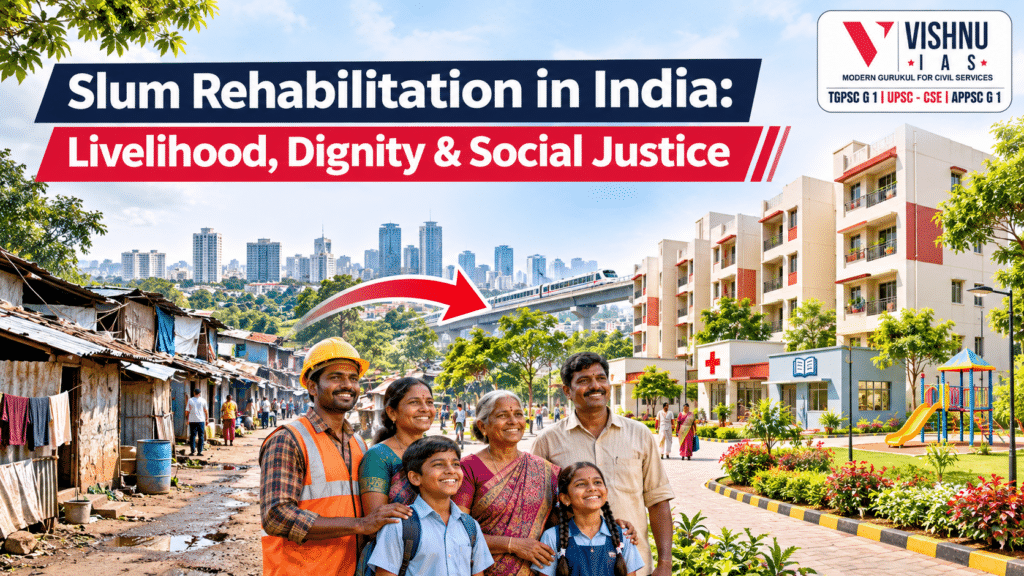
Slum Rehabilitation in India: Livelihood, Dignity & Social Justice
“Slum rehabilitation is not merely a housing issue but also a question of livelihood, dignity and social justice.” Examine
Introduction
Rapid urbanisation, rural-urban migration and the shortage of affordable housing have contributed to the growth of informal settlements in Indian cities - Slums.
I. Slum rehabilitation - livelihood, dignity and social justice.
1. Protection of livelihood and economic opportunities:
- Slum settlements are often located close to workplaces, markets and industrial areas. Their residents work as domestic workers, construction labourers, street vendors, sanitation workers and other service providers.
- Relocating them to distant peripheral areas increases commuting costs, disrupts employment and may push families further into poverty.
2. Access to essential public services:
- Rehabilitation involves ensuring continued access to schools, healthcare facilities, drinking water, sanitation, electricity and affordable public transport.
- Inadequate infrastructure at relocation sites can worsen the living conditions of already vulnerable communities.
3. Protection of social networks:
- Slum communities often depend on neighbourhood relationships, self-help groups and informal support systems for childcare, employment and emergency assistance.
- Forced displacement disrupts these networks, disproportionately affecting women, children and elderly persons.
4. Human dignity and social inclusion:
- Treating slum dwellers merely as encroachers overlooks their contribution to the functioning of cities.
- Rehabilitation must recognise their right to live with dignity, security and equal access to urban opportunities.
II. Constitutional and judicial frameworks on Rehabilitation
1. Constitutional provisions:
- Article 21 encompasses the right to life with dignity, livelihood and shelter.
- Article 14 guarantees equality before the law, while Article 19(1)(e) protects citizens' freedom to reside and settle in any part of India.
- Directive Principles under Articles 38, 39(a) and 41 emphasise social justice, adequate means of livelihood and the right to work.
2. Olga Tellis v. Bombay Municipal Corporation (1985):
- The Supreme Court recognised that the right to livelihood is an integral component of Article 21.
- It observed that eviction from a settlement near one's workplace could deprive a person of livelihood and consequently affect the right to life.
3. Sudama Singh v. Government of Delhi (2010):
- The Delhi High Court emphasised meaningful engagement with slum residents, systematic surveys and proper rehabilitation before eviction.
- It held that relocated residents must have access to basic amenities and should not be placed in a worse position after displacement.
4. Ajay Maken v. Union of India (2019):
- The Delhi High Court reinforced the rights-based approach to slum rehabilitation.
- It emphasised prior surveys, consultation with residents and rehabilitation before eviction, recognising housing as a bundle of rights encompassing livelihood, health, education, food, water and transport.
III. An inclusive approach
1. In-situ rehabilitation:
- Redevelopment at the existing location should be preferred wherever feasible, as it preserves employment opportunities, social networks and access to urban facilities.
- Relocation should be considered only when occupation is demonstrably unsafe or incompatible with an overriding public purpose.
2. Community participation:
- Slum residents should be involved in surveys, eligibility verification, redevelopment planning and implementation.
- Transparent grievance-redressal mechanisms and independent legal assistance can prevent arbitrary exclusion.
3. PPP-based redevelopment:
- Public-private partnerships must have transparent developer selection, financial-capacity assessments, performance guarantees and time-bound construction milestones.
- Transit accommodation and rental assistance should be secured in advance to prevent hardship during redevelopment.
4. Flexible eligibility framework:
- Rehabilitation shall not become inaccessible due to rigid documentary requirements or arbitrary cut-off dates.
- Proper surveys, repeated verification and digital preservation of beneficiary records can minimise exclusion.
5. Successful model
- Odisha's Jaga Mission provides an important example of community-centred slum transformation.
- Through the Odisha Land Rights to Slum Dwellers Act, 2017, it provides tenure security and combines in-situ upgrading with basic infrastructure such as drinking water, sanitation, roads, electricity and community facilities.
Conclusion
Slum rehabilitation must represent a transition from slum clearance to inclusive urban development. The success of rehabilitation should not be measured by the number of settlements demolished or housing units constructed, but by whether families secure dignified housing without losing their livelihoods, social networks and access to essential services. Thus, an inclusive city is one in which the urban poor are recognised as equal stakeholders in the process of urbanisation.