
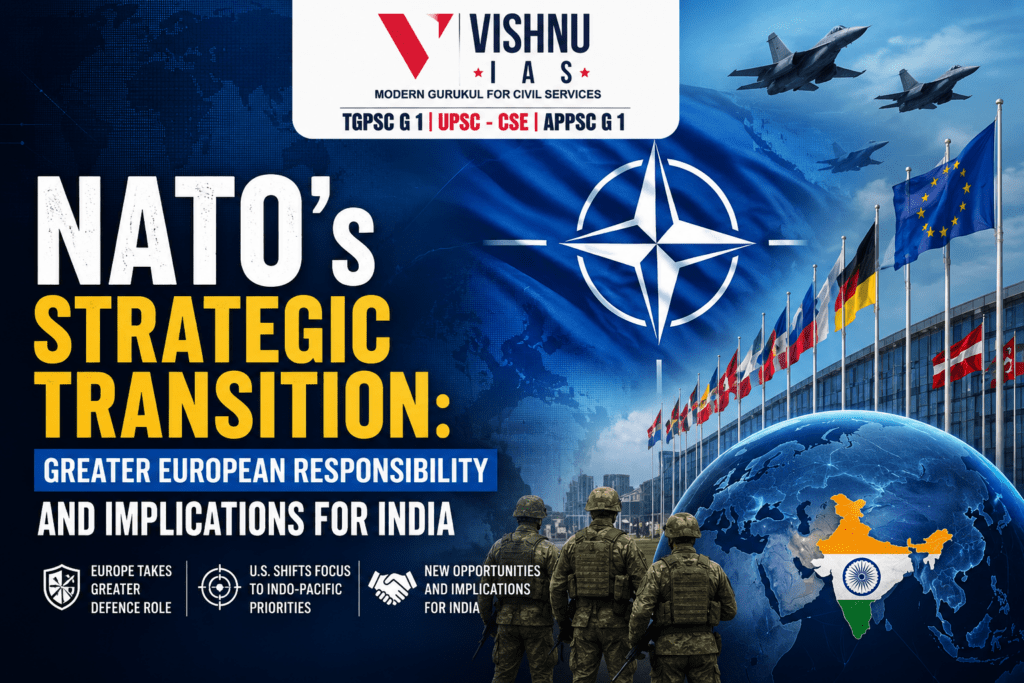
NATO’s Strategic Transition: Greater European Responsibility and Implications for India
NATO's Strategic Transition marks a significant evolution in global security as Europe assumes greater conventional defence responsibilities while the United States continues to provide strategic deterrence and critical military enablers. Driven by the Russia-Ukraine war, changing U.S. strategic priorities in the Indo-Pacific, and long-standing burden-sharing concerns, this transformation is reshaping NATO’s security architecture. The evolving model carries important implications for India, particularly in defence partnerships, strategic autonomy, and Indo-Pacific security.
Introduction
Established in 1949, NATO was built around collective defence, with the United States providing the bulk of military capabilities, nuclear deterrence, intelligence, logistics and strategic mobility. The Russia-Ukraine war, changing U.S. strategic priorities and growing European security concerns have accelerated a shift towards greater European responsibility. However, this represents strategic redistribution rather than complete American disengagement, with Europe expected to strengthen conventional defence while the U.S. continues to provide critical strategic enablers.
Drivers of NATO’s Transition
1. Changing U.S. Strategic Priorities
- The United States increasingly views the Indo-Pacific and China's rise as major long-term strategic challenges. Greater European defence capability would allow Washington to allocate more diplomatic, military and economic resources to the Indo-Pacific, making burden-sharing an increasingly important component of U.S. expectations from European allies.
2. Russia-Ukraine War
- Russia's invasion of Ukraine in 2022 revived the perception of a direct military threat in Europe. It has encouraged European states to strengthen their capabilities for territorial defence, deterrence and rapid mobilisation, while Russia's military reorganisation has reinforced European security concerns.
3. Long-standing Burden-sharing Concerns
- NATO has historically faced criticism over unequal defence contributions, with several European members remaining dependent on the U.S. for intelligence, strategic airlift, surveillance, missile defence and precision-strike capabilities. Greater European defence spending is therefore intended to reduce this structural dependence.
Evidence of Growing European Strategic Responsibility
1. Higher Defence Expenditure
- European NATO members are substantially increasing defence expenditure and military investments, reflecting a shift from reliance on U.S. capabilities towards greater national and collective European preparedness.
- At the 2025 Hague Summit, NATO allies committed to raising defence and defence-related spending to 5% of GDP by 2035, reflecting a greater emphasis on European military preparedness and capability development.
2. Strengthening European Defence Capabilities
- European countries are increasingly investing in air and missile defence, long-range precision strike, military mobility, drones, intelligence and defence-industrial capacity, thereby improving their ability to undertake conventional defence without depending entirely on U.S. support.
3. Greater Responsibility for Ukraine
- European countries have assumed an increasingly significant role in providing military, financial and industrial support to Ukraine, demonstrating greater willingness to manage security challenges in their immediate neighbourhood.
Limitations to European Strategic Autonomy
1. Continued Dependence on the U.S.
- Despite higher defence spending, Europe continues to depend heavily on the U.S. for nuclear deterrence, strategic intelligence, satellite capabilities, command and control, strategic airlift, long-range precision strike and missile defence, limiting the extent of its strategic autonomy.
2. Capability and Coordination Gaps
- European militaries remain fragmented in terms of weapons systems, procurement standards and defence-industrial capacities. Building an integrated European military capability therefore requires greater coordination, interoperability and long-term investment.
3. Continued Dependence on U.S. Nuclear Deterrence
- The U.S. nuclear umbrella remains a fundamental pillar of NATO's deterrence architecture. Although France and the United Kingdom possess independent nuclear capabilities, European nuclear forces do not replicate the scale, reach and integrated extended-deterrence role historically provided by the United States.
Emerging Model of NATO
- NATO's evolution can broadly be understood through three phases: NATO 1.0 (1949–1991), dominated by U.S.-led deterrence against the Soviet Union; NATO 2.0 (1991–2022), characterised by enlargement, out-of-area operations and growing European dependence on U.S. capabilities; and NATO 3.0 (post-2022), characterised by stronger European conventional defence alongside continued U.S. provision of strategic enablers.
- Thus, the emerging model is not "America out, Europe in", but rather "Europe takes greater conventional responsibility while America remains a strategic guarantor and enabler."
Implications for India
1. Greater U.S. Focus on the Indo-Pacific
- A more capable Europe could enable the United States to devote greater diplomatic, military and technological resources to the Indo-Pacific, where China's growing assertiveness has direct implications for India's maritime and strategic interests.
2. Opportunities for India-Europe Cooperation
- European defence modernisation can create opportunities for India in defence manufacturing, AI and emerging technologies, cybersecurity, semiconductors, space technology and maritime security, while also supporting diversification of India's defence partnerships.
3. Strengthening Strategic Autonomy
- India can deepen cooperation with both the United States and European countries without becoming part of a formal alliance system. Such diversified partnerships can strengthen India's technological capabilities and defence preparedness while preserving its commitment to strategic autonomy.
Conclusion
NATO is moving from a predominantly U.S.-centred security architecture towards greater European responsibility, driven by Russia's resurgence, burden-sharing concerns and America's strategic priorities in the Indo-Pacific. However, Europe is not yet capable of replacing the U.S. military ecosystem, particularly in nuclear deterrence, intelligence, strategic mobility and high-end military capabilities.
The emerging transformation is therefore better understood as burden redistribution rather than American withdrawal. For India, it presents an opportunity to benefit from a stronger Europe, deeper defence partnerships and greater U.S. strategic engagement in the Indo-Pacific while preserving strategic autonomy.