Introduction:
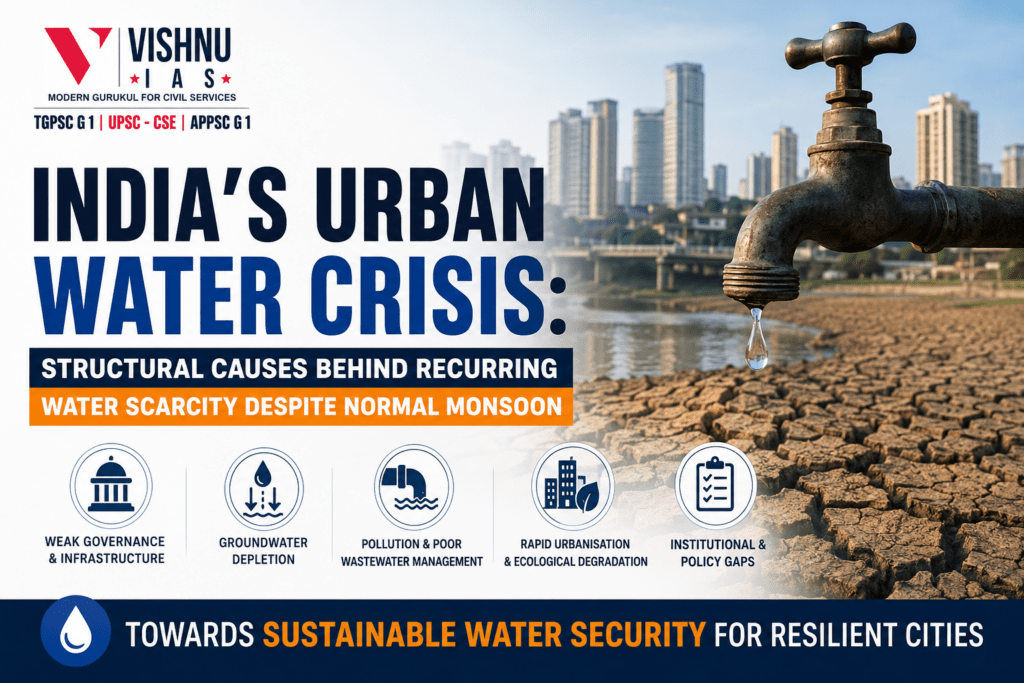
- Urban water crisis refers to the persistent inability of cities to ensure adequate, equitable, safe and sustainable water supply despite the availability of natural water resources.
- India’s challenge is increasingly structural rather than seasonal, as 18% of the world’s population depends on only about 4% of global freshwater resources, while 11 of the country’s 15 major river basins have entered the water-stressed category based on internationally accepted water availability thresholds.
- Consequently, even a normal monsoon often provides only temporary relief without addressing the underlying governance, infrastructure and resource management deficiencies.
Body:
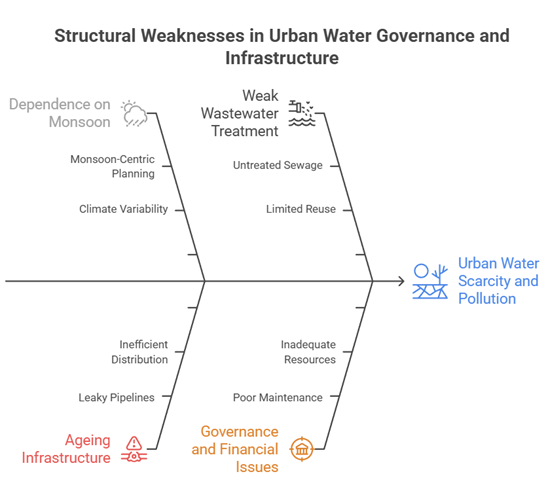
I. Structural weaknesses in urban water governance and infrastructure
1. Dependence on monsoon rather than resilient water management
- Urban water planning continues to be monsoon-centric, assuming seasonal rainfall alone can replenish reservoirs despite increasing climate variability, delayed rainfall and uneven spatial distribution.
- Limited storage capacity, rainwater harvesting, aquifer recharge and integrated urban water planning prevent cities from capturing excess rainfall during wet periods.
- Example: Bengaluru receives substantial annual rainfall but continues to experience seasonal shortages due to inadequate storage, disappearing lakes and declining groundwater.
2. Ageing infrastructure and inefficient distribution systems
- Significant quantities of treated water are lost through leaky pipelines, illegal connections and transmission losses, reducing effective supply despite adequate production.
- Urban Local Bodies often face poor maintenance, inadequate financial resources and weak cost recovery, delaying modernization of water networks.
- Government Initiative: Programmes such as the Jal Jeevan Mission (Urban initiatives by States), AMRUT 2.0, and the Urban Challenge Fund aim to strengthen urban water infrastructure, but implementation gaps remain.
3. Weak wastewater treatment and pollution management
- Large volumes of untreated or partially treated sewage contaminate rivers, lakes and groundwater, shrinking usable freshwater resources.
- Limited reuse of treated wastewater forces cities to depend excessively on freshwater for industrial, commercial and landscaping purposes.
- Case Study: Thane Municipal Corporation has expanded treated wastewater reuse for construction and non-potable applications, reducing freshwater demand while generating municipal revenue.
II. Unsustainable resource exploitation and environmental degradation
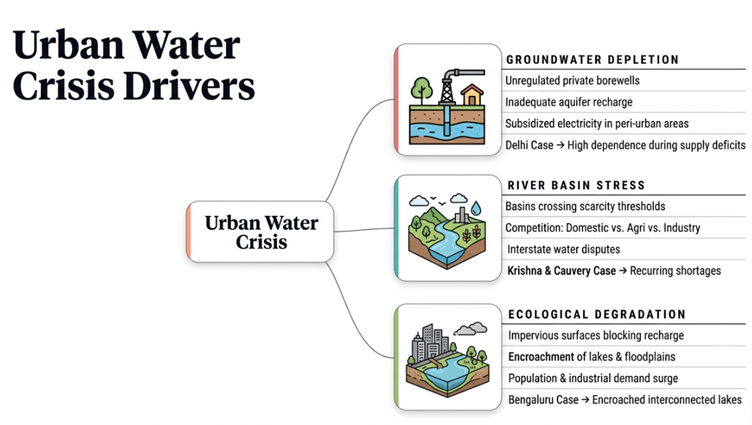
1. Excessive groundwater extraction and aquifer depletion
- Urban expansion has led to indiscriminate groundwater abstraction due to unregulated private borewells, inadequate recharge and increasing dependence on groundwater during shortages.
- Subsidized electricity and weak groundwater regulation indirectly encourage over-extraction in surrounding peri-urban and agricultural regions, affecting urban water security.
- Example: Delhi increasingly depends on groundwater during supply deficits, intensifying aquifer stress.
2. Stress on river basins and inter-state water resources
- Several major river basins have crossed internationally recognised water stress and water scarcity thresholds, reducing dependable supplies for urban centres.
- Increasing competition among domestic, agricultural, industrial and ecological water needs intensifies interstate disputes and limits urban allocations.
- Example: The Krishna and Cauvery basins face recurring shortages due to growing demand and declining per capita water availability.
3. Rapid urbanisation and ecological degradation
- Expansion of impervious surfaces reduces groundwater recharge, while encroachment of lakes, wetlands and floodplains weakens natural water storage.
- Rising population, industrialisation and changing consumption patterns increase water demand faster than supply augmentation.
- Case Study: Encroachment of interconnected lakes in Bengaluru has significantly reduced the city’s natural water storage and recharge capacity.
III. Institutional and policy gaps aggravating urban water insecurity
1. Fragmented governance and weak data systems
- Multiple agencies manage water supply, groundwater, sewerage, drainage and urban planning with limited coordination, resulting in fragmented decision-making.
- Absence of comprehensive river basin-level water accounting, withdrawal monitoring and demand assessment hinders evidence-based allocation.
- Government Initiative: Deployment of smart bulk water meters in cities such as Delhi and Bhubaneswar, along with AI-based monitoring, seeks to improve loss detection and water accounting.
2. Inadequate demand-side management
- Urban policies have historically prioritised supply augmentation instead of promoting water-use efficiency, conservation and behavioural change.
- Limited adoption of water pricing, reuse incentives, mandatory rainwater harvesting and demand management encourages inefficient consumption.
- Example: Many commercial establishments continue using potable water for landscaping, construction and vehicle washing despite feasible reuse alternatives.
3. Limited climate resilience in urban planning
- Cities remain vulnerable to alternating floods and droughts, reflecting inadequate integration of climate risk into infrastructure planning.
- Urban investments often neglect climate-proofing critical infrastructure, increasing disruptions during extreme weather events.
- Government Initiative: Climate-informed planning under AMRUT 2.0, National Water Mission, Atal Bhujal Yojana, and city-level resilience assessments promote sustainable water security through integrated resource management.
Conclusion:
- India’s recurring urban water crises are fundamentally the outcome of structural governance failures, ecological degradation, unsustainable resource use and inadequate infrastructure, rather than merely deficient rainfall.
- Achieving long-term water security requires a transition towards integrated urban water management, circular water economy through wastewater reuse, climate-resilient infrastructure, scientific groundwater governance, and data-driven river basin planning.
- As global assessments indicate that billions of people already experience seasonal water scarcity, strengthening institutional capacity and sustainable water governance is essential for building resilient and water-secure cities.