
India GDP Revision and Digital Economy: Can It Truly Reflect Productive Capacity for the $5 Trillion Target?
India GDP revision and digital economy have become central to debates on whether official data truly reflects the country’s productive capacity. As India aims to achieve a $5 trillion economy, understanding how GDP base year revisions and the inclusion of digital services influence economic measurement is crucial.
Introduction
Gross Domestic Product (GDP) is the monetary value of all final goods and services produced within a country over a specific period and serves as the principal indicator of economic performance, structural transformation and policy effectiveness.
India revised its GDP base year to 2011–12 and incorporated methodological changes such as corporate filings (MCA-21 database), improved coverage of services, and digital economy proxies, which led to higher estimated growth rates in subsequent years.
While India has been projected as one of the fastest-growing major economies, with aspirations to reach a $5 trillion economy, debates have emerged regarding whether these revisions adequately capture the true productive capacity, especially in an economy where nearly 80–85% of the workforce is informal and economic activity is unevenly recorded. :contentReference[oaicite:0]{index=0}
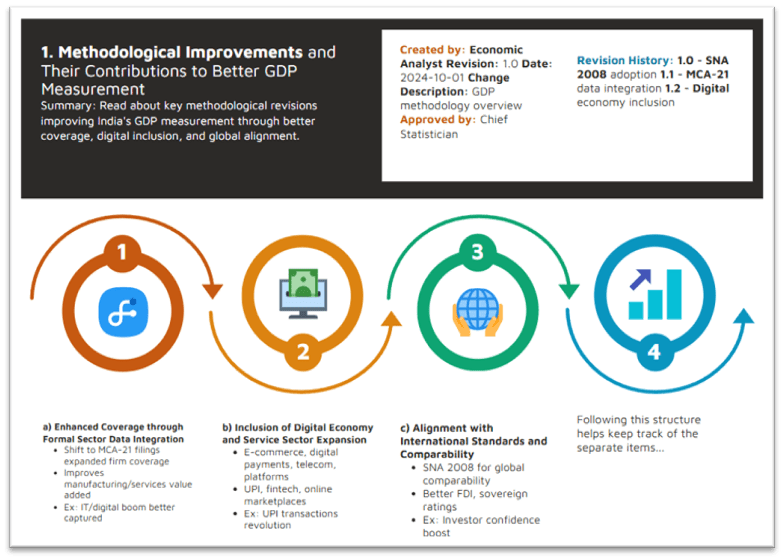
1. Methodological Improvements and Their Contributions to Better GDP Measurement
a) Enhanced Coverage through Formal Sector Data Integration
- The shift to enterprise-based estimation using MCA-21 corporate filings expanded coverage of registered firms, improving measurement of value added in manufacturing and services.
- This allowed better capture of financial services, IT sector expansion and corporate profitability, which are critical drivers of modern economic growth.
- Example: IT and digital services boom—growth in software exports and digital platforms has been more systematically recorded post-revision, aligning national accounts with structural changes.
b) Inclusion of Digital Economy and Service Sector Expansion
- Incorporation of e-commerce, digital payments, telecommunications, and platform-based services reflects the growing role of the digital economy, especially post-Digital India initiatives.
- Expansion in indicators such as UPI transactions, fintech services, and online marketplaces has improved estimation of previously undercounted service activities.
- Example: Digital Payments Revolution—rapid increase in UPI transactions indicates rising economic activity that traditional methods would have missed.
c) Alignment with International Standards and Comparability
- Adoption of System of National Accounts (SNA) 2008 framework ensures global comparability and credibility in international financial markets.
- Improved methodologies help in better investment perception, influencing FDI inflows and sovereign ratings.
- Example: Increased global investor confidence—India attracting consistent FDI inflows in sectors like manufacturing and services reflects perceived economic strength.
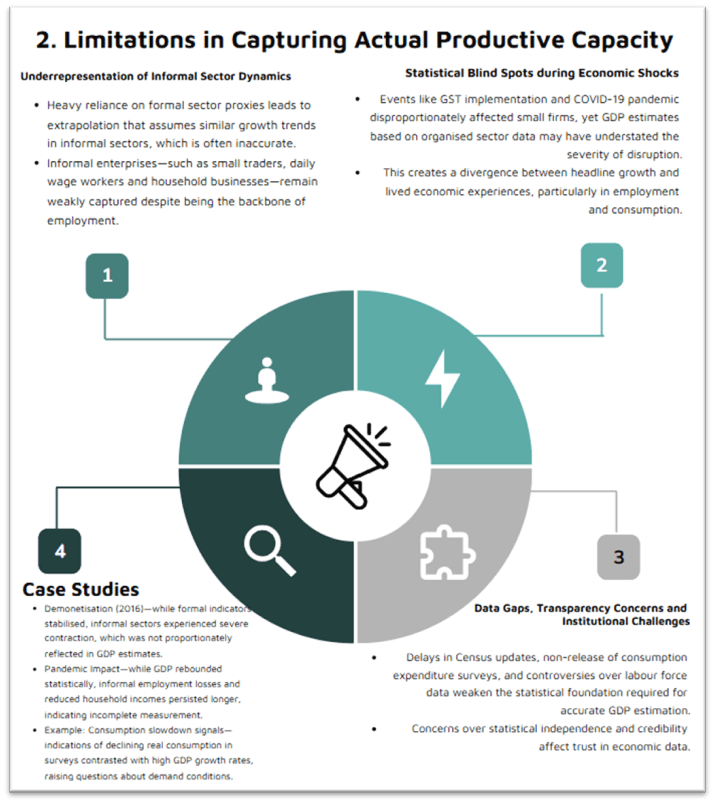
2. Limitations in Capturing Actual Productive Capacity
a) Underrepresentation of Informal Sector Dynamics
- Heavy reliance on formal sector proxies leads to extrapolation that assumes similar growth trends in informal sectors, which is often inaccurate.
- Informal enterprises—such as small traders, daily wage workers and household businesses—remain weakly captured despite being the backbone of employment.
- Case Study: Demonetisation (2016)—while formal indicators stabilised, informal sectors experienced severe contraction, which was not proportionately reflected in GDP estimates.
b) Statistical Blind Spots during Economic Shocks
- Events like GST implementation and COVID-19 pandemic disproportionately affected small firms, yet GDP estimates based on organised sector data may have understated the severity of disruption.
- This creates a divergence between headline growth and lived economic experiences, particularly in employment and consumption.
- Case Study: Pandemic Impact—while GDP rebounded statistically, informal employment losses and reduced household incomes persisted longer, indicating incomplete measurement.
c) Data Gaps, Transparency Concerns and Institutional Challenges
- Delays in Census updates, non-release of consumption expenditure surveys, and controversies over labour force data weaken the statistical foundation required for accurate GDP estimation.
- Concerns over statistical independence and credibility affect trust in economic data.
- Example: Consumption slowdown signals—indications of declining real consumption in surveys contrasted with high GDP growth rates, raising questions about demand conditions.
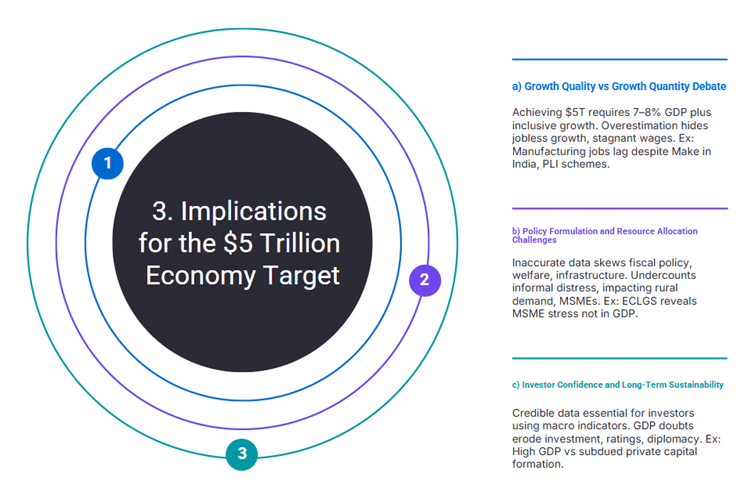
3. Implications for the $5 Trillion Economy Target
a) Growth Quality vs Growth Quantity Debate
- Achieving a $5 trillion economy depends not only on high GDP growth rates (7–8%) but also on broad-based, inclusive growth.
- Overestimation of growth may lead to misguided policy optimism, masking structural issues such as jobless growth and stagnant wages.
- Example: Manufacturing employment gap—despite policy focus (e.g., Make in India, PLI schemes), manufacturing has not generated proportional employment.
b) Policy Formulation and Resource Allocation Challenges
- Inaccurate measurement may distort fiscal policy, welfare targeting and infrastructure investment decisions.
- If informal distress is undercounted, policies may inadequately address rural demand, MSME support and employment generation.
- Example: MSME sector stress—credit schemes like Emergency Credit Line Guarantee Scheme (ECLGS) highlight recognition of sectoral distress not fully visible in GDP data.
c) Investor Confidence and Long-Term Sustainability
- Sustained economic expansion requires credible data systems, as investors rely on macroeconomic indicators for decision-making.
- Persistent doubts about GDP accuracy can affect investment flows, credit ratings and economic diplomacy.
- Example: Divergence between GDP growth and private investment trends—despite high reported growth, private capital formation has remained subdued, indicating underlying concerns.
Conclusion
The revision of GDP base years and inclusion of digital services have undoubtedly modernised India’s national accounting framework, enabling better capture of formal sector expansion and technological transformation.
However, the continued underrepresentation of informal sector realities, data gaps and methodological limitations constrain the ability of GDP to fully reflect India’s true productive capacity.
For a credible transition to a $5 trillion economy, India must strengthen statistical transparency, regularly update datasets such as Census and consumption surveys, and develop hybrid estimation models that integrate informal sector indicators.
A robust and trusted statistical system will not only enhance policy effectiveness but also ensure that economic growth is inclusive, measurable and sustainable in both perception and reality.
Recap: