
TB Mukt Bharat: How Opportunistic Screening and Microplanning Can Accelerate TB Elimination in India
Introduction
TB Mukt Bharat remains a key national goal as Tuberculosis (TB) continues to be one of India’s most pressing public health challenges, accounting for nearly one-fourth of the global TB burden, with over 25 lakh cases notified annually. Despite sustained efforts under the National Tuberculosis Elimination Programme (NTEP) and the national goal of achieving a “TB Mukt Bharat” by 2025, challenges such as delayed diagnosis, asymptomatic cases, and social stigma persist.
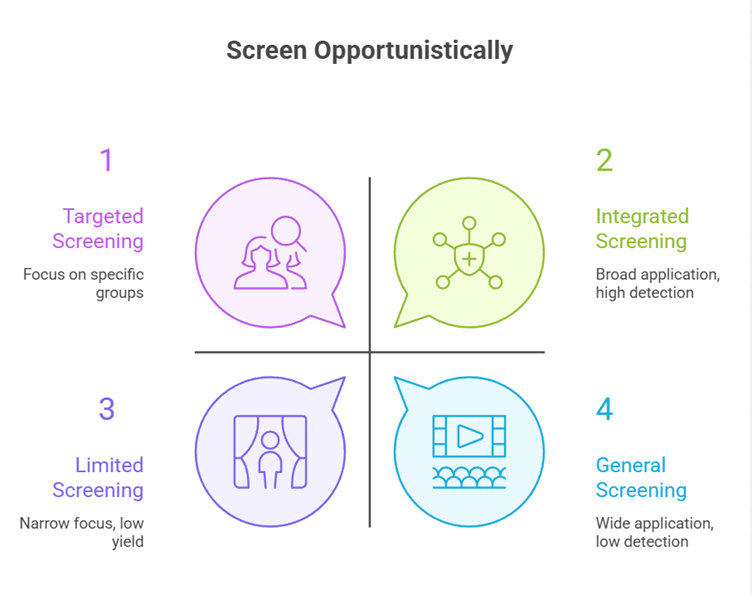
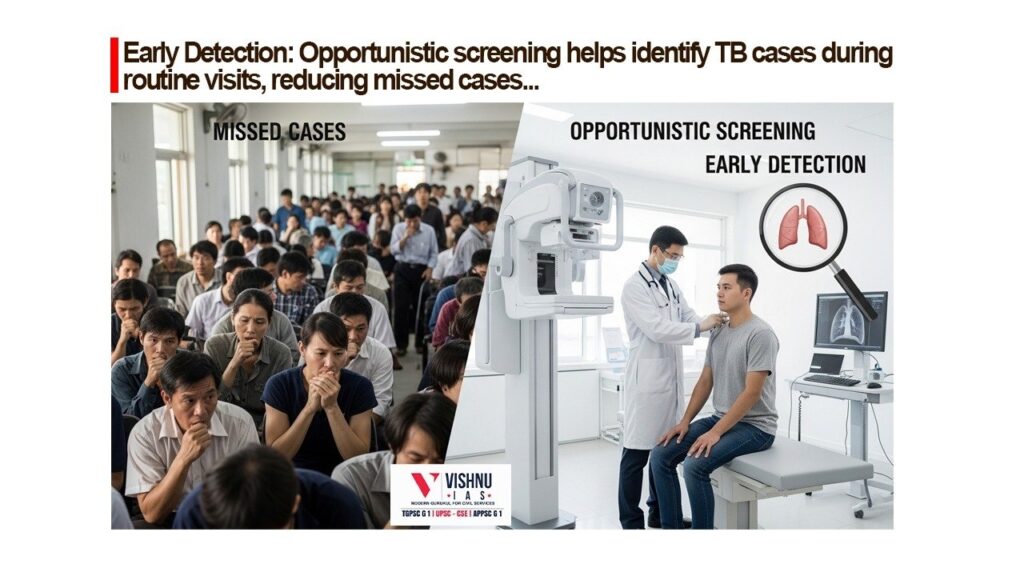
In this context, the integration of opportunistic screening (screening individuals accessing health services for other reasons) and microplanning at the primary care level emerges as a critical strategy to enhance early detection, reduce transmission, and ensure equitable access to care.
1. Role of Opportunistic Screening in Early Detection and Case Finding
Leveraging Routine Health Interactions for TB Detection
- Opportunistic screening uses existing patient inflow in hospitals and clinics to identify undiagnosed TB cases, especially where individuals present for unrelated ailments.
- With the integration of AI-enabled chest X-ray (CXR) systems, digital radiography can automatically flag suspicious lesions, enabling early referral for confirmatory testing.
- Example: Deployment of AI-integrated X-ray machines in district hospitals has helped detect TB cases among patients visiting for respiratory or general complaints.
Addressing Asymptomatic and Subclinical TB
- Evidence from national surveys highlights a significant proportion of asymptomatic TB cases, making symptom-based screening insufficient.
- Opportunistic screening helps identify such hidden cases, particularly among urban populations, elderly, and co-morbid individuals (e.g., diabetics).
- Case Study: In high-burden urban clusters like Mumbai slums, opportunistic screening during routine health visits has led to detection of early-stage TB, reducing community transmission.
Integration with Technological Advancements
- New near point-of-care (NPOC) molecular tests and non-sputum-based diagnostics (e.g., tongue swabs) improve feasibility of screening in diverse populations.
- Sputum pooling strategies and rapid molecular diagnostics like CBNAAT and Truenat enhance efficiency and scalability.
- Example: Introduction of Truenat machines in peripheral health centres has decentralised molecular testing, reducing diagnostic delays.
2. Importance of Microplanning for Targeted and Equitable Intervention
Identification of Vulnerable and High-Risk Populations
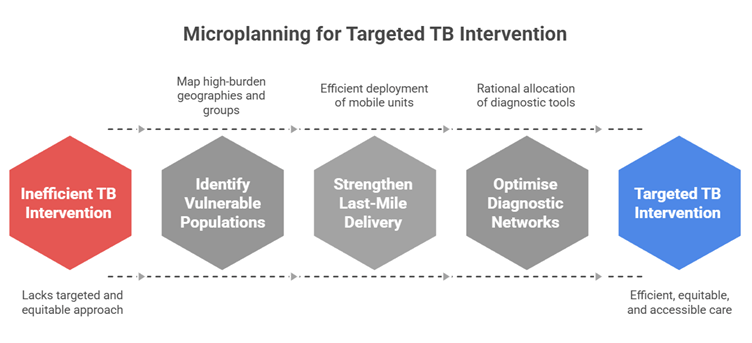
- Microplanning enables granular mapping of high-burden geographies such as tribal areas, urban slums, and migrant populations.
- Tailored interventions ensure prioritisation of socially vulnerable groups, including women, children, and the elderly.
- Example: Active case-finding campaigns under Pradhan Mantri TB Mukt Bharat Abhiyaan focus on high-risk clusters through community-level planning.
Strengthening Last-Mile Service Delivery
- Microplanning ensures efficient deployment of mobile diagnostic units, portable CXR vans, and sputum collection networks.
- It reduces diagnostic attrition by enabling on-the-spot sample collection and referral linkages.
- Case Study: In tribal districts of Odisha, microplanning facilitated door-to-door screening and same-day sample collection, significantly improving case notification rates.
Optimisation of Diagnostic Networks
- Rational allocation of diagnostic tools—AI-enabled CXR, molecular tests, and ultrasound for extra-pulmonary TB—ensures cost-effective and accessible care.
- It supports diagnostic cascade completion, including timely drug-resistance testing.
- Example: Use of diagnostic network optimisation models in states like Gujarat has improved turnaround time for TB diagnosis and treatment initiation.
3. Combined Impact on TB Elimination and Systemic Strengthening
Reduction in Diagnostic Delays and Transmission
- Early detection through opportunistic screening combined with microplanning reduces the infectious period, thereby lowering transmission rates.
- Faster diagnosis ensures early initiation of appropriate treatment, including for drug-resistant TB.
- Example: Integration of screening strategies has contributed to improved treatment success rates exceeding 85% in several states.
Enhancing Patient-Centric and Community-Based Care
- Integration supports a person-centred approach, linking diagnosis with nutritional support (Nikshay Poshan Yojana) and counselling.
- TB Champions (survivor-led initiatives) play a key role in reducing stigma and improving treatment adherence.
- Case Study: Survivor-led peer support networks in Maharashtra have improved treatment completion rates and reduced self-stigmatisation.
Reducing Out-of-Pocket Expenditure and Health Inequities
- Public sector expansion of diagnostics reduces reliance on expensive private care, lowering catastrophic health expenditure.
- Microplanning ensures equitable access across socio-economic strata.
- Example: Free diagnostics and treatment under NTEP, combined with decentralised testing, have significantly reduced financial burden on TB patients.
Conclusion
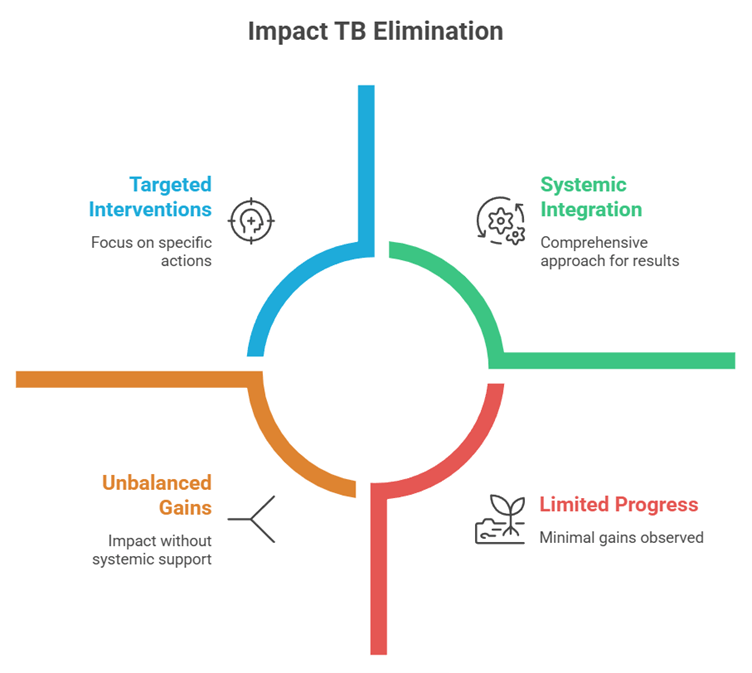
The integration of opportunistic screening and microplanning at the primary care level has the potential to act as a force multiplier in India’s fight towards TB Mukt Bharat by enabling early detection, targeted intervention, and equitable healthcare delivery.
However, its success depends on strengthening health system capacity, diagnostic infrastructure, and community participation. With India already demonstrating declining TB incidence and mortality trends, sustained investment in AI-driven diagnostics, decentralised molecular testing, and community-led models can accelerate progress.
A strategically integrated, evidence-based approach can significantly advance the vision of a TB-free India, ensuring that no case goes undetected and no patient is left behind.
Recap: