
India Strategy to Counter Unilateral Trade Sanctions: Coalition-Building and Global Trade Power Balance
India strategy to counter unilateral trade sanctions involves a mix of legal measures, economic diversification, and coalition-building with other nations to reduce dependence and balance global trade power asymmetry.
Introduction
- Unilateral trade sanctions refer to measures such as tariffs, import restrictions, or trade barriers imposed by a country without multilateral approval, often justified under domestic laws like Section 301 or Section 122 of the Trade Act of 1974. These actions challenge the rules-based multilateral trading system anchored in the World Trade Organization.
- Recent developments—such as unilateral tariff surcharges and revival of aggressive trade instruments—highlight a broader trend where global trade is shifting from rule-based cooperation to power-based bargaining.
- This is significant as global merchandise trade, which accounts for nearly 50% of world GDP, relies heavily on predictable and transparent trade rules. Reports by institutions such as the World Bank indicate that rising trade protectionism could reduce global trade growth by over 1–2 percentage points annually, disproportionately affecting developing economies like India.
1. Strategic Options Available to India to Counter Unilateral Trade Sanctions
a) Strengthening Legal and Institutional Responses
- India can actively utilize the dispute settlement mechanism of the World Trade Organization by filing cases against WTO-inconsistent tariffs, as seen in Example: India vs US solar panel dispute, where India challenged domestic content requirements.
- Even amid the paralysis of the Appellate Body, India can leverage interim arbitration mechanisms (MPIA) supported by the European Union to ensure dispute resolution continuity.
- Domestically, India can align its trade remedy frameworks (anti-dumping, safeguards) with global standards through institutions like DGTR (Directorate General of Trade Remedies) to ensure reciprocal action.
b) Diversification of Trade Partnerships and Supply Chains
- India is actively pursuing Free Trade Agreements (FTAs) such as those with the United Arab Emirates (CEPA) and Australia (ECTA), reducing overdependence on any single dominant market.
- Case Study: Supply Chain Resilience Initiative (SCRI) involving India, Japan, and Australia aims to counter supply chain vulnerabilities exposed during global disruptions.
- Government initiatives like PLI (Production Linked Incentive Scheme) enhance domestic manufacturing competitiveness, reducing exposure to external trade shocks.
c) Strategic Use of Retaliation and Negotiation Tools
- India can impose proportionate retaliatory tariffs consistent with WTO norms, as done in response to US steel and aluminum tariffs (2018).
- Parallelly, engaging in bilateral negotiations allows India to extract concessions while avoiding escalation into trade wars.
- Leveraging market access as a bargaining chip, especially in sectors like pharmaceuticals and digital services, strengthens India’s negotiating position.
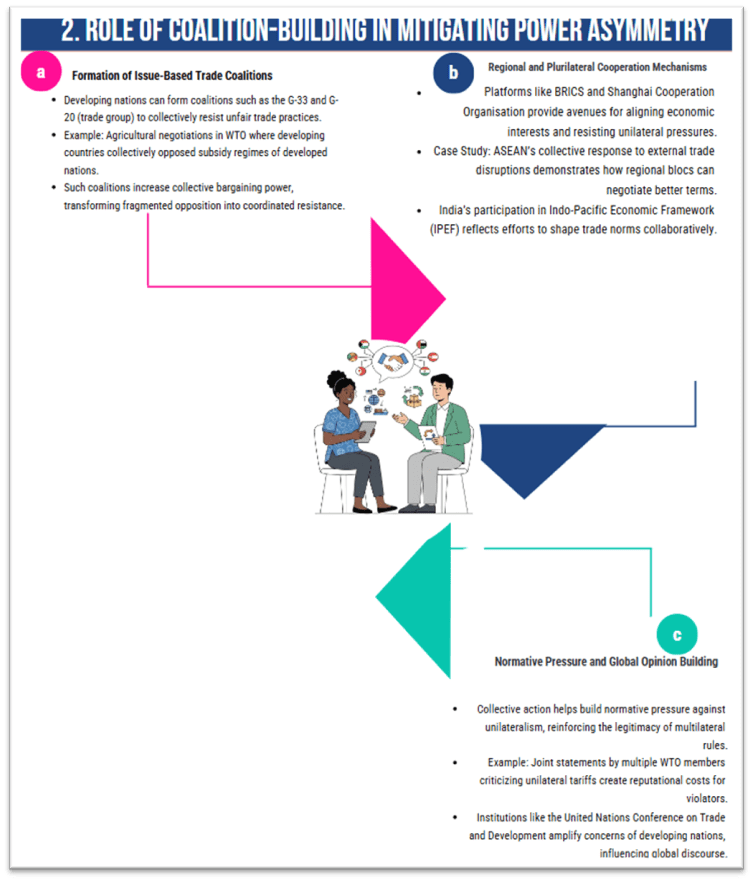
2. Role of Coalition-Building in Mitigating Power Asymmetry
a) Formation of Issue-Based Trade Coalitions
- Developing nations can form coalitions such as the G-33 and G-20 (trade group) to collectively resist unfair trade practices.
- Example: Agricultural negotiations in WTO where developing countries collectively opposed subsidy regimes of developed nations.
- Such coalitions increase collective bargaining power, transforming fragmented opposition into coordinated resistance.
b) Regional and Plurilateral Cooperation Mechanisms
- Platforms like BRICS and Shanghai Cooperation Organisation provide avenues for aligning economic interests and resisting unilateral pressures.
- Case Study: ASEAN’s collective response to external trade disruptions demonstrates how regional blocs can negotiate better terms.
- India’s participation in Indo-Pacific Economic Framework (IPEF) reflects efforts to shape trade norms collaboratively.
c) Normative Pressure and Global Opinion Building
- Collective action helps build normative pressure against unilateralism, reinforcing the legitimacy of multilateral rules.
- Example: Joint statements by multiple WTO members criticizing unilateral tariffs create reputational costs for violators.
- Institutions like the United Nations Conference on Trade and Development amplify concerns of developing nations, influencing global discourse.
3. Limitations and Effectiveness of Coalition-Building
a) Structural Constraints and Diverging Interests
- Coalitions often face internal divergences due to differing economic priorities (e.g., exporters vs import-dependent countries).
- Example: Differences within developing countries during WTO Doha Round negotiations led to limited progress.
- Power asymmetry persists as developed economies control capital, technology, and financial systems.
b) Institutional Weaknesses in Global Trade Governance
- The paralysis of the WTO Appellate Body undermines enforcement, reducing the effectiveness of collective action.
- Case Study: US blocking Appellate Body appointments weakened dispute resolution, allowing unilateral measures to persist.
- Absence of binding enforcement mechanisms limits the deterrence capacity of coalitions.
c) Continued Dominance of Economic and Strategic Leverage
- Developed economies wield influence through currency dominance, financial systems, and market size.
- Example: Sanctions regimes and tariff threats often force smaller economies into compliance despite coalition efforts.
- However, coalitions can still raise the cost of unilateralism, even if they cannot fully neutralize it.
Conclusion
- While unilateral trade sanctions challenge the credibility of the global trading system, India possesses a multi-pronged strategy combining legal recourse, economic diversification, and strategic negotiation.
- Coalition-building, though constrained by structural and institutional limitations, remains a critical instrument in balancing asymmetries, as evidenced by collective resistance shaping trade norms over time. Strengthening multilateral institutions, restoring dispute resolution mechanisms, and deepening South-South cooperation can ensure a more equitable trade order.
- As global trade is projected to grow steadily despite disruptions, fostering resilient and rules-based frameworks will be essential to safeguarding the interests of emerging economies like India.
- While unilateral trade sanctions challenge the credibility of the global trading system, India possesses a multi-pronged strategy combining legal recourse, economic diversification, and strategic negotiation.
- Coalition-building, though constrained by structural and institutional limitations, remains a critical instrument in balancing asymmetries, as evidenced by collective resistance shaping trade norms over time. Strengthening multilateral institutions, restoring dispute resolution mechanisms, and deepening South-South cooperation can ensure a more equitable trade order.
- As global trade is projected to grow steadily despite disruptions, fostering resilient and rules-based frameworks will be essential to safeguarding the interests of emerging economies like India.
Recap: