
Iran War Impact on India: How West Asia’s Strategic Reordering Constrains India’s Strategic Space
Iran War Impact on India is becoming increasingly significant as the ongoing Iran–Israel–U.S. confrontation reshapes the geopolitical architecture of West Asia. The region remains one of the most geopolitically sensitive areas in the international system due to its concentration of hydrocarbon resources, critical maritime chokepoints, and ideological conflicts.
According to the International Energy Agency, nearly one-third of global oil trade passes through the Strait of Hormuz, while West Asia supplies over 60% of India’s crude oil imports and hosts more than 9 million Indian diaspora members whose remittances significantly support India’s economy.
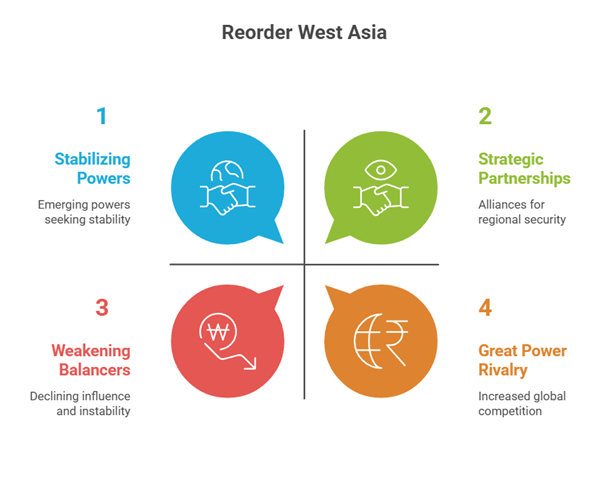
The ongoing Iran–Israel–U.S. confrontation, increasingly interpreted as a conflict aimed at altering the ideological and political foundations of the Iranian regime rather than merely dismantling military capabilities, is triggering a broader reordering of West Asia’s strategic architecture. This transformation—characterised by shifting alliances, weakening regional balances and rising great-power competition—directly constrains India’s strategic autonomy, regional outreach and global diplomatic space.
I. Strategic Reordering of West Asia: Changing Power Structures
1. Decline of Iran as a Regional Balancer and Rise of New Power Aspirants
Potential weakening of Iran’s strategic influence due to sustained military strikes on its security infrastructure, oil installations and proxy networks alters the regional balance of power, creating a vacuum that countries such as Türkiye, Saudi Arabia and Pakistan may attempt to fill.
Iran has historically projected power through non-state actors such as Hezbollah in Lebanon, the Houthis in Yemen and Shia militias in Iraq, forming the so-called “Axis of Resistance.” Weakening this network reshapes regional political alignments.
Example – Hezbollah in Lebanon: Iran’s long-standing support allowed Hezbollah to function as a “state within a state”, influencing Lebanese politics and confronting Israel. Erosion of this axis weakens Iran’s deterrence while enabling new regional coalitions.
2. Consolidation of Israel-Gulf Strategic Partnerships
The Abraham Accords, which normalised relations between Israel and several Arab states, have accelerated the regional strategic alignment against Iran, with Gulf monarchies prioritising security stability over the Palestinian issue.
These alignments are reinforced by shared concerns over Iran’s missile programme and ideological outreach, particularly the concept of exporting revolutionary ideology.
Example – Gulf–Israel Security Cooperation: Intelligence sharing and missile defence coordination between Israel and Gulf countries indicate a new regional security bloc, reducing the space for neutral actors to manoeuvre.
3. Intensification of Great Power Rivalry in West Asia
The conflict has drawn deeper involvement from global powers, especially the United States, which seeks to reorder the regional security architecture, while China and Russia view prolonged U.S. engagement as strategically advantageous.
Rising oil prices benefit Russia, while geopolitical distractions for the United States may strengthen China’s strategic calculations in areas like Taiwan.
Example – Ukraine War Parallel: Russia has often used energy politics during the Ukraine conflict to expand influence; similarly, West Asian instability provides Moscow leverage in global energy markets.
II. Constraints on India’s Strategic and Economic Interests
1. Energy Security Vulnerabilities
India imports nearly 85% of its crude oil, with a majority sourced from West Asia, making disruptions in the Strait of Hormuz or attacks on energy infrastructure a major economic risk.
Iran has historically been an important energy partner for India, and sanctions or war limit options for diversified energy sourcing.
Example – 2019 Strait of Hormuz Tensions: Earlier disruptions raised shipping insurance costs and crude prices, demonstrating India’s exposure to regional instability.
Government Initiative – Strategic Petroleum Reserves: India has established reserves in locations like Visakhapatnam, Mangaluru and Padur, intended to cushion supply shocks, though they cover only limited weeks of demand.
2. Impact on Connectivity and Trade Corridors
India’s regional connectivity initiatives rely significantly on Iran as a gateway to Central Asia and Afghanistan, particularly through the Chabahar Port and the International North-South Transport Corridor (INSTC).
Regime instability or increased U.S. pressure on Iran could undermine these projects, constraining India’s access to Eurasian markets and reducing its ability to counterbalance competing infrastructure networks.
Example – Chabahar Port Project: Developed with Indian assistance to bypass Pakistan and access Afghanistan and Central Asia, the project faces delays due to sanctions and geopolitical tensions.
3. Security Risks for Indian Diaspora and Maritime Interests
West Asia hosts the largest overseas Indian population, especially in Gulf countries such as Saudi Arabia, the UAE and Qatar, making regional instability a humanitarian and diplomatic concern.
Escalating conflict may lead to missile attacks on Gulf energy infrastructure, maritime insecurity and disruption of shipping lanes critical for India’s trade.
Example – Operation Rahat (2015): India evacuated thousands of citizens during the Yemen conflict, highlighting the scale of diaspora protection challenges in conflict zones.
III. Diplomatic and Strategic Constraints on India’s Foreign Policy
1. Balancing Relations Among Rival Regional Actors
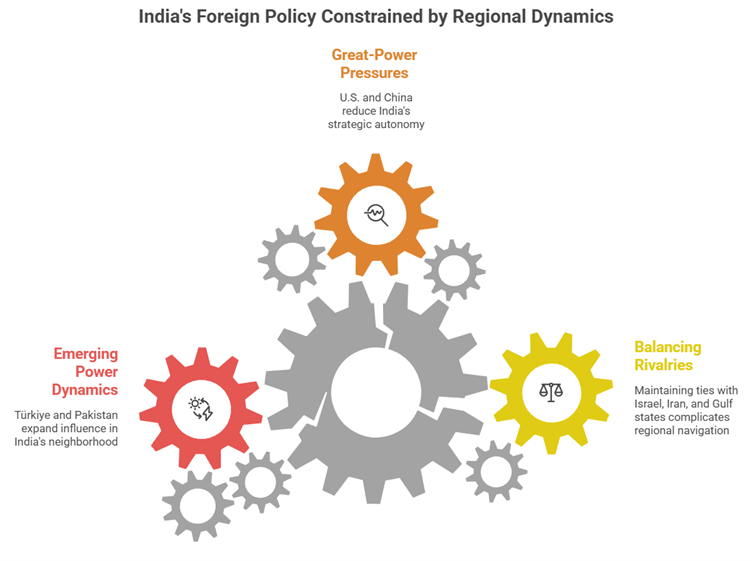
India maintains simultaneously strong ties with Israel, Iran and the Gulf monarchies, making regional polarisation increasingly difficult to navigate.
Israel is a critical partner in defence technology and intelligence cooperation, while Iran remains vital for connectivity and energy diplomacy.
Example – Defence Cooperation with Israel: India is among the largest importers of Israeli defence systems such as air defence and surveillance technologies, reflecting strategic interdependence.
2. Reduced Strategic Autonomy Amid Great-Power Pressures
Heightened U.S. involvement in the conflict may push regional partners into security alignments dominated by Washington, reducing India’s ability to pursue independent diplomatic initiatives.
Simultaneously, China’s expanding economic presence in the Gulf through infrastructure investments and energy partnerships increases competitive pressures on India.
Example – China-Gulf Energy Partnerships: China has become the largest trading partner of several Gulf states, strengthening Beijing’s leverage in the region.
3. Emerging Regional Power Dynamics Affecting India’s Neighbourhood
With a weakened Iran, other regional powers such as Türkiye and Pakistan may expand their strategic influence, particularly in Central Asia and the Islamic world, potentially affecting India’s diplomatic outreach.
Pakistan may attempt to leverage Islamic solidarity narratives and closer ties with Gulf states to shape regional political discourse.
Example – Türkiye’s Expanding Role: Türkiye has increasingly projected itself as a security and ideological leader in parts of the Muslim world, influencing conflicts in Syria, Libya and beyond.
Conclusion
The evolving conflict involving Iran is reshaping West Asia’s strategic and security architecture, marked by new alliances, declining traditional balances and intensified great-power competition. For India, whose economic growth and external engagement depend heavily on stable energy supplies, secure sea lanes and balanced diplomacy, these transformations significantly constrain strategic space.
Going forward, India will need to strengthen multi-vector diplomacy, deepen energy diversification including renewables and alternative suppliers, and enhance regional engagement through platforms such as the India–Middle East–Europe Economic Corridor and maritime security cooperation in the Indian Ocean.
With global energy demand projected by the International Energy Agency to remain substantial for decades, ensuring stability in West Asia while preserving strategic autonomy and diversified partnerships will remain central to India’s long-term foreign policy approach.
Recap: