
Jagdeep Dhankhar’s Resignation: A Turning Point in Executive–Legislative Relations and Constitutional Autonomy
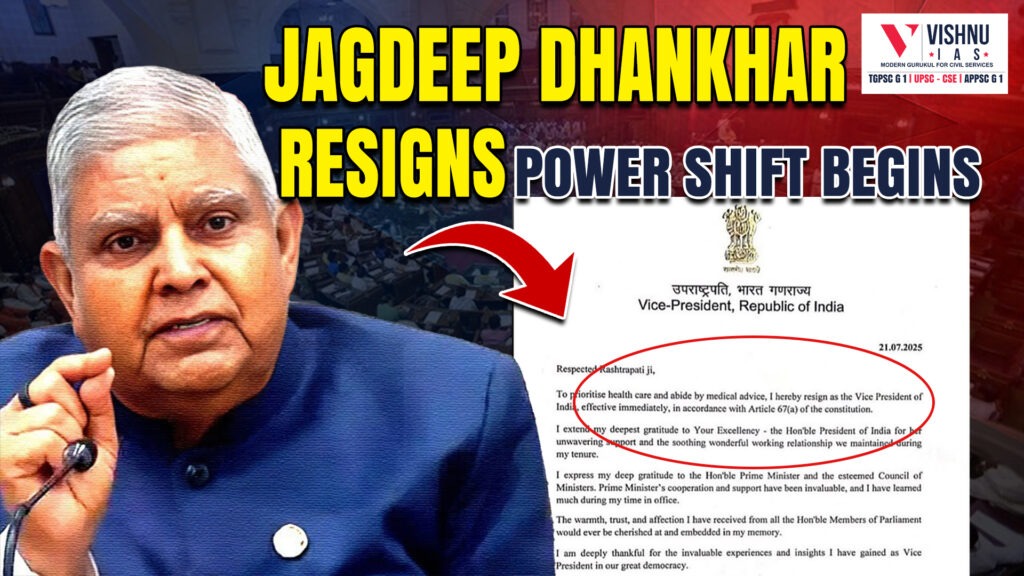
Jagdeep Dhankhar’s resignation marks a historic moment in India’s political landscape, revealing the growing tensions between the executive and legislature, and raising urgent questions about the autonomy of constitutional offices. The Vice-President of India, ex-officio Chair of the Rajya Sabha, occupies a pivotal constitutional role at the nexus of executive and legislature. On July 21, 2025, Jagdeep Dhankhar became the first Vice-President in the Republic’s history to resign mid-term—citing health reasons—amid clashes over parliamentary procedure and judicial accountability. His departure, coming on the first day of the Monsoon Session, exposed deeper frictions between the ruling executive and parliamentary independence.
Constitutional Role and Partisan Controversies
- In his role as Chair of the Rajya Sabha, Dhankhar staunchly defended the supremacy of Parliament, openly contesting Supreme Court rulings such as the NJAC verdict, and positioning himself as a "foot soldier" for judicial accountability.
- He raised questions regarding the presence of the terms 'secular' and 'socialist' in the Preamble, resonated with the RSS's calls for discussion, and considered Opposition proposals to impeach two High Court judges, including Yashwant Varma, based on allegations of corruption.
- His actions prompted a no-confidence motion in December 2024—the first of its kind against a sitting Vice-President—highlighting significant polarization within the Upper House.
Impeachment Motion vs Government Script
- On July 21, Dhankhar acknowledged an Opposition notice regarding the removal of Justice Varma, even as the government was formulating its own motion for the Lok Sabha, thus obligating the Treasury bench to comply with parliamentary regulations concerning impeachment procedures.
- Law Minister Kiren Rijiju and Leader of the House J. P. Nadda did not attend his afternoon Business Advisory Committee meeting without prior notification, indicating a deterioration in the coordination between the executive and legislative branches.
- By demanding signature verifications and the admission of motions, Dhankhar conformed to the Judges (Inquiry) Act and Standing Orders, which placed him in conflict with the legislative agenda of the government.
Executive–Legislative Tension and Ruling Party Dynamics
- His stringent enforcement of regulations irritated senior ministers, undermining trust and sidelining the Chair’s office within the ruling BJP-led coalition.
- In private discussions, tensions had been escalating due to his public criticisms of the judiciary (for instance, referring to the Supreme Court as a “super Parliament”) and his readiness to meet Opposition demands—a rare stance for an office that typically remains apolitical.
- Confronted with ongoing violations of protocol and a perception that Dhankhar was no longer aligned with the government's position, the power centers in New Delhi may have considered his departure essential.
Implications for Institutional Autonomy and Parliamentary Democracy
- The sudden departure of the Vice-President diminishes the Chair’s perceived neutrality, compromises oversight of executive actions, and deters future officeholders from enforcing rules vigorously.
- This establishes a concerning precedent: Chairs who obstruct government initiatives may face compelled resignations, thereby stifling legislative autonomy.
- By marginalizing a constitutional position through intra-party tactics, the separation of powers encounters new strains, and public trust in parliamentary discussions declines.
Safeguarding Constitutional Offices: Way Forward
- Establish a formal Code of Conduct for parliamentary Chairs, elucidating their responsibilities regarding impartiality, adherence to rules, and mechanisms for resolving conflicts with the executive.
- Enhance the autonomy of the Rajya Sabha Secretariat by protecting funding and staffing decisions from direct influence by ministers.
- Create cross-party consultative forums for significant parliamentary committees (such as the BAC) to prevent unilateral actions by the executive.
- Facilitate Vice-Presidential appointments through a wider consensus—potentially through a designated parliamentary committee—to promote non-partisanship.
- Incorporate regular orientation and legal training for constitutional office-holders concerning their rights and responsibilities in relation to the executive.
Conclusion:
Jagdeep Dhankhar’s resignation underscored an acute clash between democratic procedure and executive convenience. It highlighted the Chair’s vital role in enforcing parliamentary rules and the fragility of institutional autonomy in the face of partisan pressures. To preserve India’s parliamentary democracy, mechanisms that protect the impartiality and security of constitutional offices—coupled with a mature, rules-based interface between government and legislature—are indispensable.