
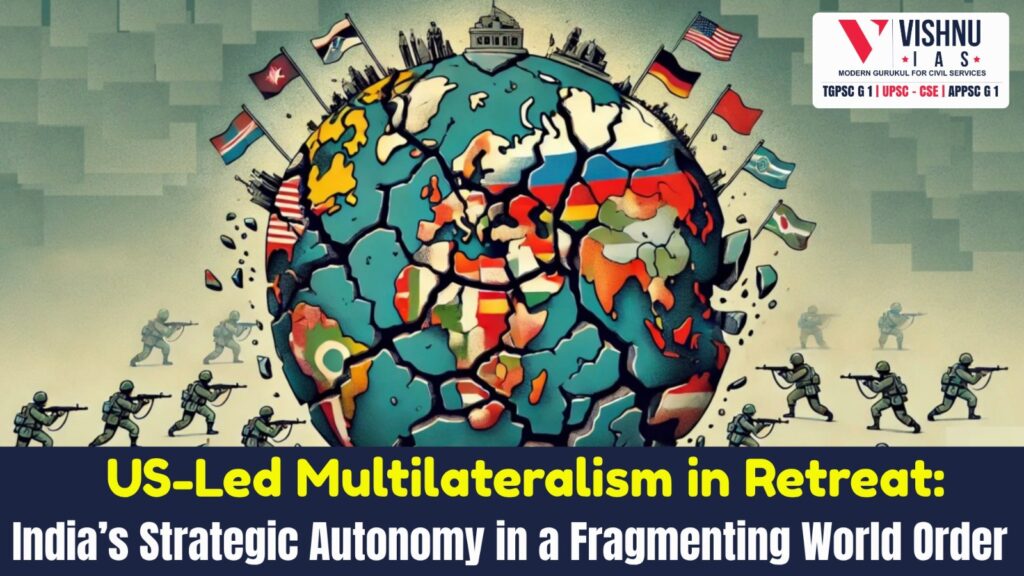
India’s Strategic Autonomy in a Post-Multilateral World: US Retreat and Global Order Shifts
SYLLABUS: GS2 – INTERNATIONAL RELATIONSStrategic Autonomy has emerged as a key pillar of India’s foreign policy, especially in the backdrop of the declining multilateral order once shaped and now seemingly dismantled by the United States. As the global governance architecture undergoes fragmentation, India’s evolving diplomatic playbook presents a compelling case of balancing tradition with innovation.
Introduction:
- Multilateralism refers to a system of coordinating relations among three or more states in pursuit of common objectives, typically through international institutions or norms such as the United Nations (UN), World Trade Organization (WTO), and International Monetary Fund (IMF).
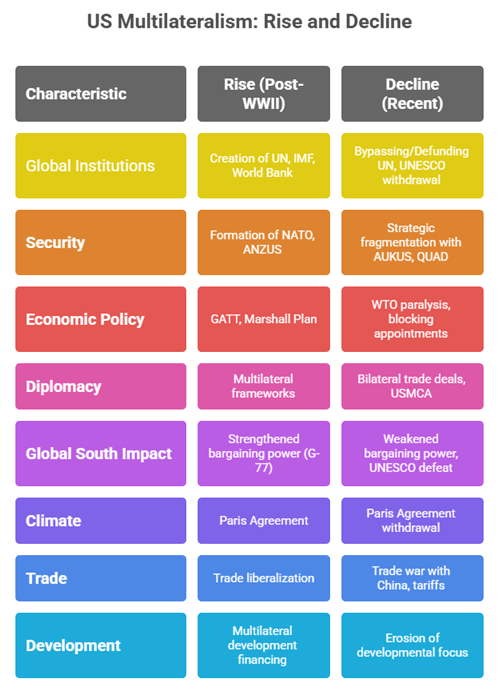
- It gained prominence after World War II, with the United States playing a foundational role in shaping the post-war liberal international order through initiatives like the Bretton Woods institutions, Marshall Plan, and the establishment of NATO.
- However, contemporary global dynamics point to a significant erosion of multilateralism, with the United States itself contributing to its undoing. This reversal became particularly stark under the Trump presidency, which witnessed the U.S. withdrawing from key multilateral agreements, imposing unilateral tariffs, and promoting "America First" foreign policy. Even under subsequent administrations, the underlying trend persists.
The Rise and Decline of U.S.-Driven Multilateralism
- Foundations of U.S.-Led Multilateral Order
Post-WWII institutions such as the UN, IMF, World Bank, and WTO were created under U.S. leadership.
Example: The U.S. contributed over 22% of the UN's regular budget in the 20th century. - Security Architecture: Creation of NATO and Asia-Pacific alliances like ANZUS ensured deterrence and collective security.
- Economic Globalization: The Marshall Plan and GATT laid the foundation for liberal trade and economic integration.
- Gradual Retreat from Global Institutions
UN marginalization, withdrawal from the Paris Climate Accord, and WTO blockage show strategic retreat.
Example: The U.S. exit from UNESCO and defunding of the UN Human Rights Council. - Bilateralism over Collective Action
The USMCA replaced NAFTA. Trade wars bypass WTO. Deals like AUKUS and QUAD signify shift toward minilateralism. - Impact on Global South
Weakened bargaining power of G-77, less developmental finance, and India’s defeat at UNESCO are indicative of multilateral decline.
Example: The BRICS 2025 Summit avoided directly criticizing this trend despite extensive declarations.
India’s Position in a Fragmented Global Order
- Strategic Autonomy and Non-Alignment 2.0
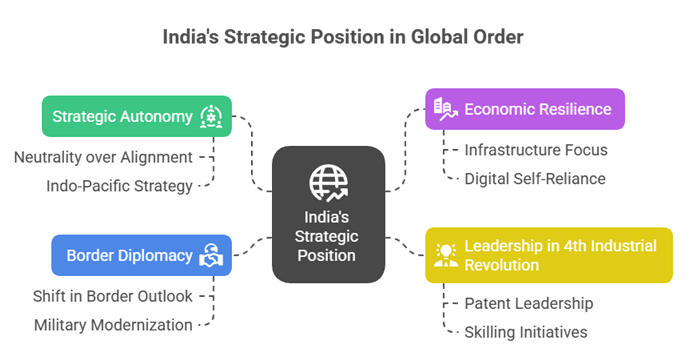
India’s abstention on Russia-related resolutions and multi-vector engagement with BRICS, QUAD, and ASEAN show policy of neutrality.
Initiatives like ‘Neighbourhood First’ and SAGAR project regional self-reliance. - Atmanirbhar Bharat and Economic Resilience
Massive infrastructure development through PM Gati Shakti and Digital India reduce dependence on external systems.
India’s DPI exports (UPI, CoWIN) strengthen digital multilateralism. - Leadership in the Fourth Industrial Revolution
India’s dominance in AI patents, skill development schemes, and robust startup ecosystem reflect proactive innovation policy.
Example: India is now 3rd largest startup hub. - Border Diplomacy and De-escalation
Mature handling of China and Pakistan border issues emphasizes diplomatic engagement over military escalation.
Operation Sindoor and modernization of forces highlight strategic flexibility.
The Future of Global Cooperation Post-Multilateralism
- Rise of Minilateralism
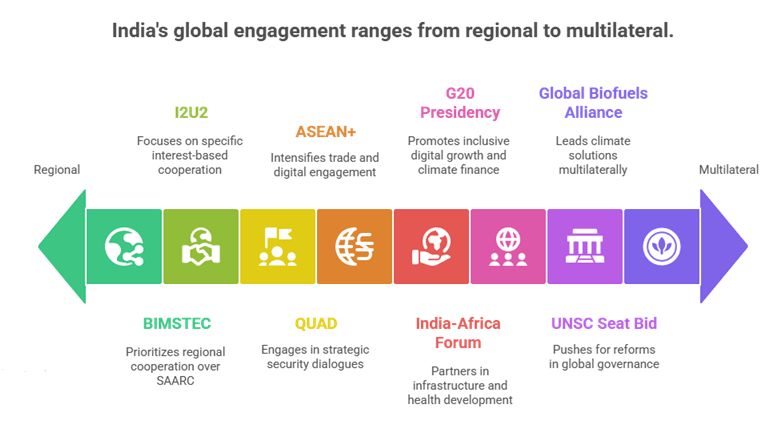
QUAD, I2U2, and BRICS+ are interest-driven mini-groupings replacing grand multilateral platforms.
Example: BIMSTEC rising over SAARC due to political blockages. - South-South Trade and Value Chains
Trade shift toward Africa and ASEAN is essential.
Example: India-Mauritius CECPA as a template for Global South partnerships. - India’s Global Aspirations
Projected to be 3rd largest economy by 2027 with demographic and soft power assets.
Use of cultural diplomacy and Sanskrit AI signifies new soft power dimensions. - Global Governance Reforms
Push for UNSC reforms, legacy of G20 Presidency, and leadership in Global Biofuels Alliance mark India’s ambition to influence future global frameworks.
Conclusion:
- The erosion of multilateralism by the very power that built it — the United States — marks a historic inflection point in global governance.
- This disruption creates space for emerging powers like India to redefine the world order through strategic autonomy, technological leadership, and Global South cooperation.
- The upcoming BRICS 2026 Summit hosted by India offers a platform to promote consensus, growth, and digital multilateralism rooted in equitable progress rather than bloc politics.
- According to a 2025 Pew Research survey, over 64% of citizens in the Global South now believe regional leadership, not Western multilateralism, is the path to progress.