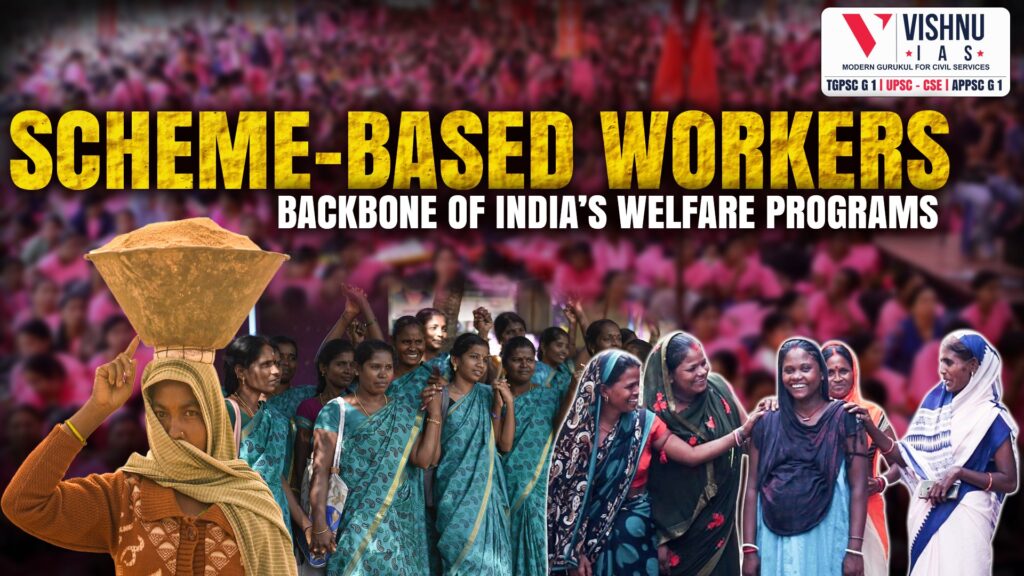
Scheme-Based Workers: Backbone of India’s Welfare Programs
Introduction
Scheme-Based Workers (SBWs) are the millions of primarily women frontline workers implementing India’s flagship welfare schemes. Examples include Anganwadi workers/helpers under ICDS, ASHAs under the National Health Mission, and Mid-Day Meal (MDM) cooks/helpers. These workers perform critical socio-developmental tasks such as preschool education, maternal nutrition, health outreach, and school meal preparation.
Despite their vital contributions, they are classified as “volunteers” or contract workers and receive only honorariums without basic job benefits like leaves, pensions, or job security.

Legal Status: “Volunteers,” Not Employees
- SBWs are ambiguously classified as volunteers rather than formal employees.
- The Supreme Court and various state governments have historically upheld this classification, which denies them statutory benefits.
- Recent judicial pronouncements, however, have challenged this approach, highlighting contradictions in their employment status. Courts have begun to recognize that SBWs perform essential services comparable to public health and education, suggesting they deserve labour protections.
- Despite some state courts granting benefits like gratuity and higher pay, there is no uniform national framework, leaving SBWs in a legal grey zone.
Socio-Economic Realities: Wages and Workloads
- SBWs are burdened with heavy workloads and receive meagre honorariums.
- Anganwadi workers earn around ₹10,000 per month on average, while helpers and midday meal cooks often earn far less, some as little as ₹1,000 monthly.
- ASHA workers receive task-based incentives, with most earning below any living wage threshold.
- These low wages are compounded by extensive responsibilities, with many SBWs working long hours under challenging conditions, particularly during crises like the COVID-19 pandemic.
Collective Mobilization and Strikes
- SBWs have increasingly mobilized to demand better wages and recognition. Protests and strikes have been held nationwide, with demands for regularization, minimum wages, and social security.
- Notable examples include protests by Mid-Day Meal workers in Delhi, Anganwadi worker strikes in Kerala, and ASHA demonstrations in several states.
- These movements often emphasize the recognition of SBWs as workers rather than volunteers, framing their struggles as part of women workers’ rights movements.
Trade Union and Political Dynamics
- SBWs are organized through unions often affiliated with major political parties.
- Key organizations include the All India Federation of Anganwadi Workers & Helpers and the Mid-Day Meal Workers’ Federation.
- While opposition parties frequently support SBWs’ demands, the ruling government has largely resisted formalizing their status. This has turned SBWs’ rights into a contested political issue, with demands for their recognition as workers often sidelined by government policies emphasizing voluntarism.
International Comparisons
- India’s treatment of SBWs is an outlier globally.
- In most OECD and BRICS countries, equivalent roles are regularized, with workers receiving formal salaries, benefits, and legal protections.
- For instance, Brazil integrates community health agents into the public health system, and many European nations employ similar roles under labour laws.
- By contrast, India’s reliance on “honorarium” models for SBWs reflects a policy choice to externalize labour costs.
Policy Response: Insufficient and Ad Hoc
- Government responses to SBW issues have been reactive and fragmented.
- While occasional honorarium hikes are announced, there is no comprehensive policy to provide SBWs with living wages or labour protections.
- Social security coverage remains inconsistent, and many administrations resist collective bargaining efforts. Without strategic reforms, SBWs continue to face precarious employment conditions.
Policy Recommendations
To address these issues, the government should consider the following reforms:
- Statutory Formalization: Recognize SBWs as government employees or create a contractual cadre under law.
- Minimum Wages and Benefits: Guarantee minimum wages (e.g., ₹21,000/month) and provide social security, including provident fund, pensions, and medical benefits.
- Legislative Action: Amend labour codes to explicitly include SBWs or issue national directives aligning their rights with their responsibilities.
- Standardized Pay Scales: Ensure consistent pay scales across states to prevent disparities.
- Social Dialogue: Involve trade unions and civil society in policy-making to set sector-wide norms.
Conclusion
SBWs are indispensable to India’s welfare programs. Ensuring they receive fair wages and labour rights is not only an economic imperative but also a matter of social justice. Recognizing their contributions through improved employment conditions would reflect a commitment to equity and dignity for the workers who sustain India’s welfare infrastructure.