UPSC Economy Analysis: Weakening Rupee and Rising Input Costs Impact on Inflation and Growth
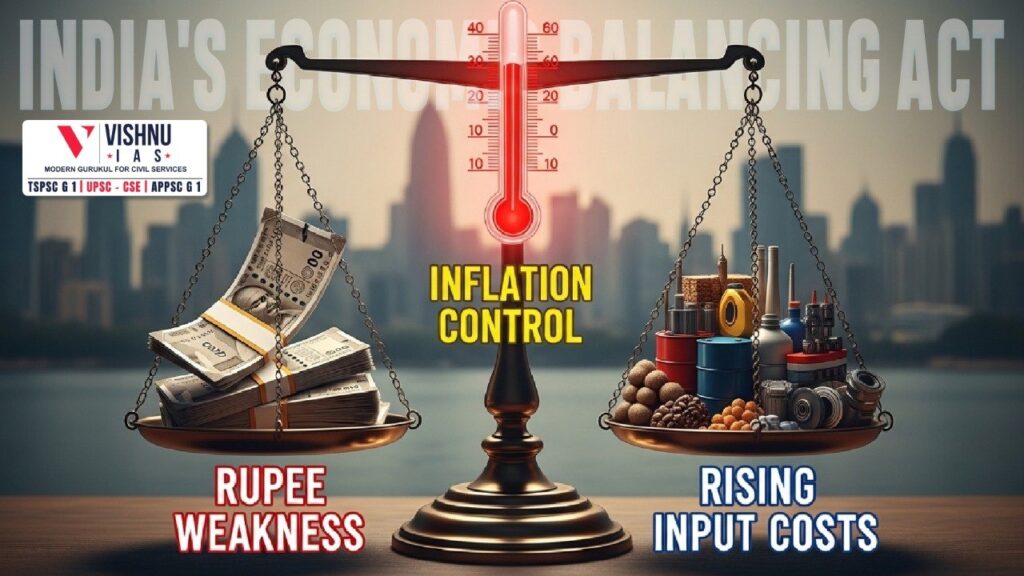
Weakening Rupee and Rising Input Costs have emerged as significant challenges for India’s macroeconomic stability. These factors complicate the government’s efforts to balance economic growth while controlling inflation. A depreciating currency increases import costs, while rising industrial input prices generate supply-side inflationary pressures, making policy responses more complex for both the government and the Reserve Bank of India.
Introduction
- Inflation refers to the sustained rise in the general price level of goods and services, eroding purchasing power and affecting macroeconomic stability. In India, inflation is primarily measured through the Consumer Price Index (CPI), which reflects retail price movements across consumption categories.
- Recent data shows that retail inflation increased to about 3.2% in February 2026, largely driven by food items and precious metals, though still within the 4% target (±2%) inflation band maintained by the Reserve Bank of India under the flexible inflation targeting framework.
- At the same time, the depreciation of the Indian Rupee, rising energy and commodity prices, and higher industrial input costs create a complex macroeconomic environment.
- These factors generate cost-push inflation, complicating the government’s challenge of sustaining economic growth while maintaining price stability.
1. Exchange Rate Depreciation and Imported Inflation
1. Rising Import Costs and Pass-through to Domestic Prices
- A weakening Rupee increases the domestic cost of imports, particularly crude oil, fertilizers, electronic components and machinery, which India heavily depends upon for industrial production.
- Since India imports over 85% of its crude oil requirements, depreciation directly increases the import bill and fuel prices, thereby raising transportation, logistics and manufacturing costs, which eventually get transmitted to consumer prices.
- Case Study – Oil Price Shocks and Currency Depreciation: During periods of global geopolitical tensions in West Asia, rising crude prices combined with a weak Rupee increase petrol, diesel and LPG costs, contributing to inflationary pressures across sectors.
2. Transmission into Food Inflation and Agriculture Input Costs
- Currency depreciation also raises the price of fertilizers, edible oils and agricultural machinery, many of which rely on imported raw materials or natural gas.
- Higher fertilizer prices increase the cost of cultivation, which eventually raises food prices, making inflation harder to control even when demand conditions remain stable.
- Example – Fertilizer Subsidy Regime in India: The government spends heavily under the Nutrient Based Subsidy (NBS) scheme and Urea subsidy programme to cushion farmers from global price shocks caused by currency depreciation.
3. Impact on Macroeconomic Stability and Current Account Deficit
- A weakening Rupee often reflects or contributes to a widening Current Account Deficit (CAD) as imports become costlier relative to exports.
- Higher import bills can increase fiscal pressure if the government intervenes through fuel subsidies, tax reductions or price stabilization measures.
- Case Study – Exchange Rate Volatility Management: The Reserve Bank of India uses foreign exchange reserves and open market operations to reduce excessive currency volatility and stabilize inflation expectations.
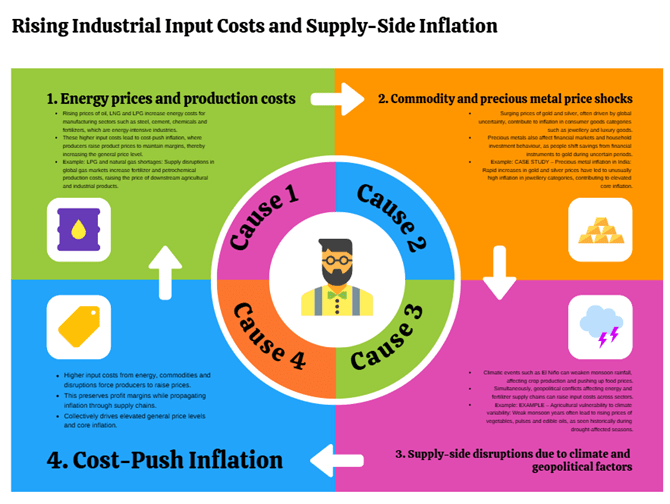
2. Rising Industrial Input Costs and Supply-Side Inflation
1. Energy Prices and Production Costs
- Rising prices of oil, LNG and LPG increase energy costs for manufacturing sectors such as steel, cement, chemicals and fertilizers, which are energy-intensive industries.
- These higher input costs lead to cost-push inflation, where producers raise product prices to maintain margins, thereby increasing the general price level.
- Example – LPG and Natural Gas Shortages: Supply disruptions in global gas markets increase fertilizer and petrochemical production costs, raising the price of downstream agricultural and industrial products.
2. Commodity and Precious Metal Price Shocks
- Surging prices of gold and silver, often driven by global uncertainty, contribute to inflation in consumer goods categories such as jewellery and luxury goods.
- Precious metals also affect financial markets and household investment behaviour, as people shift savings from financial instruments to gold during uncertain periods.
- Case Study – Precious Metal Inflation in India: Rapid increases in gold and silver prices have led to unusually high inflation in jewellery categories, contributing to elevated core inflation.
3. Supply-side Disruptions due to Climate and Geopolitical Factors
- Climatic events such as El Niño can weaken monsoon rainfall, affecting crop production and pushing up food prices.
- Simultaneously, geopolitical conflicts affecting energy and fertilizer supply chains can raise input costs across sectors.
- Example – Agricultural Vulnerability to Climate Variability: Weak monsoon years often lead to rising prices of vegetables, pulses and edible oils, as seen historically during drought-affected seasons.
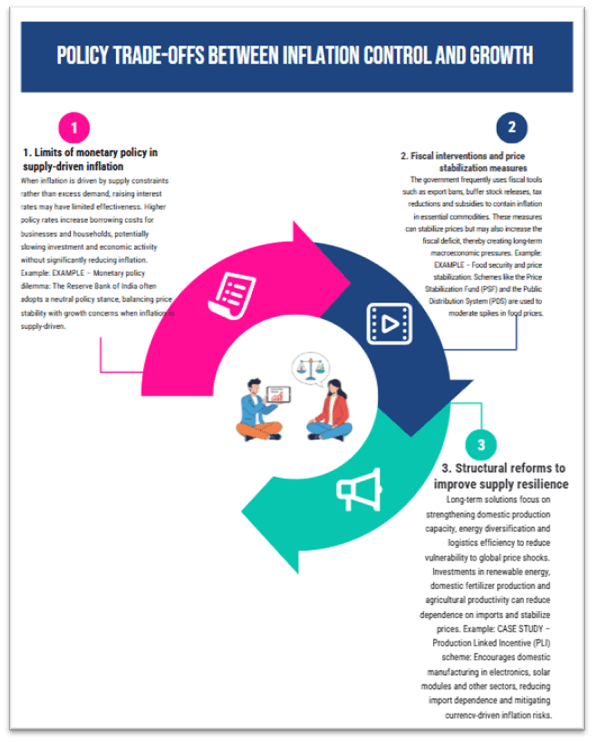
3. Policy Trade-offs between Inflation Control and Growth
1. Limits of Monetary Policy in Supply-driven Inflation
- When inflation is driven by supply constraints rather than excess demand, raising interest rates may have limited effectiveness.
- Higher policy rates increase borrowing costs for businesses and households, potentially slowing investment and economic activity without significantly reducing inflation.
- Example – Monetary Policy Dilemma: The Reserve Bank of India often adopts a neutral policy stance, balancing price stability with growth concerns when inflation is supply-driven.
2. Fiscal Interventions and Price Stabilization Measures
- The government frequently uses fiscal tools such as export bans, buffer stock releases, tax reductions and subsidies to contain inflation in essential commodities.
- These measures can stabilize prices but may also increase the fiscal deficit, thereby creating long-term macroeconomic pressures.
- Example – Food Security and Price Stabilization: Schemes like the Price Stabilization Fund (PSF) and the Public Distribution System (PDS) are used to moderate spikes in food prices.
3. Structural Reforms to Improve Supply Resilience
- Long-term solutions focus on strengthening domestic production capacity, energy diversification and logistics efficiency to reduce vulnerability to global price shocks.
- Investments in renewable energy, domestic fertilizer production and agricultural productivity can reduce dependence on imports and stabilize prices.
- Case Study – Production Linked Incentive (PLI) Scheme: Encourages domestic manufacturing in electronics, solar modules and other sectors, reducing import dependence and mitigating currency-driven inflation risks.
Conclusion
- The simultaneous occurrence of a weakening Rupee and rising industrial input costs creates a complex macroeconomic challenge by generating imported inflation, supply-side price pressures and policy trade-offs between growth and price stability.
- Although inflation remains within the target band of the Reserve Bank of India, risks from energy prices, climate variability and global geopolitical tensions continue to persist.
- Going forward, a balanced strategy involving exchange-rate stability, targeted fiscal support, supply-chain diversification and investments in energy and agricultural resilience will be essential.
- With India projected to sustain economic growth close to 7% in the coming years, strengthening domestic production capacity and reducing import dependence can help maintain stable growth with moderate inflation in the medium term.
- The simultaneous occurrence of a weakening Rupee and rising industrial input costs creates a complex macroeconomic challenge by generating imported inflation, supply-side price pressures and policy trade-offs between growth and price stability.
- Although inflation remains within the target band of the Reserve Bank of India, risks from energy prices, climate variability and global geopolitical tensions continue to persist.
- Going forward, a balanced strategy involving exchange-rate stability, targeted fiscal support, supply-chain diversification and investments in energy and agricultural resilience will be essential.
- With India projected to sustain economic growth close to 7% in the coming years, strengthening domestic production capacity and reducing import dependence can help maintain stable growth with moderate inflation in the medium term.
Recap: