
India Innovation Paradox: Why High Government Funding Coexists with Low R&D Investment
India innovation paradox refers to the situation where strong government funding, policy initiatives, and regulatory reforms exist alongside relatively low research and development (R&D) intensity and weak private sector participation. While India has made progress in innovation rankings and startup development, the gap between public investment and industry-led innovation outcomes continues to raise important policy questions.
Introduction
Innovation refers to the process of transforming scientific knowledge, research, and ideas into commercially viable technologies, products, or services that enhance productivity and economic competitiveness. Countries with strong innovation ecosystems typically exhibit high Research and Development (R&D) spending, robust patent ecosystems, strong industry–academia collaboration, and a skilled research workforce.
India has shown notable progress in recent years, reflected in its rise to 38th position in the Global Innovation Index (GII) 2025, increasing patent filings from less than 59,000 in 2020–21 to over 1,10,000 in 2024–25, and large public investments such as the ₹1,00,000 crore Research, Development and Innovation (RDI) Fund and a ₹20,000 crore corpus for deep-tech startups. However, India’s R&D expenditure remains around 0.65% of GDP, far lower than innovation leaders, highlighting the “innovation paradox”—where strong policy ambition and funding coexist with weak industry-led research and limited innovation outcomes.
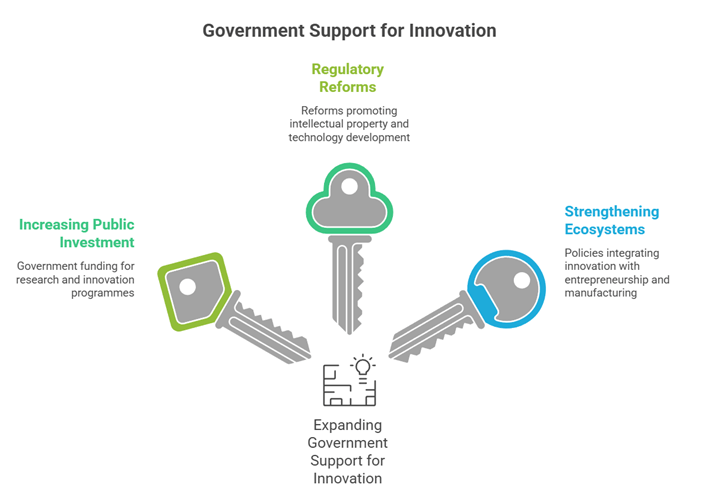
1. Expanding Government Support for Innovation
1.1 Increasing Public Investment in Research and Innovation
The government has significantly expanded public funding for research ecosystems, including the ₹1,00,000 crore RDI Fund aimed at promoting advanced technologies such as artificial intelligence, semiconductors, biotechnology, and quantum computing.
Programmes like the Atal Innovation Mission (AIM) and Atal Tinkering Labs (ATL) aim to nurture scientific curiosity and entrepreneurship among students, with funding rising from ₹500 crore to ₹3,200 crore.
Example – Atal Tinkering Labs: Over 10,000 school laboratories provide facilities for robotics and IoT experimentation, building an early innovation culture.
1.2 Regulatory Reforms to Promote Intellectual Property and Technology Development
Reforms such as removal of restrictions for deep-tech startups to access R&D incentives have improved early-stage innovation opportunities.
Legislative initiatives like the SHANTI Act, 2025, permitting patents for peaceful uses of nuclear technology, expand opportunities for private-sector participation in advanced research sectors.
Example – Space Sector Liberalisation: Institutional reforms enabling private participation in the space industry have allowed startups to develop launch vehicles and satellite technologies.
1.3 Strengthening Innovation Ecosystems through Startup and Digital Infrastructure
Policies such as Startup India, Digital India, and Make in India aim to integrate innovation with entrepreneurship and manufacturing growth.
Expansion of digital public infrastructure has enabled scalable innovation platforms across sectors such as finance, healthcare, and e-governance.
Example – Digital Public Infrastructure: Platforms like UPI have created a large fintech innovation ecosystem, enabling startups to develop digital financial solutions.
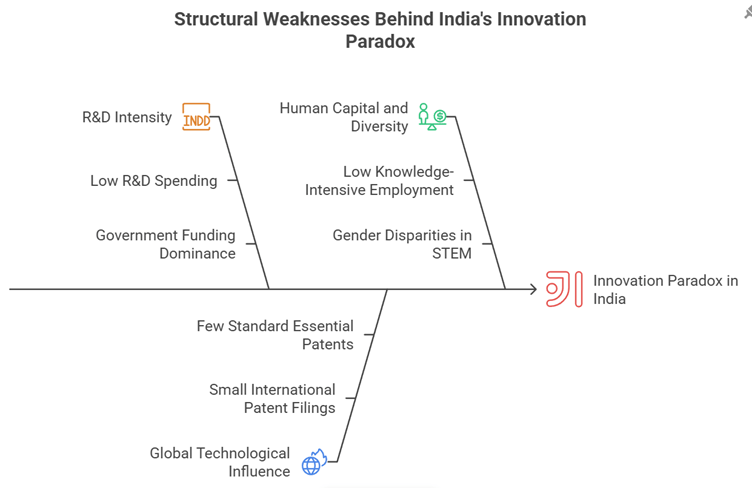
2. Structural Weaknesses Behind the Innovation Paradox
2.1 Low R&D Intensity and Weak Private Sector Investment
India’s R&D spending at around 0.65% of GDP is significantly lower than innovation leaders such as South Korea and Japan, where spending exceeds 3% of GDP.
Unlike advanced economies where industry drives R&D investment, the Indian government remains the primary funder of research, indicating limited private sector commitment to long-term innovation.
Example – Pharmaceutical Sector: Many firms focus on generic drug production rather than new drug discovery, reflecting risk-averse research strategies.
2.2 Limited Global Technological Influence
Although domestic patent filings have increased, international patent applications remain relatively small, with India filing about 4,500 PCT patents annually, far below China and the United States.
This indicates limited global technological leadership and commercialization capacity.
Example – Telecommunications Standards: Indian firms hold relatively few Standard Essential Patents (SEPs) in emerging technologies such as 5G and future 6G systems.
2.3 Human Capital and Diversity Constraints
Innovation capacity depends on a strong research workforce, yet India ranks relatively low in knowledge-intensive employment and number of researchers per capita.
Gender disparities in STEM fields further reduce innovation potential despite policy efforts.
Example – Women in Science Programmes: Initiatives such as WISE-KIRAN and WIDUSHI fellowships aim to improve women’s participation in scientific research and innovation.
3. Strengthening the Research–Industry–Market Linkages
3.1 Weak Industry–Academia Collaboration
India’s universities and public laboratories generate significant academic research, but technology transfer and commercialization mechanisms remain limited.
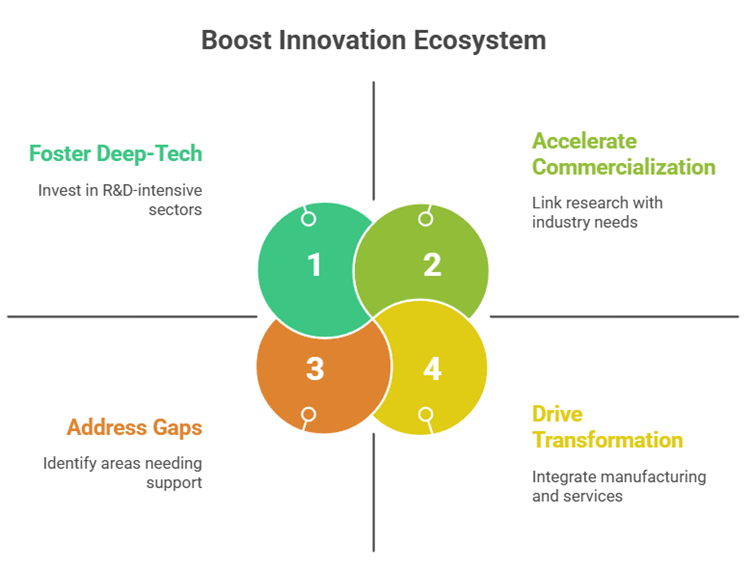
Stronger partnerships between research institutions and industries are necessary to convert scientific discoveries into marketable technologies.
Case Study – IIT Madras Research Park: This model demonstrates how collaboration between academia and industry can foster deep-tech startups and applied innovation.
3.2 Limited Risk Capital for Deep-Tech Innovation
Deep-tech sectors require large investments and long gestation periods, which discourages private investors seeking quick returns.
Consequently, venture capital often flows to consumer internet platforms rather than R&D-intensive sectors.
Example – India Semiconductor Mission: Government incentives aim to build a domestic semiconductor ecosystem and encourage private research investment.
3.3 Need for Innovation-Oriented Industrial Transformation
India’s economic growth has been driven largely by services rather than manufacturing-led technological innovation, limiting the emergence of globally competitive technology firms.
Integrating manufacturing growth, research institutions, and private sector innovation is essential to strengthen the innovation ecosystem.
Case Study – Commercial Space Startups: Firms such as Skyroot Aerospace and Agnikul Cosmos demonstrate the potential of public–private collaboration in advanced technology sectors.
Conclusion
India’s innovation paradox arises from the gap between strong policy initiatives and limited industry-led innovation outcomes. While large public investments, regulatory reforms, and rising patent filings indicate positive momentum, challenges such as low R&D intensity, weak private-sector participation, limited commercialization mechanisms, and human capital gaps continue to constrain innovation performance.
Moving forward, India must encourage greater private-sector investment in research, strengthen industry–academia collaboration, expand deep-tech financing, and promote inclusive scientific talent development. By leveraging its growing startup ecosystem, digital infrastructure, and scientific workforce, India can gradually transform its innovation ecosystem and emerge as a globally competitive technology leader in the coming decades.
Recap: