
Gender Wage Gap in Indian Agriculture: Impact on Female Agricultural Labourers
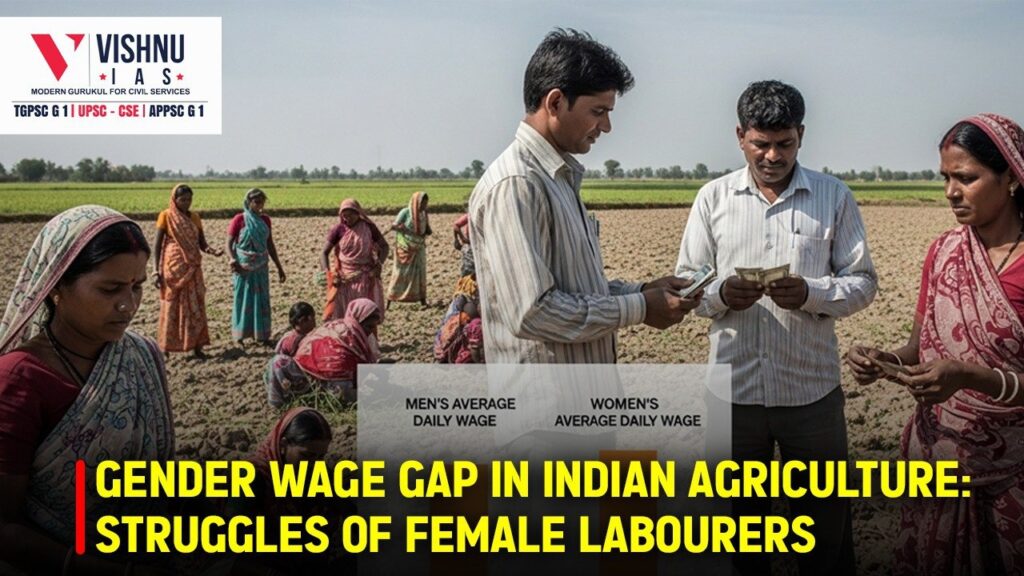
Gender Wage Gap in Indian Agriculture has become a critical issue affecting the socio-economic status of female agricultural labourers in India. Despite their growing participation in the rural workforce, stagnant real wages and persistent gender discrimination in labour markets continue to limit their economic security and empowerment.
Introduction
- Female agricultural labourers constitute a crucial pillar of India’s agrarian economy, contributing significantly to crop cultivation, livestock rearing, fisheries, and allied activities. However, their contribution remains undervalued due to low wages, limited asset ownership, and structural gender inequalities.
- Recent labour force estimates show that rural women’s workforce participation has risen from about 35% in 2011–12 to around 46.5% in 2023–24, yet much of this increase is driven by self-employment rather than remunerative wage employment.
- Women today form nearly half of India’s agricultural workforce, with over 117 million women engaged in agriculture, but wage disparities persist: average daily wages for women in agricultural operations are significantly lower than men’s, and inflation-adjusted wages have remained largely stagnant over the past decade.
- This gender wage gap combined with stagnant real wages has profound implications for the economic security, social empowerment, and livelihood sustainability of female agricultural labourers.
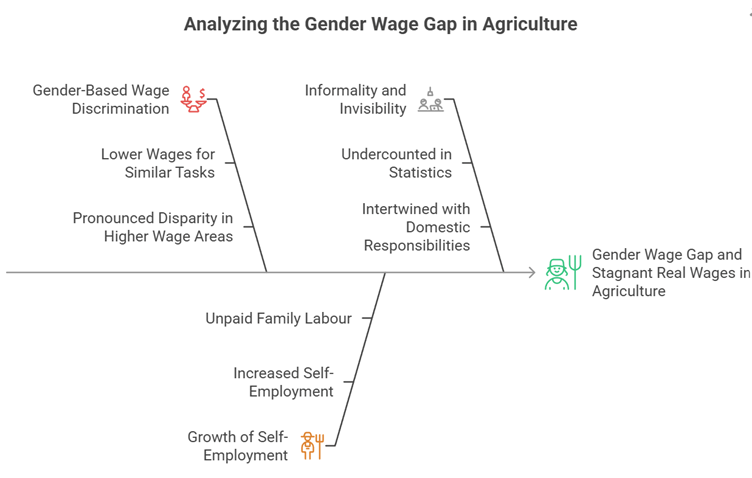
1. Structural Features of Gender Wage Gap and Stagnant Real Wages in Agriculture
1.1 Gender-Based Wage Discrimination in Agricultural Labour Markets
- Women agricultural labourers receive systematically lower wages than men for similar tasks, reflecting entrenched gender norms and labour market segmentation.
- In many regions, women earn 30–50% less than men, even when engaged in labour-intensive tasks such as sowing, transplanting, and weeding.
- The wage disparity becomes more pronounced in areas where overall agricultural wages are relatively higher, indicating that rising wage levels do not necessarily translate into gender parity.
- Example: Field studies from villages in Tamil Nadu and Uttar Pradesh reveal women earning around ₹240–₹290 per day, often less than half of male wages in some regions despite performing comparable work.
1.2 Growth of Self-Employment and Disguised Labour Participation
- A significant increase in women’s work participation in rural areas has occurred primarily through self-employment in agriculture, which rose from about 60% of rural female workers in 2011–12 to nearly three-fourths in recent years.
- Self-employment often includes family labour on farms, livestock rearing, and unpaid household agricultural work, which frequently remains unpaid or poorly remunerated.
- Example: In family-based dairy and poultry activities, women undertake feeding, milking, and animal care but the economic returns are usually recorded as household income rather than individual earnings.
1.3 Informality and Invisibility of Women’s Agricultural Work
- Women’s work often remains undercounted in official labour statistics because their activities are intermittent, seasonal, and intertwined with domestic responsibilities.
- Large-scale labour surveys struggle to capture home-based agricultural tasks such as fodder collection, seed processing, and animal care, leading to underestimation of their actual contribution.
- Example: Rural women frequently combine childcare with livestock management or crop processing, resulting in their classification as non-workers despite significant economic activity.
2. Socio-Economic Consequences for Female Agricultural Labourers
2.1 Economic Vulnerability and Persistent Rural Poverty
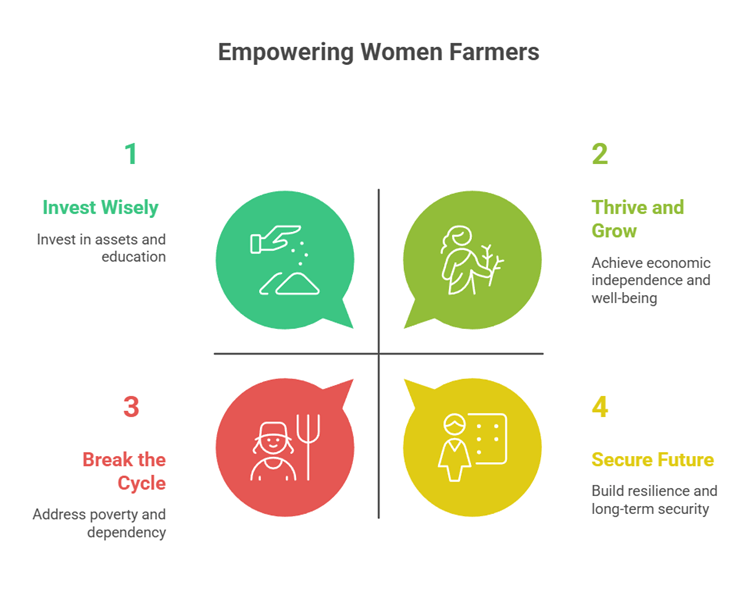
- Low wages limit women’s individual income, savings, and financial autonomy, perpetuating cycles of rural poverty and economic dependency.
- Even when women participate extensively in agricultural work, the returns from crop cultivation remain extremely low, with smallholder households often earning modest annual incomes from farming.
- Case Study: In many smallholder villages in eastern India, annual crop incomes per household are modest, meaning women’s share of earnings is often insufficient to cover basic health, nutrition, and education expenditures.
2.2 Limited Asset Ownership and Bargaining Power
- Despite their central role in agricultural production, only around one-tenth of rural women own agricultural land, the primary productive asset in rural economies.
- Lack of land ownership restricts women’s access to institutional credit, crop insurance, and agricultural subsidies, reinforcing economic marginalisation.
- Example: Without land titles, women often cannot directly benefit from schemes such as institutional farm credit or input subsidies, which are typically linked to land ownership records.
2.3 Intergenerational Effects on Health, Nutrition, and Education
- Stagnant wages reduce women’s ability to invest in household nutrition, healthcare, and children’s education, leading to long-term human development impacts.
- Women agricultural labourers frequently experience high workloads combined with nutritional deprivation, contributing to poor health outcomes.
- Example: Regions with high female agricultural labour participation also report high levels of anaemia among rural women, indicating a link between economic vulnerability and health outcomes.
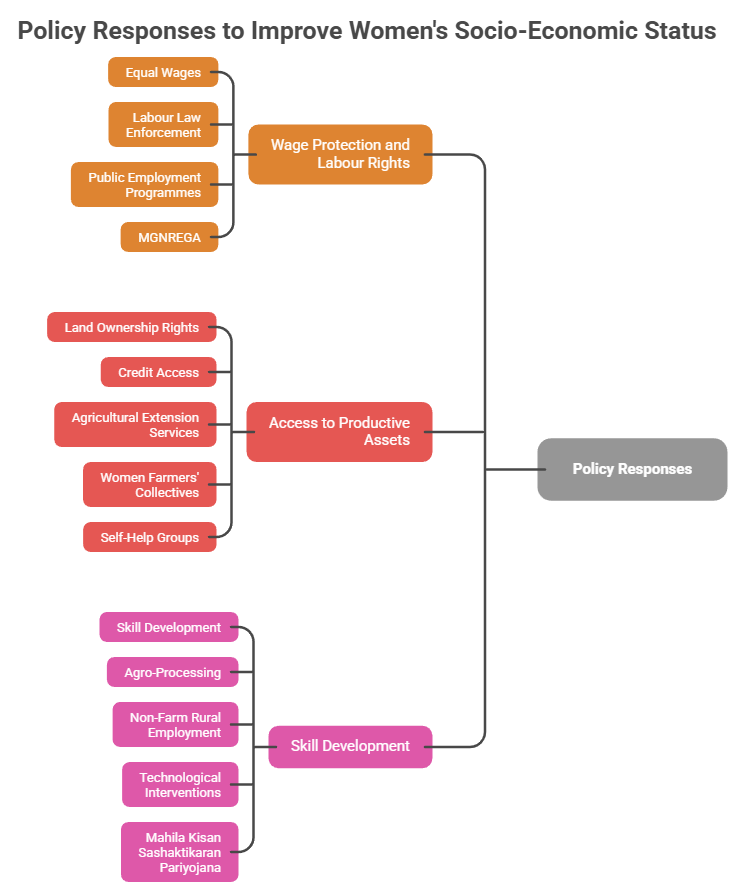
3. Policy Responses and Pathways to Improve Women’s Socio-Economic Status
3.1 Wage Protection and Labour Rights
- Ensuring equal wages for equal work and strengthening enforcement of labour laws can reduce gender wage disparities in rural labour markets.
- Public employment programmes can provide wage benchmarks that help improve rural labour standards.
- Example: The Mahatma Gandhi National Rural Employment Guarantee Act (MGNREGA) mandates equal wages for men and women and has increased female labour participation in many states.
3.2 Enhancing Women’s Access to Productive Assets and Resources
- Expanding land ownership rights, credit access, and agricultural extension services for women can significantly improve their economic status.
- Women farmers’ collectives and producer groups enable collective bargaining and market access, improving farm incomes.
- Example: Self-Help Groups under the National Rural Livelihoods Mission have enabled millions of rural women to access microcredit, livestock assets, and small-scale enterprise opportunities.
3.3 Skill Development and Diversification of Rural Livelihoods
- Encouraging skill development, agro-processing, and non-farm rural employment can reduce dependence on low-paid agricultural labour.
- Technological interventions and training programmes can enhance productivity and increase women’s earnings in agriculture.
- Example: The Mahila Kisan Sashaktikaran Pariyojana focuses on empowering women farmers through training in sustainable agriculture, improved farming techniques, and collective farming models.
Conclusion
- Female agricultural labourers play an indispensable role in sustaining India’s agrarian economy, yet gender wage disparities and stagnant real wages continue to undermine their socio-economic advancement.
- With women forming nearly half of the agricultural workforce but receiving significantly lower remuneration, addressing these disparities is critical for inclusive rural development.
- Strengthening equal wage enforcement, asset ownership, financial inclusion, and skill development programmes can help transform women’s agricultural work from low-paid survival labour into a pathway for economic empowerment.
- Ensuring fair wages, improved productivity, and greater institutional recognition of women farmers will not only uplift millions of rural households but also contribute to sustainable agricultural growth and broader socio-economic transformation in rural India.
- Female agricultural labourers play an indispensable role in sustaining India’s agrarian economy, yet gender wage disparities and stagnant real wages continue to undermine their socio-economic advancement.
- With women forming nearly half of the agricultural workforce but receiving significantly lower remuneration, addressing these disparities is critical for inclusive rural development.
- Strengthening equal wage enforcement, asset ownership, financial inclusion, and skill development programmes can help transform women’s agricultural work from low-paid survival labour into a pathway for economic empowerment.
- Ensuring fair wages, improved productivity, and greater institutional recognition of women farmers will not only uplift millions of rural households but also contribute to sustainable agricultural growth and broader socio-economic transformation in rural India.
Recap: