

Algorithmic Sovereignty in India: Why India Must Build Its Own AI Models
Algorithmic Sovereignty in India refers to the country’s ability to design, control, govern, and deploy its own algorithms, data infrastructures, and artificial intelligence systems according to national interests, legal frameworks, and societal values. As artificial intelligence rapidly transforms global economies and security systems, ensuring algorithmic sovereignty has become crucial for emerging digital powers like India.
Introduction
- Algorithmic Sovereignty refers to a nation’s ability to design, control, govern, and deploy its own algorithms, data infrastructures, and artificial intelligence systems in accordance with its national interests, legal frameworks, and societal values. It is closely related to the broader concepts of technological sovereignty and data sovereignty, which emphasize reducing dependence on external technological ecosystems.
- The rapid expansion of Generative Artificial Intelligence (AI) and Large Language Models (LLMs) has transformed AI into a dual-use general-purpose technology with applications in civilian sectors such as healthcare, education and governance, as well as military domains including surveillance, cyberwarfare, and autonomous weapons systems.
- According to estimates from the International Data Corporation (IDC), global spending on AI is expected to exceed $500 billion by 2027, while reports by the United Nations Educational, Scientific and Cultural Organization (UNESCO) emphasize that AI governance must balance innovation, security, and ethical safeguards. In this evolving technological landscape, the question of algorithmic sovereignty has become central to national security, economic development, and democratic governance, particularly for emerging digital powers such as India.
1. Understanding Algorithmic Sovereignty in the Contemporary AI Ecosystem
1.1 Control over Data, Algorithms and Digital Infrastructure
- Algorithmic sovereignty implies that a country possesses independent capabilities to develop AI models, datasets, and computational infrastructure, ensuring that decision-making systems reflect national priorities and legal standards.
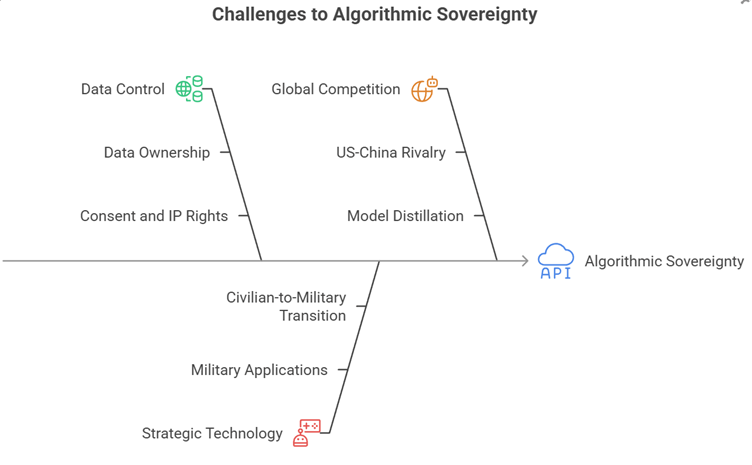
- Many modern AI models are trained on massive datasets collected globally, raising concerns about data ownership, consent, and intellectual property rights, as large-scale models often rely on publicly available digital content produced by millions of individuals.
- Example: The European Union’s push for “Digital Sovereignty” through the AI Act aims to ensure that AI systems operating within the EU comply with European ethical and regulatory norms, highlighting how nations increasingly view algorithms as strategic assets.
1.2 AI as a Strategic Technology with Dual-Use Implications
- AI technologies have increasingly been integrated into military command systems, intelligence analysis, and decision-support tools, enabling rapid processing of surveillance data and accelerating the “kill chain” from target identification to strike execution.
- Such applications illustrate how AI models initially designed for civilian purposes can acquire strategic military significance, blurring the boundaries between private innovation and national security infrastructure.
- Real-Life Case Study: Several advanced AI models developed by private technology companies in the United States have reportedly been integrated into defence and intelligence operations, demonstrating how private AI innovations can become embedded within national security frameworks.
1.3 AI Development and Global Technological Competition
- The global AI ecosystem is increasingly shaped by geopolitical competition among major powers, especially the United States and China, where governments and corporations collaborate to develop advanced AI capabilities.
- Concerns have emerged regarding practices such as model distillation, where smaller models learn from the outputs of stronger frontier models, raising debates around intellectual property, technological diffusion, and innovation barriers.
- Example: Chinese firms such as DeepSeek have reportedly produced high-performing AI models at a fraction of the cost of frontier models, illustrating how technological diffusion can rapidly reshape global AI competitiveness despite export controls or hardware restrictions.
2. Why Algorithmic Sovereignty is Crucial for India
2.1 National Security and Strategic Autonomy
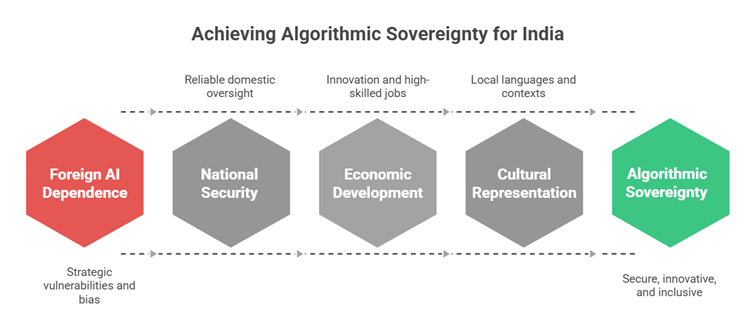
- Dependence on foreign AI systems may expose countries to strategic vulnerabilities, including data extraction, algorithmic bias, and potential manipulation of digital infrastructure during geopolitical tensions.
- AI systems embedded in critical sectors such as defence, cybersecurity, financial systems, and telecommunications require reliable domestic oversight to prevent security risks arising from external control or supply chain dependencies.
- Example: India’s emphasis on indigenous defence technology under the Atmanirbhar Bharat initiative reflects the broader need to extend self-reliance to digital technologies, including AI algorithms used in defence and surveillance systems.
2.2 Economic Development and Technological Competitiveness
- AI is increasingly viewed as a foundational technology similar to semiconductors, enabling productivity gains across sectors such as agriculture, manufacturing, healthcare and digital services.
- Countries that develop indigenous AI ecosystems gain advantages in innovation, intellectual property generation, high-skilled employment and global digital trade.
- Example: India’s National Strategy for Artificial Intelligence (NITI Aayog) identifies sectors such as healthcare, agriculture, education, smart mobility and smart cities as priority areas where domestic AI innovation could significantly enhance socio-economic outcomes.
2.3 Cultural Representation and Ethical Governance
- AI models trained primarily on Western data sources may fail to accurately represent the linguistic, cultural, and social diversity of India, leading to algorithmic biases or misinterpretations in automated systems.
- Developing indigenous AI models enables the incorporation of local languages, cultural contexts, and regulatory safeguards, ensuring that digital technologies align with constitutional values and democratic norms.
- Example: India’s Bhashini initiative under the National Language Translation Mission aims to build AI-powered language tools covering multiple Indian languages, demonstrating how local AI development can promote inclusive digital access and cultural representation.
3. Challenges and Pathways for Achieving Algorithmic Sovereignty in India
3.1 Technological and Infrastructure Constraints
- Building advanced AI models requires large-scale computational resources, high-performance semiconductors, and massive datasets, areas where global supply chains remain concentrated in a few countries.
- Restrictions on advanced semiconductor exports and access to high-end GPUs highlight how geopolitical dynamics can influence technological development.
- Example: India’s India Semiconductor Mission, launched with financial incentives exceeding ₹76,000 crore, aims to strengthen domestic semiconductor manufacturing, which is crucial for AI computing infrastructure.
3.2 Talent, Research Ecosystem and Global Collaboration
- The AI sector depends heavily on highly skilled researchers, engineers and data scientists, many of whom move across global research institutions and technology companies.
- Talent mobility and international collaboration remain essential for scientific progress, even as countries seek technological independence.
- Real-Life Case Study: Many researchers working in leading AI laboratories worldwide have been trained in American universities or multinational technology companies, illustrating the global nature of AI talent flows.
3.3 Governance, Regulation and Responsible AI Deployment
- Corporate safeguards or “guardrails” embedded within AI models are insufficient to regulate the broader societal impacts of AI deployment.
- Effective governance requires international cooperation, ethical standards, and regulatory frameworks that ensure responsible use of AI technologies, particularly in sensitive domains such as surveillance and autonomous weapons.
- Example: India’s Digital Personal Data Protection Act (2023) and ongoing discussions on an AI regulatory framework highlight efforts to balance innovation, privacy protection, and ethical governance in the emerging digital economy.
Conclusion
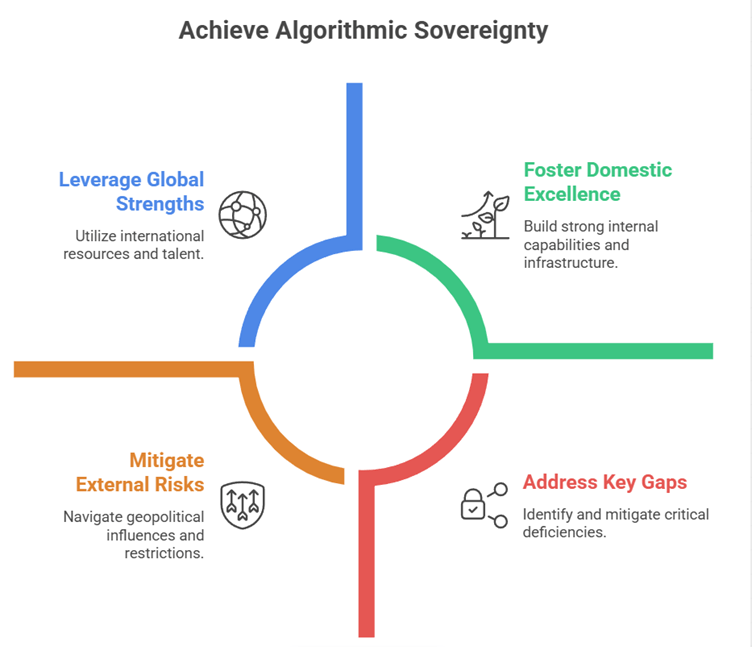
Algorithmic sovereignty represents a critical dimension of technological self-reliance, national security, and democratic governance in the digital era. As AI increasingly shapes economic productivity, public policy, and military strategy, reliance solely on foreign algorithms may expose nations to strategic vulnerabilities, cultural biases, and economic dependence.
For India, developing indigenous AI models aligned with its linguistic diversity, regulatory values, and developmental priorities is essential for long-term technological leadership. With initiatives such as Digital India, the National AI Mission, the India Semiconductor Mission, and the National Language Translation Mission, India is gradually building the foundations for a robust domestic AI ecosystem.
Strengthening public–private partnerships, research investments, ethical governance frameworks, and international cooperation can ensure that AI development contributes to inclusive growth while preserving national autonomy in the rapidly evolving global technological order.
Recap: