Importance of Community Engagement in Organ Donation: Fostering a Culture of Life-Saving Awareness in India
Introduction:
Organ donation, particularly deceased organ donation, represents a pivotal intervention in modern medicine, offering life-saving treatment for terminal organ failure. Despite India performing a record 18,911 transplants in 2024, its organ donation rate remains under 1 per million population, starkly contrasted with Spain’s ~48 pmp. Out of those transplants, only about 1,128 were from deceased donors, emphasizing a systemic dependency on living donations. The gap is further illustrated by an estimated over 300,000 patients waiting for organs and approximately 20 people dying daily due to non-availability. In this context, community engagement in organ donation and education emerge as indispensable levers to foster a culture of donation across India.
Grassroots Awareness and Community Outreach
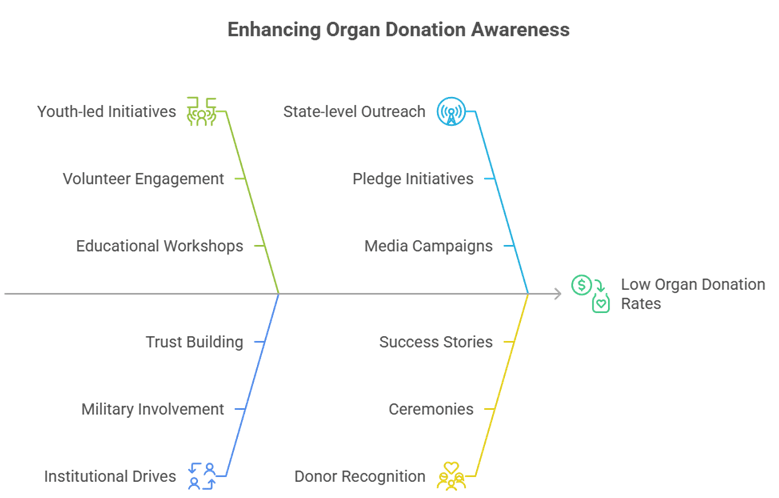
- Youth-led grassroots initiatives: DONATE Foundation, since 2022, has mobilized over 100 volunteers across 50+ villages, engaging 100,000 villagers and conducting programs for 16,000 students in 15+ states. Campaigns like Dharavi’s week-long awareness drive demonstrated myth-busting effectiveness at scale.
- Military and institutional community drives: The Indian Army’s Western Command involved 400+ participants in Chandigarh, framing organ donation as service beyond the battlefield.
- State-level outreach: Kerala leads pledges (~1.3 lakh) followed by Delhi (58,000) and Maharashtra (49,000). Media-NGO partnerships like Times of India & MOHAN Foundation brought 50,000+ pledges.
- Honouring donors: Kerala’s “Smrithi Vandanam 2025” honoured 122 donor families, showcasing emotional impact stories like a Maharashtra family whose donation saved three lives.
Institutional Capacity & Structural Strengthening
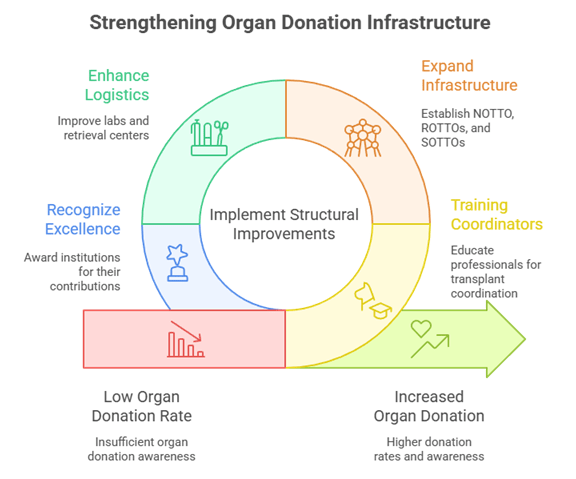
- Training transplant coordinators: MOHAN Foundation trained 1,967 professionals, raising India’s donation rate from 0.08 pmp (2008) to 0.8 pmp (2017).
- Organizational infrastructure: NOTTO, ROTTO, SOTTO coordinate organ retrieval, distribution, and matching nationwide.
- Lab and retrieval centres: Karnataka’s CDC cross-match labs and Odisha’s retrieval centres improve logistics and organ compatibility testing.
- Recognition of excellence: Institutions like GMCH Nagpur and AIIMS-Nagpur boost morale and public trust through innovation and results.
Policy Frameworks & Curriculum Integration
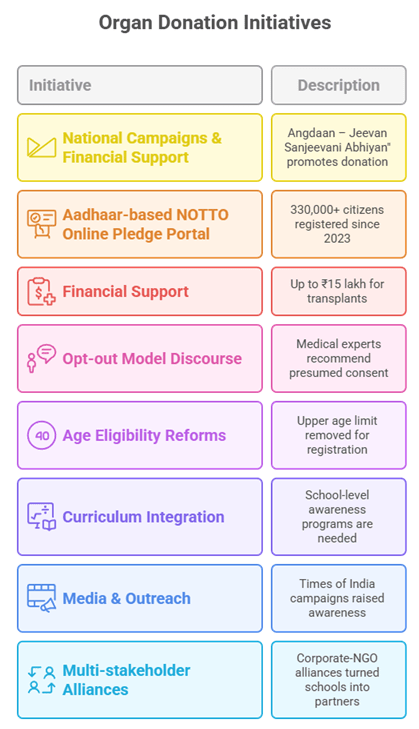
- National campaigns: The “Angdaan – Jeevan Sanjeevani Abhiyan” promotes pledging and dispels myths. Aadhaar-linked NOTTO portal saw 330,000+ registrations.
- Opt-out model discourse: Considered for increasing donation rates while ensuring informed consent and awareness.
- Curriculum integration: Embedding organ donation discussions in school life-science and ethics curricula fosters empathy and awareness from an early age.
- Media and stakeholder alliances: Campaigns, donor cards, corporate partnerships, and celebrity endorsements normalize the culture of donation.
Conclusion:
A sustainable culture of organ donation in India requires multi-pronged efforts—grassroots education, institutional strengthening, supportive policies, and curriculum integration. Encouraging trends such as rising transplant numbers, increasing pledge registrations, and state-level recognitions point towards progress. Scaling community-led initiatives, expanding trained coordinators, improving infrastructure, and embedding education will bring India closer to global benchmarks—ensuring no life is lost for want of a donor.
Recap: